
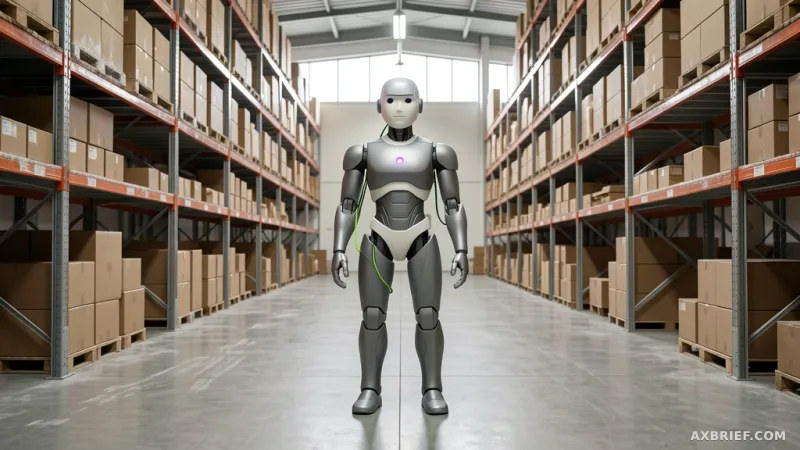
For many operators of logistics centers and quick-service restaurants, the morning routine begins not with operational planning, but with the frustration of checking empty shift slots. Despite constant job postings, the gap between available labor and operational demand has become a chronic systemic failure. This is the environment where Robotcom introduced R-noid at Automate 2026, held from June 22 to 25, 2026. Rather than presenting a laboratory curiosity or a conceptual prototype, Robotcom positioned R-noid as a deployable service designed to step directly into the vacancies of the modern industrial workforce.
The Hardware and Intelligence of R-noid
Robotcom has identified six primary industries where labor shortages are most acute: logistics, healthcare, food service, hospitality, and experiential industries. To address these, the company defined five specific service categories, including restaurant assistants, packaging specialists, pickers for product sorting, laundry folders, and hosts. The urgency of this deployment is underscored by staggering industry data. Employee turnover in quick-service restaurants now exceeds 130 percent, while the average tenure for a warehouse picker has plummeted to just 1.2 years. Furthermore, over 67 percent of hospitality operators report severe staffing shortages in room management and laundry services. R-noid is engineered to absorb these repetitive, high-strain tasks that humans increasingly avoid.
To operate within environments designed for humans, R-noid utilizes a sophisticated physical architecture. Each arm is equipped with 7 degrees of freedom (DoF), mimicking the complex joint structure of a human arm to allow for precision grasping and movement at difficult angles. This is paired with a 4 DoF articulated upper body, enabling a vertical reach ranging from 0 to 1.9 meters. For mobility, the robot sits on an omnidirectional mobile base, allowing it to navigate tight spaces without the constraints of a traditional turning radius.
This physical flexibility is governed by a Vision-Language-Action (VLA) model. Unlike traditional industrial robots that rely on hard-coded coordinates, the VLA model integrates visual data from the robot's cameras with natural language commands to generate optimal behavioral trajectories in real time. This allows R-noid to generalize tasks, meaning it can apply learned behaviors to new, similar environments without requiring an entirely new programming cycle. To ensure safe human-robot collaboration, Robotcom implemented R SOUL, an expression and behavior system. R SOUL serves as a software layer that communicates the robot's current state and intent through visual and behavioral cues, allowing human coworkers to intuitively predict the robot's next move.
Shifting the Metric from Capability to Deployment Speed
While the hardware specifications are impressive, the true disruption lies in the transition from a product-purchase model to a Robot as a Service (RaaS) model. Robotcom is shifting the central question of humanoid adoption from whether a robot is technically capable of a task to how quickly it can be operational on-site. The company claims a deployment window of 8 to 12 weeks from the initial site visit to full autonomous operation. By converting the high initial cost and maintenance risk of ownership into a subscription, Robotcom lowers the barrier to entry for small and medium-sized enterprises.
This rapid deployment is made possible by a unified software stack. R-noid shares its core control logic and communication protocols with Robotcom's other offerings, such as the R-Kiwi delivery robot and the R-Cargo transport robot. Because these different form factors operate on the same underlying software architecture, the engineering effort required for site-specific optimization is drastically reduced. David Rodriguez, co-founder of Robotcom, noted that this integration allows robots to begin performing actual tasks within weeks of the first consultation.
To manage the risks associated with autonomy, Robotcom employs a 5-stage intervention model. Rather than pursuing an immediate, absolute autonomy that could lead to operational failures, this system allows operators to select the level of human intervention based on the complexity of the task and the stability of the environment. This phased approach minimizes early-stage trial and error and prevents costly operational shutdowns.
Robotcom has already moved beyond benchmarks to define 19 specific deployable tasks across its five categories. The R-noid Packer, for instance, is currently operational at a well-known golf course, handling order packaging. This use case is now being scaled toward production lines in large-scale food manufacturing facilities, where the robot is being tested specifically to resolve bottlenecks at the end of the line. Similarly, the R-noid Picker is designed to integrate directly into existing picking ports without requiring expensive facility modifications or structural changes to shelving and workflows.
This strategy of lighthouse deployment allows Robotcom to prove ROI through actual revenue and efficiency gains before scaling to similar business sites. By partnering with the PMG AI & Tech Sandbox, Robotcom is validating these applications in real-world testbeds. In markets like South Korea, where the working-age population is declining rapidly, the ability to fill a labor gap in 12 weeks is a more powerful competitive advantage than any single hardware specification.
The arrival of R-noid signals a pivot in the humanoid industry where the speed of integration has become the primary product. The focus is no longer on the elegance of the machine, but on the velocity at which it can replace a missing employee.



