
Surgeons have long chased the ideal of the invisible incision, a world where the trauma of surgery is reduced to a pinprick and the recovery time to a matter of hours. In current minimally invasive procedures, the limitation is rarely the surgeon's skill, but rather the physical bulk of the tools. Even the most advanced laparoscopic instruments require a certain diameter to maintain structural integrity, and switching between a scalpel, a gripper, and a drug delivery system often requires withdrawing one tool to insert another. This mechanical friction creates a bottleneck in the operating room, where every second spent swapping hardware is a second of increased risk for the patient. The industry has been waiting for a platform that does not just shrink the tool, but integrates the entire toolkit into a single, autonomous entity.
The 4.4mm Multi-Tool Architecture
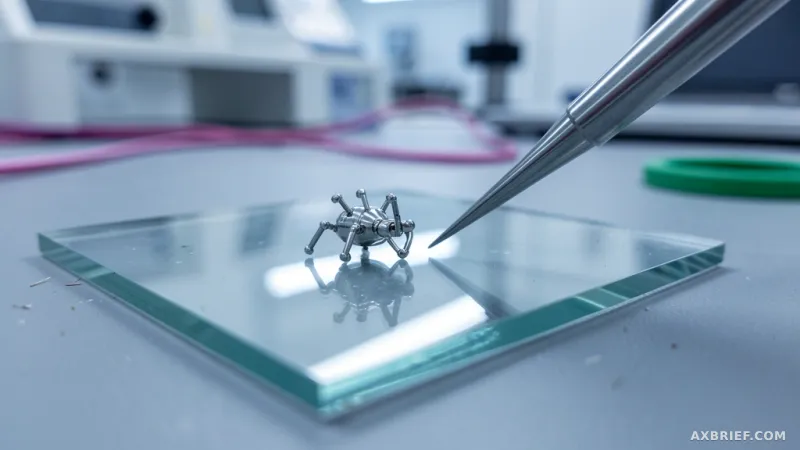
Researchers at Nanyang Technological University (NTU) Singapore have introduced a paradigm shift in this space with a seed-sized robot measuring just 4.4mm in length. Rather than relying on internal motors or batteries, which would be impossible to scale down to this size, the robot is powered and steered entirely by external, weak magnetic fields. This wireless approach allows the device to navigate the soft, irregular landscapes of the human body without the need for tethering. The robot is not a single-purpose device; it is a versatile platform capable of five distinct surgical functions: locomotion, tissue incision, targeted drug release, the gripping and storage of tissue samples, and remote heat generation.
To achieve this versatility, the NTU team utilized a sophisticated blend of materials science and soft robotics. The robot's chassis is constructed from polydimethylsiloxane (PDMS) and Ecoflex, two silicone-based flexible materials renowned in the field of soft robotics for their elasticity and biocompatibility. Within this flexible matrix, the researchers embedded magnetic micro-particles measuring 5 micrometers (μm) in size. This embedding allows the robot to respond to external magnetic stimuli while maintaining the structural flexibility needed to squeeze through narrow biological pathways. The efficiency of this system is most evident in its transition speed. The research team, publishing their findings in the journal Advanced Materials, demonstrated that the robot can switch between its five different functions in less than one second. This near-instantaneous reconfiguration ensures that a surgeon can move from navigating to incising or delivering medication without any lag, mirroring the real-time responsiveness required in a critical surgical environment.
The Logic of Magnetic Reprogramming
Until now, the primary limitation of magnetic micro-robots has been their lack of selectivity. When an external magnetic field is applied, most micro-robots react as a single, monolithic magnet, moving the entire body in one direction. This makes it nearly impossible to activate a specific tool—like a scalpel—without also moving the entire robot. The NTU team solved this by implementing a regional magnetic response design. By varying the magnetic sensitivity across different sections of the robot's body, they created a system where specific parts can remain stationary while others deform or activate. This allows the robot to anchor itself to a tissue wall while simultaneously deploying a tool, a level of precision previously unseen in seed-sized robotics.
At the heart of this capability is a reprogrammable magnetic module. This central hub can be magnetized, demagnetized, and remagnetized based on the direction and intensity of the external field. These magnetic states act as wireless commands. For instance, one magnetic orientation might trigger the deployment of a gripping mechanism, while another might trigger the release of a drug payload. This removes the need for electrical switches or physical contact, effectively turning the robot's physical state into a programmable variable.
Furthermore, the team has pushed the boundaries of movement by implementing 6-degree-of-freedom (6-DOF) control. While most micro-robots are limited to 5-DOF—covering three axes of translation and two axes of rotation—the NTU robot adds a rolling function around its own longitudinal axis. This addition is critical for navigating the complex, three-dimensional geometry of internal organs. Rolling allows the robot to adjust its entry angle with extreme precision, enabling it to slide through tight gaps that would stop a less maneuverable device. To support this movement, the robot employs a solid-but-flexible composite structure. Unlike purely soft robots that can collapse under external pressure, this hybrid structure maintains enough rigidity to provide leverage during surgery while remaining flexible enough to avoid damaging surrounding tissue. This structural balance also ensures that the robot can be safely retrieved using magnetic fields after the procedure is complete, without the risk of the device breaking apart inside the patient.
From Gelatin Models to Clinical Integration
To validate these capabilities, the research team conducted a series of tests using chicken liver tissue and gelatin models designed to mimic the mechanical properties of human soft tissue. The results confirmed that the robot could successfully activate its micro-blades for incision, release drug particles at a target site, and capture tissue samples for biopsy. One of the most promising findings was the robot's ability to generate heat when exposed to a high-frequency alternating magnetic field. This phenomenon, known as magnetic hyperthermia, provides a non-invasive method for destroying cancer cells by overheating them, potentially turning the robot into a targeted thermal therapy device.
Safety remains the paramount concern for any implantable technology. In biocompatibility tests, the robot's materials were exposed to human skin cells, resulting in a survival rate of over 99%. This confirms that the PDMS and Ecoflex composition is non-toxic and suitable for internal use. However, the path to the operating room requires more than just material safety. The next phase of development involves integrating the robot with real-time imaging technologies, such as ultrasound and X-ray, to provide surgeons with a high-resolution map of the robot's position. The team is also working on adding sensing systems to detect local pressure and temperature, which would provide a feedback loop for the external controller.
Associate Professor Lum and his team are currently collaborating with surgeons to integrate these controls into actual clinical workflows. The ultimate success of this platform depends on the synchronization between the 6-DOF control system and the resolution of imaging guides. By testing the robot in advanced artificial organ models that replicate the friction and fluid dynamics of human blood flow, the NTU team is refining the algorithms that will eventually allow a surgeon to operate a seed-sized robot with the same intuition and precision as a traditional scalpel.



