
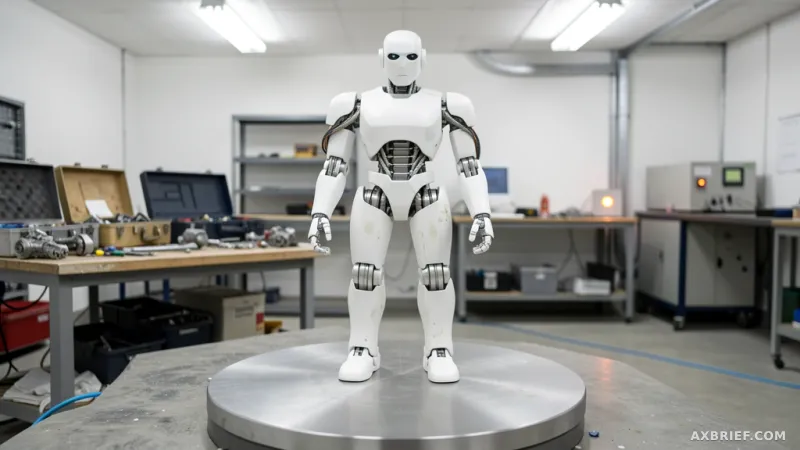
The vision of a humanoid robot assisting with household chores or collaborating on a factory floor is no longer a distant science-fiction trope. While the global conversation often centers on the software breakthroughs of Large Language Models, a quieter but more physical race is accelerating in the East. In the corridors of intellectual property offices and the workshops of industrial hubs, China is aggressively pivoting toward Physical AI, attempting to secure a stranglehold on the hardware and control systems that will define the next era of robotics.
The Mathematical Surge of Humanoid IP
The scale of this ambition is visible in the raw data of patent filings. As of June 22, 2026, China has amassed a total of 2,895 patents related to humanoid robots. The most striking aspect of this growth is not the total volume, but the velocity of recent filings. Between 2021 and June 22, 2026, the country filed 2,488 patents, meaning 85.94% of all humanoid robot intellectual property in China has been generated within the last five years.
This growth trajectory followed a period of surprising stagnation. In 2021 and 2022, patent filings actually dipped by 13% and 5% respectively, suggesting a phase of theoretical uncertainty or a lack of clear direction. However, the trend reversed violently starting in 2023. That year, filings jumped to 132, representing a 247.37% increase over the previous year. The momentum accelerated in 2024, with 623 patents filed, a massive 371.97% surge. By 2025, the numbers reached a peak of 1,342 filings, an increase of 115.41% from 2024. Even in the first half of 2026, the pace remains aggressive, with 313 patents already registered by June 22.
From Paper Patents to Industrial Capital
The critical question for any tech observer is whether these patents represent genuine innovation or merely a strategic land grab of intellectual property. The answer lies in the capital structures supporting these filings. The humanoid sector in China is now composed of 1,106 distinct companies. This is not a fragmented landscape of academic startups; it is a well-funded industrial movement. More than 60% of these firms possess a capital base of 10 million yuan (approximately 1.8 billion KRW) or more, providing the necessary liquidity to move from prototype to production.
This expansion is not happening in a vacuum but is concentrated in specific geographic clusters that leverage existing manufacturing prowess. The East China region hosts 47.20% of these companies, while the South China region accounts for 23.60%. By clustering in these areas, firms gain immediate access to the supply chains and precision engineering ecosystems required to build complex actuators and sensors. The rate of new entry is also hitting historic highs. In 2024, 90 new companies registered, a 32.35% increase over 2023. In 2025, that number rose to 97, marking the highest number of new entrants in a decade.
The synergy between this concentrated capital and the explosion of IP suggests that China is moving past the experimental phase. When a high density of patents overlaps with a high concentration of capital and manufacturing infrastructure, the result is a commercialization flywheel. The industry is no longer just filing patents to protect ideas; it is building the financial and physical infrastructure to deploy those ideas at scale.
The intersection of massive patent accumulation and strategic capital injection now serves as the primary indicator for when these robots will move from the lab to the assembly line.



