
Robotics developers have long operated under a frustrating compromise. To give a small-scale robot the intelligence to recognize objects or navigate complex environments, they typically rely on a cloud-based brain. The workflow is predictable: the device captures sensor data, sends it across a network to a powerful remote server, waits for the inference to complete, and then receives a command to act. In a controlled lab, this works. In the real world, the milliseconds spent in transit create a perceptible lag. This latency is not just a performance issue; it is a fundamental barrier to the deployment of truly autonomous systems that must react to their environment in real time.
The Architecture of Local Intelligence
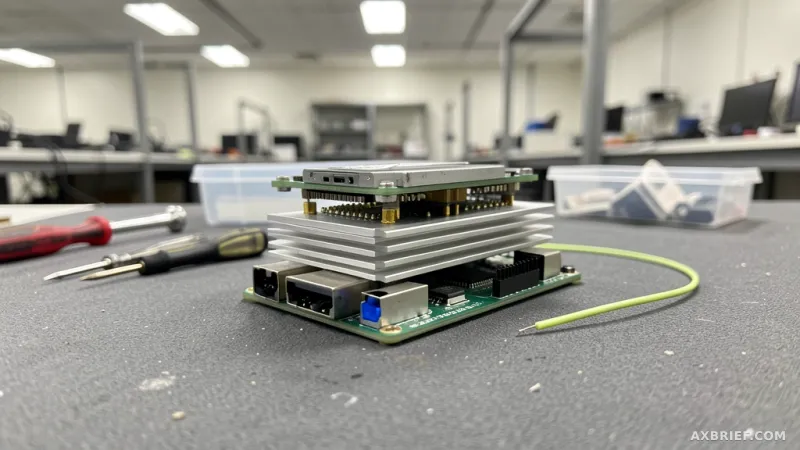
To break this cycle of cloud reliance, DEEPX has partnered with Sixfab, an official Raspberry Pi design partner, to launch the Sixfab AI HAT+. This hardware is specifically engineered for the Raspberry Pi 5, transforming a general-purpose single-board computer into a potent edge AI node. At the heart of the device is DEEPX's proprietary Neural Processing Unit (NPU) technology. Unlike a standard CPU or GPU, the NPU is a specialized circuit designed exclusively for the mathematical operations required by deep learning, allowing for high-throughput inference with extremely low power consumption.
The release is not limited to a standalone board. DEEPX is providing a comprehensive ecosystem designed to accelerate the transition from prototype to production. This includes a production-ready starter kit and a dedicated Software Development Kit (SDK). By providing the SDK alongside the hardware, DEEPX allows developers to bypass the arduous process of custom hardware design. Engineers can simply mount the HAT+ onto their Raspberry Pi 5 and use the provided tools to determine if their specific AI models can be deployed effectively at the edge. Detailed technical specifications and integration guides are available via the DEEPX official website.
Shifting the Bottleneck from Network to Silicon
The introduction of dedicated NPU hardware for the Raspberry Pi 5 changes the fundamental calculus of robotics deployment. When AI inference happens in the cloud, the primary bottleneck is the network. A momentary dip in Wi-Fi signal or a spike in server traffic can introduce a one-second delay in response time. In an industrial setting, such as a warehouse with autonomous mobile robots, a one-second hesitation can be the difference between a successful maneuver and a costly collision. By moving the inference process onto the Sixfab AI HAT+, the network is removed from the critical path of the decision-making loop.
This shift creates a reversal in how developers optimize their systems. Previously, the goal was to minimize data packet size and optimize API calls to reduce latency. Now, the focus shifts to the efficiency of the NPU itself. The performance of the robot is no longer dictated by the quality of the internet connection or the response time of a remote data center, but by the raw inference speed and power efficiency of the local silicon. This allows for the creation of smart automation systems that function with total autonomy, operating reliably in environments where internet connectivity is unstable or entirely nonexistent.
Beyond the technical performance, there is a significant economic shift. Cloud-based AI carries a recurring operational cost that scales with every single inference request. For a fleet of robots processing high-frequency sensor data, these costs can become prohibitive. The DEEPX approach converts this operational expenditure into a one-time hardware investment. Developers can now design their services based on the fixed constraints of the device's computational power and energy budget, rather than worrying about a monthly cloud bill that grows as their robot becomes more active.
As the industry moves toward more sophisticated autonomous agents, the ability to process intelligence locally is becoming a requirement rather than a luxury. The integration of specialized NPU hardware into accessible platforms like the Raspberry Pi 5 signals a broader trend where the edge is no longer just a data collection point, but the primary site of intelligence.



