The transition from a successful AI prototype to a production-ready API is where most engineering teams hit a wall. For those deploying autonomous agents, the priority shifts instantly from prompt engineering to infrastructure security. The standard industry response is to wrap the service in a web application firewall to prevent unauthorized external requests from hitting internal infrastructure. However, when using Amazon Bedrock AgentCore, this standard security layer introduces a critical technical conflict that can bring an entire deployment to a halt.
The Architecture of the Authentication Clash
Securing Bedrock AgentCore in a production environment requires the integration of AWS WAF. In a typical setup, WAF is attached to an internet-facing Application Load Balancer (ALB), which controls incoming traffic before routing it to the AgentCore runtime via the `com.amazonaws.<region>.bedrock-agentcore` data plane endpoint. It is important to distinguish between the different planes here: the data plane handles the runtime, memory, and tools, while the control plane is managed via bedrock-agentcore-control and the gateway via bedrock-agentcore.gateway. Selecting the correct endpoint is the first step in avoiding routing errors.
While some teams consider using API Gateway as an intermediary, this often leads to a double-authentication crisis. API Gateway introduces its own authentication and request transformation layers, which frequently conflict with the SigV4 (AWS request signing protocol) and OAuth standards used internally by AgentCore. This makes the ALB the most viable integration point because it can pass headers transparently, support VPC internal routing, and allow for the direct attachment of WAF WebACLs.
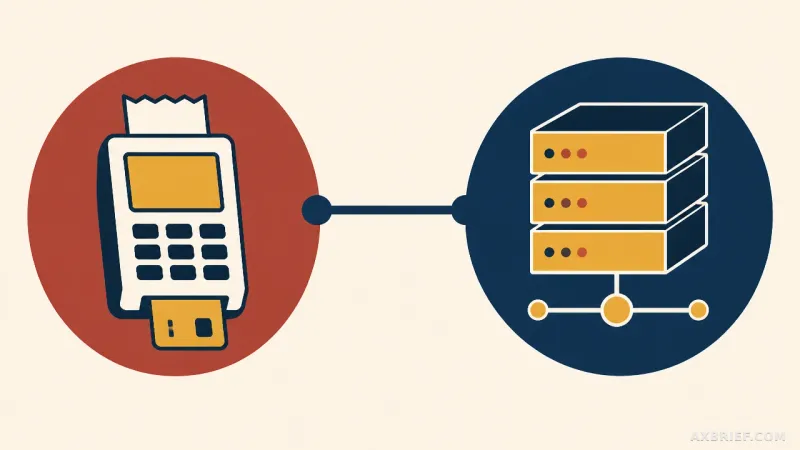
The failure occurs during the ALB health check process. To ensure a backend target is operational, the ALB sends unauthenticated requests to the target server. However, the Bedrock AgentCore runtime is designed with a strict security posture that requires every single API call to be authenticated via SigV4 or OAuth. When the ALB sends its unauthenticated health check, AgentCore rejects it. The ALB interprets this rejection as a target failure and stops sending traffic to the endpoint, effectively killing the service despite the runtime being perfectly healthy.
Choosing Between Control and Velocity
To bypass this deadlock, architects must choose between two distinct patterns: a Lambda proxy for maximum control or direct ENI targeting for minimum latency. The decision hinges on whether the organization needs to modify requests in flight or simply move data as fast as possible.
Pattern 1 introduces a Lambda function between the ALB and the VPC endpoint. In this flow, the client request passes through AWS WAF to the ALB, which terminates TLS and forwards the decrypted request to the Lambda proxy. The Lambda function then acts as a computational layer that can modify the request or perform custom logging before sending it to the VPC endpoint. This is particularly critical for SigV4 authentication. Because SigV4 signatures are bound to the host information, any change in the host during the proxy process invalidates the signature. The Lambda proxy solves this by using its own execution role credentials to re-sign the request.
For OAuth-based setups, the process is simpler as the Lambda function merely passes the Bearer token in the Authorization header without modification. The following implementation demonstrates the core logic for forwarding an OAuth Bearer token:
import urllib3
import json
http = urllib3.PoolManager()
def lambda_handler(event, context):
ALB 이벤트에서 헤더 및 본문 추출
headers = event.get('headers', {})
body = event.get('body', '')
VPC 엔드포인트 대상 URL 설정
target_url = "https://com.amazonaws.<region>.bedrock-agentcore.vpce.amazonaws.com"
요청 포워딩 (OAuth Bearer 토큰의 경우 그대로 전달)
response = http.request(
'POST',
target_url,
body=body,
headers=headers
)
return {
'statusCode': response.status,
'body': response.data.decode('utf-8')
}
This approach provides a high degree of auditability and flexibility but comes with a performance tax. Each request incurs an additional 50 to 200ms of latency due to the extra network hop, and cold starts can further degrade the user experience. This pattern is the only viable solution for enterprise environments requiring detailed custom audit trails or complex request transformations.
Pattern 2 prioritizes raw performance by removing the Lambda layer entirely. Here, the ALB targets the private IP address of the VPC endpoint's Elastic Network Interface (ENI) directly. Traffic flows from the client through WAF and ALB straight to the AgentCore runtime via HTTPS port 443. By using an IP-type target group, the infrastructure is simplified and the network path is shortened.
To solve the health check conflict in this model, the ALB must be configured with a specific health check setting that does not trigger the AgentCore authentication requirement, ensuring service availability. Because the ALB passes SigV4 signatures and OAuth tokens transparently without modification, there is no need for re-signing. This is the optimal choice for consumer-facing AI agents where every millisecond of response time impacts the perceived quality of the interaction.
Beyond the routing pattern, the security posture is hardened through resource policies and WAF rules. To prevent attackers from bypassing the WAF by connecting directly to the VPC endpoint, a resource policy must be implemented to enforce a single entry point. This ensures that all traffic is centralized for analysis and that abnormal access attempts are identified quickly.
Within the WAF WebACL, the `AWSManagedRulesCommonRuleSet` is used to defend against standard web threats like SQL injection and cross-site scripting. To protect AI resources from being drained by automated scripts, the `AWSManagedRulesBotControlRuleSet` analyzes HTTP headers and behavior patterns to block malicious bots. Furthermore, rate-based rules are essential to prevent Denial of Service (DoS) attacks or infinite loops in client software from overwhelming the backend. This three-tier defense—resource policies for path control, managed rules for content inspection, and rate limits for volume control—ensures only verified traffic reaches the runtime.
When calculating the total cost of ownership, teams must account for both fixed and variable expenses. AWS WAF charges per WebACL, per rule, and per million requests. The ALB incurs hourly base charges and LCU (Load Balancer Capacity Units) fees. Pattern 1 adds the cost of AWS Lambda requests and execution time measured in GB-seconds. However, the most significant cost driver for generative AI services is typically the VPC interface endpoint data processing fee, as these services often exchange large volumes of tokens.
Ultimately, the architectural choice is a trade-off between the granularity of control and the speed of execution. Enterprise services requiring strict compliance and request modification lean toward the Lambda proxy, while high-scale consumer applications favor the direct ENI approach to eliminate overhead.
The final design depends entirely on whether the service's success is measured by the depth of its audit logs or the speed of its responses.