Warehouse managers have long operated under a persistent tension between throughput and safety. In the narrow aisles of a high-density distribution center, the margin for error is measured in millimeters. A single misplaced pallet at a height of six meters or a slight miscalculation in a tight turn does not just result in damaged inventory; it creates a high-risk environment for every human worker on the floor. For years, the industry has relied on the intuition of skilled forklift operators to navigate these hazards, but as volume scales, human intuition becomes a bottleneck and a liability.
The Architecture of Autonomous Logistics
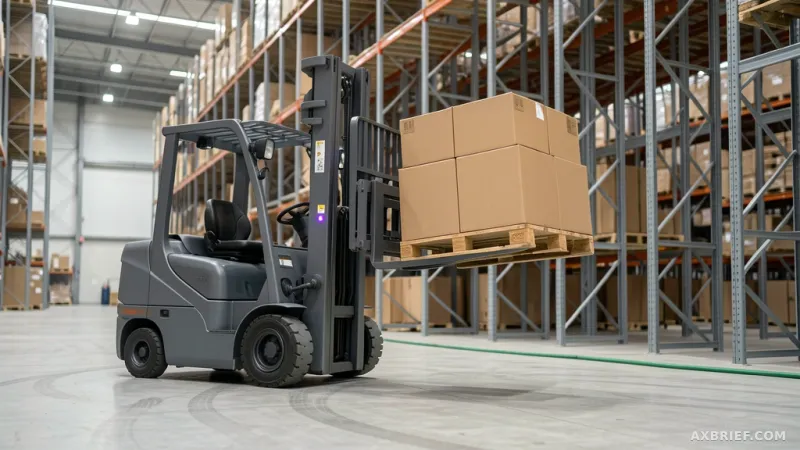
VisionNav Robotics is stepping into this gap with a comprehensive hardware and software suite designed to remove the volatility of manual stacking. From June 22 to June 25, 2026, the company will showcase its latest autonomous logistics lineup at Automate 2026 in Chicago, occupying booth #1841. The center-piece of the exhibit is the VNE40-66 Autonomous Precision Stacking Solution. Unlike standard automated guided vehicles that focus primarily on horizontal transport, the VNE40-66 is engineered for the vertical challenge, utilizing precision stacking technology to place loads in designated positions with near-zero variance.
Complementing the stacking specialist is the VNE20-07 Autonomous Counterbalance Truck. This vehicle employs a traditional counterbalance design, using a heavy rear weight to stabilize the lifting of front-loaded cargo, but replaces the human driver with a sophisticated autonomous navigation system. To tie these physical assets together, VisionNav is introducing the BrightEye Vision Platform. This system serves as the sensory cortex of the operation, processing visual data to ensure the robots can perceive their environment in real-time. Detailed technical specifications for these systems are available via the VisionNav official website.
From Simple Navigation to Physical Intelligence
The industry has seen plenty of robots that can move a pallet from point A to point B, but the transition from navigation to precision manipulation represents a fundamental shift in physical AI. The VNE40-66 and VNE20-07 do not merely follow a pre-mapped line; they operate within complex logistics environments where cargo dimensions vary and traffic patterns are unpredictable. By integrating precision control with autonomous drive, VisionNav is addressing the specific friction point of loading delays and collision risks that typically plague high-density warehouses.
This is where the BrightEye platform transforms the value proposition from a tool to a system. Most autonomous fleets operate as a collection of individual units, but BrightEye introduces operational visibility. By synthesizing visual information across the fleet, the platform allows managers to see the exact status and location of every asset in real-time. The result is a causal chain where better vision leads to tighter precision, which in turn reduces the physical risk of collisions. The shift is not just about replacing a driver, but about creating a transparent, data-driven layer of control over the physical movement of goods.
As warehouses evolve into fully autonomous ecosystems, the ability to execute a perfect stack becomes the primary metric of efficiency.