
The space industry is currently navigating a precarious transition where technical brilliance is no longer the primary currency. For years, the goal was simply to prove that a private entity could touch the lunar surface without crashing. But as the novelty of the first landing wears off, the community is realizing that the real barrier to entry is not the rocket itself, but the trust and contractual history established with government agencies. The race has shifted from a sprint to the surface to a marathon of sustainability, where the winners will be those who can provide the utilities, the power, and the housing for a permanent human presence.
The $300 Million Shortcut to Government Trust
Voyager Technologies recently decided to bypass the slow process of building government rapport from scratch by deploying a massive amount of capital. The company has entered into a definitive agreement to acquire Astrobotic Technology Inc. for $300 million. This transaction, which is expected to close in early July following standard regulatory approvals, is less about the immediate hardware and more about the strategic positioning that comes with the Astrobotic brand. While the acquisition price is significant, the true value lies in the existing portfolio of contracts that Astrobotic brings to the table.
Astrobotic currently holds over $600 million in contracts with the National Aeronautics and Space Administration (NASA) and the U.S. Department of Defense. By acquiring the company, Voyager has effectively purchased a revenue stream and a vendor status that is more than double the cost of the acquisition itself. This move eliminates the immense risk and time associated with developing hardware from the ground up and competing for government tenders in a crowded field. Voyager is not just buying a company; it is absorbing a certified government partner.
Since its founding in 2007, Astrobotic has spent nearly two decades proving that private companies can reliably deliver cargo to the lunar surface. They have accumulated critical operational data by launching the first private lunar lander from the United States. To ensure this momentum is not lost, Voyager will maintain Astrobotic's operational hubs, including the Moon Base headquarters in Pittsburgh and its facilities in Mojave. By preserving the existing management structure and operational centers, Voyager aims to achieve economies of scale without disrupting the technical continuity of the lunar programs.
This acquisition aligns perfectly with NASA's Artemis program, which is aggressively shifting the leadership of lunar exploration from government agencies to private industry. In this new era, competitiveness is no longer measured by the ability to launch, but by the ability to survive and operate on the surface. Through this deal, Voyager has instantly acquired the hardware and systems necessary to land, sustain life, and execute complex missions. The company is effectively evolving from a transportation provider into a lunar infrastructure operator.
From Lunar Courier to Infrastructure Landlord
To understand the strategic pivot Voyager is making, one must distinguish between a delivery service and a utility provider. For years, Astrobotic focused on the courier model: the goal was to deliver a payload to a specific coordinate and successfully exit the mission. However, Voyager is introducing a platform model that integrates mission management, communication, propulsion, power, and habitation into a single ecosystem. This is the difference between a delivery driver leaving a package on a porch and a developer building the entire apartment complex, including the electricity and plumbing.
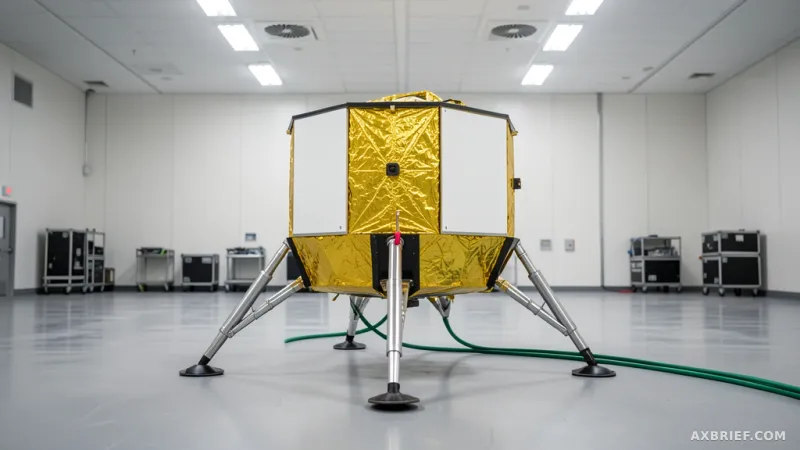
The physical foundation of this platform begins with the Peregrine and Griffin landers. These are not just vehicles; they are the primary logistics arteries connecting Earth to the Moon. The core competency here is precision landing, which allows for the timely delivery of materials and equipment necessary for base construction. Once the lander touches down, the physical expansion of the platform begins. This delivery capability serves as the entry point for all subsequent infrastructure.
Once the hardware is on the surface, the LunaGrid solar power distribution system takes over. LunaGrid is designed as a modular infrastructure that collects solar energy and distributes it to habitation modules and exploration equipment. Without a scalable power grid, any equipment landed on the moon is merely a temporary visitor. By combining LunaGrid with investments in Max Space for long-term habitation, Voyager is transforming the lunar surface from a place of temporary visits into a zone of permanent residence. The stability of the power supply and the availability of pressurized living quarters are the two primary variables that determine how long humans can stay on the Moon.
To ensure the longevity of this infrastructure, Voyager is implementing advanced environmental controls. One critical technology is a transparent dust-repellent coating. Lunar dust is electrostatically charged and highly abrasive, meaning it clings to everything and destroys precision instruments and seals. This coating acts as a physical shield, preserving the visibility of optical sensors and reducing mechanical failure. Complementing this is In-Situ Resource Utilization (ISRU) technology, which allows the platform to mine lunar soil and ice to produce oxygen and fuel. By localizing the production of raw materials, Voyager reduces the dependency on Earth-based supply chains and slashes the astronomical costs of transporting consumables.
This vertical integration changes the value proposition for every other company wanting to go to the Moon. Instead of sourcing a lander from one company, a communication array from another, and a power source from a third, customers can simply use the Voyager platform. They provide the payload, and Voyager provides the operating system. The company that controls the infrastructure defines the standards, and the company that defines the standards controls the lunar economy.
The Robotics Pivot and the ISS Gateway
As NASA Director Jared Isaacman has signaled a goal to establish a permanent U.S. lunar base by 2028, the focus is shifting toward automated construction. Human labor in the vacuum of space is prohibitively expensive and dangerous. Consequently, the efficiency of base construction will depend entirely on the autonomy and deployment frequency of robotic systems. Voyager is positioning itself as the primary orchestrator of this robotic workforce.
Voyager has already secured a mission management contract with Icarus Robotics to prepare for real-world deployment. The first major milestone will occur in 2027, when the autonomous flying robot Joy will be deployed to the International Space Station (ISS) to test operational capabilities in an orbital environment. Voyager's role extends beyond providing the platform; they are managing payload integration, safety certification, launch coordination, and real-time mission support. The data gathered from Joy's mission on the ISS will serve as the blueprint for the autonomous construction processes used on the lunar surface.
Central to this strategy is Voyager's control over the only commercial airlock on the ISS. An airlock is the critical interface between the pressurized interior of a station and the vacuum of space. By controlling this gateway, Voyager controls the flow of robotic assets into the orbital environment. Scott Rodriguez, Voyager's Vice President of Government Programs, has emphasized that human labor alone cannot build a lunar or Martian base. The future belongs to robot-led construction, where machines analyze terrain and deploy materials autonomously.
For robotics engineers and developers, this represents a massive shift in market opportunity. The industry is moving away from simple assembly robots toward high-autonomy systems capable of self-maintenance in extreme environments. The challenge is no longer just about movement, but about edge computing that can handle communication delays with Earth and hardware that can survive extreme temperature swings and radiation. The value is shifting from the robot's mobility to the operational process that governs how that robot interacts with the environment.
By integrating Astrobotic's landers, the LunaGrid power system, and the Icarus Robotics partnership, Voyager Technologies is not just building a company; it is building the operating system for the Moon. The competition is no longer about who lands first, but about who owns the grid, the airlock, and the power lines. In the new lunar economy, the infrastructure provider is the ultimate authority.



