The modern football fan no longer watches a match in isolation. They operate a second screen, toggling between live streams, social media feeds, and complex statistical dashboards to make sense of a tactical shift or a controversial substitution. This fragmented experience has created a tension between the raw emotion of the game and the desire for professional-grade analysis. This week, the boundary between the spectator and the analyst shifted as Google integrated its most advanced AI and hardware directly into the infrastructure of the world's most prestigious sporting institutions.
The Hardware-Software Synergy of the Elite Partnership
Google has entered into a sweeping official partnership with five of Europe's most dominant football clubs: Arsenal, FC Barcelona, FC Bayern Munich, Liverpool, and Paris Saint-Germain. This is not a traditional sponsorship deal focused on perimeter board advertising. Instead, it is a structural integration where Gemini is designated as the Official Consumer AI and the Pixel series serves as the Official Smartphone Partner. The objective is to reconstruct the entire fan journey, turning the smartphone from a passive viewing device into a core interface for club interaction.
As the Official Consumer AI, Gemini acts as the primary gateway to the clubs' vast internal databases. Rather than forcing fans to navigate cumbersome archives or third-party stat sites, Google has built an environment where fans can query club data using natural language. This transforms a general-purpose large language model into a domain-specific expert, capable of delivering tailored match insights based on official club records. The AI handles the heavy lifting of data retrieval, allowing the user to consume complex performance metrics as a conversational narrative.
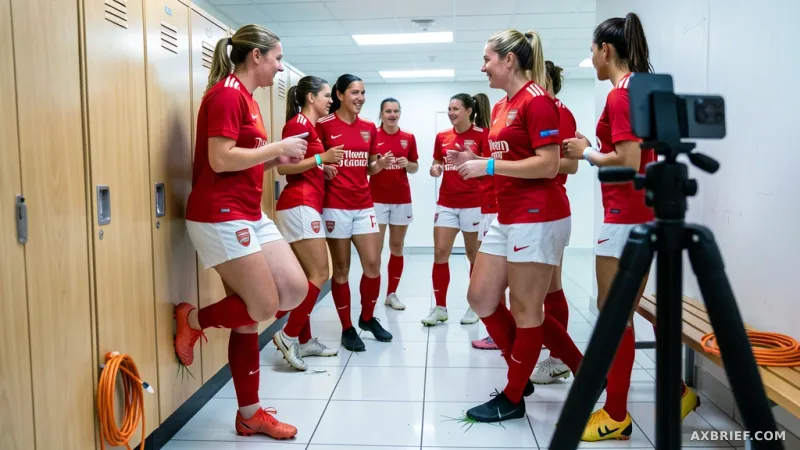
Parallel to the software integration, the Pixel 11 serves as the primary tool for the clubs' media teams. By leveraging the high-end imaging capabilities of the Pixel camera, these teams are producing raw, behind-the-scenes content designed to eliminate the psychological distance between the stars on the pitch and the fans in the stands. To deepen this connection, Google is providing Pixel 11 users with exclusive official wallpapers from each club, turning the physical device into a digital badge of membership. This strategy ensures that the partnership is felt both in the cloud via Gemini and in the hand via Pixel hardware.
This integrated pipeline extends across all official club channels and Google's own social media ecosystem. Crucially, the technical support is not limited to the men's teams. Google has applied the same scope of AI and hardware resources to the women's teams, ensuring that media coverage and technological accessibility are standardized across the entire organization. By deploying the same Pixel toolsets and Gemini capabilities for both, Google is effectively using technology to flatten the visibility gap in professional football.
From Static Stats to Agentic Insights
The true technical pivot in this partnership lies in the transition from generative AI to agentic AI. Most fans are used to AI that can summarize a game or list a player's goals, but Gemini's agentic capabilities allow it to act as a proxy for the user. In the context of a live match, an agentic system does not just retrieve data; it plans and executes a series of steps to achieve a goal. When a manager changes a formation mid-game, the AI does not wait for a specific keyword search. It actively monitors the shifting data, analyzes the tactical implication, and provides a real-time explanation of the change.
This shift is most evident when fans engage in post-match debates regarding head-to-head records. Traditionally, verifying a historical trend between two clubs required manual filtering of decades of results. Gemini now functions as a data agent, autonomously filtering through massive historical datasets to extract specific correlations and evidence. It moves beyond simple keyword matching to analyze the relationship between different data points, drastically reducing the time between a fan's curiosity and a verified insight.
This functionality relies on a sophisticated pipeline where real-time match data is fed into an AI agent, which then cross-references it with historical club archives. The agent translates numerical tactical movements into natural language, effectively giving every fan access to a professional analyst's toolkit. The complexity of the task is significant: the AI must maintain the absolute currency of the data to avoid hallucinations while processing information at a speed that matches the live action of the game.
For the clubs' media teams, this agentic approach extends to content production. Using the Shot on Pixel series, teams capture high-resolution action shots and raw footage, which are then processed through AI-driven editing tools. These tools simplify the post-production workflow, allowing the teams to generate social-media-optimized clips in near real-time. This allows the clubs to push out authentic, high-fidelity content that captures the intensity of the sideline, further enhancing the global visibility of the sport, particularly for the women's game where high-quality media exposure has historically been a bottleneck.
From a development perspective, the core of this system is the optimization of the data pipeline. The challenge is converting structured sports statistics into a context that a large language model can reason with without losing precision. By combining on-device AI processing on the Pixel 11 with the massive compute power of Gemini's cloud models, Google has created a hybrid environment where latency is minimized. The success of the service depends entirely on the synchronization between the data update cycle and the agent's inference speed.
The stadium is no longer just a venue for a game, but a live data set being decoded in real-time by the devices in the fans' pockets.