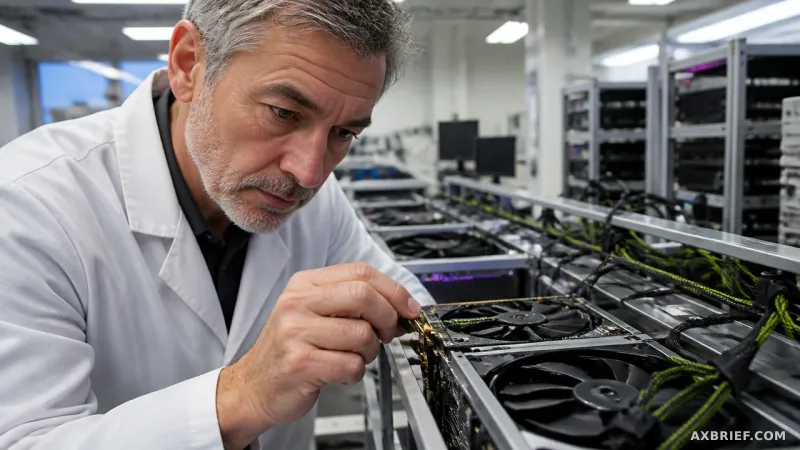
The current era of artificial intelligence is defined by a frantic, global scramble for silicon. For the past few years, the prevailing wisdom in boardroom meetings and engineering sprints has been simple: secure as many H100s as possible. The assumption was that compute capacity would be the primary bottleneck for intelligence. However, as the industry moves from experimental prototypes to massive production scales, a more punishing reality is setting in. The competitive edge is no longer found in the sheer volume of hardware owned, but in the ruthless optimization of how that hardware is kept busy.
The Financial Friction of Calendar Time
To understand the economics of AI infrastructure, one must first distinguish between the calendar hour and the compute hour. GPU costs are billed in calendar time. From the moment a chip is purchased or leased, the clock starts ticking on a series of relentless expenses: financing costs, hardware depreciation, electricity, and the massive cooling overhead required to keep high-density clusters from melting. These costs are fixed and indifferent to whether the GPU is executing a complex transformer block or sitting completely idle.
Value, however, is only generated during the compute hour—the actual window of time when the silicon is performing meaningful calculations. This creates a financial structure strikingly similar to the aviation industry. An airline may own a massive fleet of aircraft, which provides the theoretical capacity to move millions of passengers. Yet, a plane sitting on a tarmac is a liability; it continues to accrue lease payments, insurance, and maintenance costs without generating a single cent of revenue. Revenue is only realized when the plane is in the air. In the AI world, a GPU in a standby state is a plane on the tarmac.
This shift in perspective changes the definition of success. In the early days of the LLM boom, the primary goal was capability—increasing the intelligence or reasoning power of the model. Now, capability has become a baseline. The new constraint is efficiency. Two companies with identical GPU budgets will see wildly different returns on investment based on their utilization rate. The winner is not the one who bought the most chips, but the one who minimized the gap between calendar time and compute time.
This economic pressure is amplified as companies transition from API-based models to self-hosted infrastructure. API costs are linear and variable; you pay for the tokens you use, and the provider absorbs the risk of idle hardware. But when a company builds its own cluster, it trades variable costs for a massive fixed-cost structure. Once the break-even point is crossed, self-hosting is cheaper, but it introduces the burden of resource management.
Consider the scale of this commitment. In 2020, Microsoft constructed a dedicated supercomputer for OpenAI featuring over 10,000 GPUs and 285,000 CPU cores to train GPT-3. By 2026, such concentrations of power are no longer the ceiling but the starting point. Even the most well-capitalized labs treat compute access not as a solved problem, but as a real-time strategic constraint. The challenge is compounded by peak sizing. To ensure that a system doesn't crash during the highest traffic spikes or the most intensive training runs, engineers must size their infrastructure for the peak, not the average. This means that during off-peak hours, a staggering percentage of the hardware remains idle, draining capital without producing output.
The Orchestration Trap and Workload Mismatch
The difficulty of maintaining high utilization is not merely a matter of finding more work to do; it is a matter of matching the right work to the right hardware profile. In the first generation of enterprise AI, GPUs were primarily used for inference. Today, a single cluster must simultaneously handle training, fine-tuning, quantization, real-time inference, batch processing, and embedding generation. Each of these workloads demands a fundamentally different resource profile.
Real-time inference is a game of low latency. The priority is an immediate response to a user query, requiring small, frequent bursts of resource allocation. If the response lags, the user experience fails. Batch processing, conversely, is a game of throughput. It doesn't matter if a batch job takes six hours to complete, as long as the total volume of data processed per hour is maximized. While real-time inference sips resources quickly, batch jobs gulp them in massive, sustained quantities.
Training is the most demanding of all, often monopolizing GPUs for days or weeks at a time to update model weights. This creates a long-term occupancy lock that prevents other tasks from entering the cluster. Then there is quantization—the process of reducing model precision to save memory. Quantization is characterized by short, explosive bursts of extreme memory and compute demand. It is a spike in the system that can starve other processes if not managed precisely.
This diversity of needs creates a scheduling nightmare. A scheduler optimized for low latency will fragment resources in a way that makes it impossible to launch a massive training job. Conversely, a throughput-oriented scheduler will cause real-time inference latency to skyrocket. When a company optimizes for one workload, it inherently misallocates resources for the other three. The result is a paradoxical state where the hardware exists, but the logic required to distribute it efficiently is missing.
This leads to the danger of the occupancy metric. Many infrastructure managers rely on a dashboard that shows a high average GPU utilization percentage and assume the system is healthy. However, this is often a mirage. High occupancy does not equal high efficiency. It is common to see a cluster reporting 90% utilization while critical high-priority jobs sit in a queue, unable to start. This happens because the specific shape of the GPU—the combination of available VRAM and compute cores—is being occupied by a low-priority task that doesn't actually need those specific resources but is holding them anyway.
Returning to the airline analogy, this is equivalent to having a fleet of planes that are all full, but the passengers are in the wrong cities. The planes are occupied, but the actual demand of the market is not being met. In AI infrastructure, the core question has shifted from whether the GPU is occupied to whether the right workload is running on the right GPU at the right time. Qualitative utilization—orchestration—has replaced quantitative procurement as the primary driver of ROI.
The scale of this challenge is evident in the strategies of the industry giants. Anthropic, unable to secure sufficient capacity from a single source, entered multi-gigawatt power and hardware contracts across four different platforms: Amazon, Google, Microsoft, and AMD. Meta has pursued a similar path of massive power acquisition. Even with virtually unlimited capital, these companies are forced to diversify their supply chains because the scarcity of compute is so acute.
For the AI practitioner moving from a Proof of Concept (PoC) to full production, this is the most dangerous transition. In the PoC stage, the API economy hides the complexity of infrastructure. You pay for tokens, and the economics are simple. But in production, the GPU becomes a massive capital asset. The act of buying hardware is a straightforward administrative task with a clear deadline. The act of running that hardware to achieve a positive return on investment is a complex operational struggle. The gap between procurement and utilization is where most AI projects fail financially. The ultimate victory goes to the organization that can keep its silicon screaming, 24 hours a day, without wasting a single calendar hour.