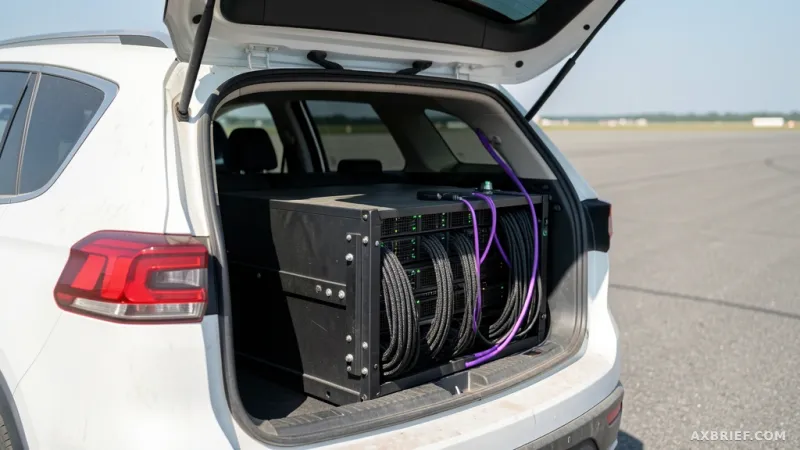
The landscape of large-scale artificial intelligence is shifting rapidly this week, marked by the arrival of Alibaba’s Qwen 3.8, a model designed for autonomous tasks that can run for days without human intervention. As model capabilities expand to handle more complex, long-term operations, the infrastructure supporting them is evolving in tandem. We are seeing a notable push toward specialized hardware, with NVIDIA’s DGX Spark leading in compute-bound processing speeds and AMD preparing its Gordon Halo architecture for a 2026 release. Beyond raw power, the focus is increasingly on the reliability of AI-generated work. New frameworks like ACDC are shifting security verification earlier into the development process, while tools like the Hermes agent are integrating fact-check modes to reduce the risk of hallucinations in automated outputs. Meanwhile, the daily workflow of software engineering is undergoing a transformation; teams are moving toward agentic systems that generate shippable code directly from meetings, and platforms like Kestra are simplifying local automation through expanded API integrations. As organizations navigate these changes, they are also grappling with the practical realities of compute capacity, the need for better content transparency on platforms like LinkedIn, and the desire to consolidate fragmented AI tools into unified interfaces. This digest explores how these hardware advancements, verification protocols, and workflow shifts are reshaping the current state of autonomous computing.
01Alibaba Qwen 3.8 Scales to 2.4 Trillion Parameters
Artificial intelligence is shifting from a tool that answers prompts to a digital employee capable of working for days without human supervision. Alibaba recently launched Qwen 3.8, a massive model trained on 2.4 trillion parameters, placing it on par with the largest systems from OpenAI and Anthropic. Described as an "always on workmate," the model is specifically engineered for long-term autonomous tasks, meaning it can manage complex projects independently over extended periods. For example, a version called Qwen 3.8 Max demonstrated this capability by coding on its own for 16 consecutive days. During this time, it self-tested and improved its own project, successfully adding a goal system, a desktop application, and an interactive galaxy map without needing a human to guide every step. This represents a significant leap in reasoning benchmarks, research, and general computer use.
This advancement is part of a broader trend where Chinese AI development is accelerating rapidly. Alongside Alibaba, other players like DeepSeek have introduced models such as Deepseek V4 Flash, which combines high-capacity agent capabilities with extremely low pricing. The arrival of these powerful and affordable models is creating intense pressure on American AI labs to rethink their pricing and operational strategies to maintain their market share.
In response to this global competition, OpenAI is exploring ways to make its high-end reasoning more sustainable. The company utilized GPT 5.6 Sol to optimize the very systems that run it, effectively cutting its own operational costs. This process of recursive improvement—where a model is used to build and refine the infrastructure it relies on—demonstrates a new phase of AI development. By automating the optimization of its own underlying hardware and software, OpenAI aims to keep its advanced capabilities competitive while reducing the massive financial overhead required to run such large-scale systems.
02ACDC Framework Optimizes AI Agent Verification
Shipping AI-generated code can be dangerous because security flaws are often exploited by bad actors almost the same day they are announced. To mitigate this risk, the Agent-Centric Development Cycle (ACDC) framework introduces a structured loop consisting of guidance, verification, and solving. Instead of letting an AI write and deploy code blindly, ACDC provides guardrails upfront, runs multi-layered checks for security and compliance, and then empowers the agent to remediate any discovered issues. This approach "shifts security left," meaning it catches vulnerabilities at the very beginning of the development process rather than at the end, preventing risky code from ever reaching production.
This verification happens in two distinct stages to ensure no errors slip through. First, an "inner loop" uses Sonar Vertex to provide real-time verification as the AI agent writes code. By identifying errors immediately, the agent can fix them on the fly, preventing mistakes from propagating into future development cycles. Second, an "outer loop" serves as a final quality gate in the deployment pipeline. In this stage, Guitar provides a "superhuman" review driven by a large language model, while SonarQube performs a computational review that assigns grades for maintainability, security, and quality. This dual-layer system ensures that verification is independent of the tool that wrote the code, providing a more objective audit.
To scale these tools, organizations are adopting "bounded autonomy." This strategy gives AI agents the freedom to generate code while enforcing a centralized, independent scheme of constraints and verification. Standardizing this process across all teams eliminates organizational blind spots and prevents inconsistent quality standards. Most importantly, this framework preserves human ownership. If engineers allow AI agents to make critical decisions without a rigorous verification loop, they effectively cede control of their codebase. By implementing ACDC, companies can leverage the speed of AI agents while ensuring that human developers remain the ultimate owners of the product.
03NVIDIA DGX Spark and RTX Spark Set Hardware Pace
For users processing massive documents, the NVIDIA DGX Spark is a game-changer because it solves the "prefill" bottleneck. Prefill is the phase where the AI reads and processes a prompt before generating a response. This task is compute-bound, meaning it relies on raw processing power from tensor cores rather than memory bandwidth. Equipped with a Blackwell GPU featuring 6,144 CUDA cores, the DGX Spark processes prompts roughly five times faster than an AMD APU. While it offers only a marginal 13% improvement in the speed of the actual answer—which is bandwidth-bound—the massive leap in prefill speed makes it essential for developers who feed the model entire documents or complex datasets.
To illustrate this gap, benchmarks using Llama.cpp and GPTOSs 120B show the DGX Spark hitting 1,723 tokens per second during prefill, dwarfing the AMD Stricks Halo's 339.87 tokens per second. This hardware specialization has led to creative hybrid setups. ExoLabs recently wired a DGX Spark to a Mac Studio M3 Ultra, assigning the compute-heavy prefill to NVIDIA and the bandwidth-heavy decode to Apple. For a Llama 3.1 8B model with an 892-token prompt, this combined approach reduced latency from 6.42 seconds to 2.32 seconds, representing a 2.8x speedup. This demonstrates that high-end AI hardware is becoming complementary rather than purely competitive.
Looking ahead, the RTX Spark is scheduled for release in fall 2026, promising further advancements in capacity. This hardware evolution supports a broader shift toward AI agents—tools that move beyond simple chatting to execute actual tasks. A prime example is Claude Code, which expands the AI's operational range from a web browser to the local computer. By using the terminal as a bridge, Claude Code can directly read, create, and manage files and folders on a user's PC. This eliminates the need for manual uploads or downloads, allowing the AI to run programs and perform tests directly within the local environment, significantly increasing developer productivity.
04Agentic Engineering Streamlines PR Generation
Software teams are now using autonomous AI agents to turn live conversations into actual code updates. This approach, known as agentic engineering, allows a team to prototype ideas and generate shippable pull requests—proposed changes to a codebase—directly from customer onboarding calls or team meetings. For instance, the company Superconductor reports that nearly 99.9% of its pull requests are heavily generated by agents. This shift enables non-technical staff, such as growth or support teams, to trigger real product fixes simply by describing a bug in a chat tool, bypassing the traditional delay of filing a formal ticket for an engineer to eventually address.
However, giving AI agents the power to write code introduces significant safety and quality risks. Running these agents on local laptops can be dangerous, as an agent might discover a sensitive security token and accidentally apply changes to a live production environment instead of a testing area. To prevent this, teams are moving agent operations to the cloud and restricting access to the absolute minimum required. Even with these safeguards, human oversight remains essential. A study by Carnegie Mellon found that while AI tools like Cursor create an initial spike in productivity, these gains often vanish after three months. This is partly due to "verification debt," where the gap between default AI output and the high quality required for critical software creates a burden of manual cleanup for human engineers.
To sustain long-term efficiency, teams must move beyond generic AI benchmarks. Public tests like SWE-bench are often Python-based, which provides little value to a team using a different language, such as Ruby on Rails. Instead, companies are developing their own internal benchmarks to remain model-agnostic, meaning they can switch between different AI providers to optimize for cost and speed without being locked into one vendor. Superconductor is building a system to automatically route tasks to the specific model that performs best on their unique codebase. Similarly, Sonar utilizes a leaderboard of 4,000 coding tasks and SonarCube metrics to track the reliability and security of new models, helping teams manage the persistent increase in code complexity and static analysis warnings that often accompany AI-generated software.
05Hermes Agent Introduces Fact-Check Mode
AI tools often struggle with accuracy, sometimes presenting false information as fact with an air of confidence. To address this, the Herald release of the Hermes agent from Nous Research introduces a specialized fact-check mode designed to make AI responses significantly more reliable. For the average user, this means the AI no longer asks for blind trust; instead, it provides a transparent trail of evidence for its assertions. By focusing on direct verification, the agent aims to reduce the frequency of hallucinations, which occur when a model generates plausible-sounding but entirely incorrect data.
The technical approach relies on a rigorous and granular linking system. Rather than providing a general summary or a few scattered citations, the Hermes agent links every individual claim it makes to a verifiable source. This allows users to instantly navigate to the original context of the information to confirm its validity. To ensure the highest level of precision, the system matches specific quotes directly against the actual text found on the source page. This critical step prevents the AI from accidentally misquoting a source or attributing a statement to a page where the specific wording does not actually exist, ensuring that the evidence provided is genuine.
The primary value of this update is the ability to distinguish truth from error in real-time. The dedicated fact-check mode does not just provide links; it explicitly informs the user which claims hold up under scrutiny and which do not. This shift changes the user's workflow from one of skeptical, manual auditing to one of guided verification. By highlighting the accuracy of specific points, Nous Research provides a mechanism for users to quickly identify errors and rely on the verified portions of the output. This makes the agent far more useful for professional tasks where factual precision is mandatory and the cost of an AI error is high.
06LinkedIn Debuts AI-Generated Content Reporting
LinkedIn users now have a direct way to flag content that feels artificial, as the platform attempts to curb the rise of synthetic posts. The company has recently introduced a new reporting tool specifically designed to target AI-generated content that appears inauthentic, repetitive, or fake. This move comes as a response to the increasing volume of posts that lack a human touch, allowing the community to help moderate the quality of the professional network's feed and ensure that the content users encounter remains grounded in genuine human experience.
The decision to implement this feature follows a study analyzing over one million social media entities, which revealed a startling trend: 41% of long-form posts on LinkedIn are now fully generated by artificial intelligence. To combat this flood of synthetic text, the platform added a reporting button that users can tap when they encounter a post that seems like it was copied directly from ChatGPT. This mechanism allows members to signal when a post feels robotic or repetitive, effectively crowdsourcing the detection of low-effort content that often clutters professional timelines.
The practical consequence of this reporting feature is that flagged posts can be removed from feeds, reducing the visibility of content that does not provide real value. By empowering users to identify and report material that feels fake, LinkedIn is attempting to restore the perceived authenticity of professional interactions. This shift signals a move away from the unchecked proliferation of AI-written posts and toward a standard where human-led communication is prioritized over automated output. For the average professional, this means a potential reduction in the noise of generic, AI-driven posts, making the platform more effective for genuine networking and the discovery of authentic professional insights.
07Securing AI computing capacity earlier can justify paying a price premium
In the race for artificial intelligence dominance, the timing of a product launch is often more valuable than the cost of the hardware used to build it. For major tech firms, paying a premium to secure computing power today is a strategic investment rather than an unnecessary expense. The logic is simple: the revenue generated by launching a service a year early far outweighs the extra cost paid for the hardware. If a company can deploy its services in 2027 rather than waiting until 2028, the early entry into the market allows them to capture users and generate profits that justify a higher upfront price.
This economic calculation is evident in the current behavior of the industry's biggest players. SemiAnalysis has highlighted this dynamic through its analysis of Microsoft, noting that the company views early access to GPUs—the specialized chips that power AI—as a critical driver of profitability. Microsoft has indicated that demand for these chips currently exceeds supply, meaning that any new computing capacity they acquire translates almost immediately into revenue. This pattern is mirrored across the cloud sector, where AWS AI has already surpassed $25 billion in revenue and Google Cloud continues to grow rapidly to keep pace with the massive demand for AI infrastructure.
The scale of this competition is further illustrated by SpaceX, which is investing $15.8 billion to secure an immense amount of power, targeting 10GW—a capacity roughly equivalent to seven nuclear power plants. The primary objective here is not just the hardware itself, but the ability to turn those GPUs on before anyone else. When a single megawatt of power can generate substantial revenue, the ability to secure that energy and computing capacity just a few months ahead of the competition creates a massive financial advantage. In this environment, the time to market becomes the most expensive and valuable commodity, making a price premium a rational business decision.
08Kestra Integrates Gemini 2.5 Flash for Local Automation
Giving an AI agent total control over a company's digital infrastructure is a risky prospect. While modern AI can write code, send emails, and update databases, most organizations are hesitant to trust these tools to operate entirely on their own. Kestra addresses this trust gap by treating AI not as an autonomous boss, but as a single intelligent step within a larger, predictable workflow. By combining AI reasoning with human-in-the-loop approval gates—mechanisms that require a person to sign off before a task is completed—the platform ensures that no critical action, especially those that affect the outside world, happens without human intervention.
This approach transforms AI from a fragile demo into a production-ready system. For instance, a workflow might use an AI agent to analyze a GitHub issue and draft a classification label, but the system will pause at an "apply decision" stage. The AI's drafted labels and comments are only published to the repository once a human explicitly approves the work. To support these complex sequences, Kestra operates as a language-agnostic platform, meaning it can execute almost any code that runs on a computer, including Python, Bash, Node.js, and Go. This flexibility is bolstered by a library of over 1,800 plugins that allow it to integrate seamlessly with external services like Slack, various databases, and cloud platforms.
For those looking to implement these capabilities locally, Kestra's open-source edition integrates with the Gemini 2.5 Flash API. By utilizing the free tier available through Google AI studio, users can build sophisticated local automation that leverages high-speed AI reasoning without sacrificing safety. The result is a system where the AI handles the heavy lifting of reasoning and drafting, while the human remains the final authority. This structure prevents the unpredictability often associated with fully autonomous agents, turning AI into a reliable tool for orchestrating complex business processes.
09AMD Gordon Halo Targets High VRAM Addressability
Running large-scale artificial intelligence models typically requires an immense amount of specialized memory, which often forces users to rely on expensive enterprise-grade hardware. The upcoming AMD Gordon Halo aims to lower this barrier by providing massive memory capacity in a more accessible hardware format, allowing users to handle larger datasets and more complex models locally on their own machines.
Confirmed for a Q3 2026 release through partnerships with ASUS, HP, and Lenovo, the Gordon Halo is built on the Ryzen AI Max Plus Pro 495. The hardware is equipped with 192 GB of LPDDR5X8,533 memory. The most significant technical advantage here is the system's high addressability, meaning that up to 160 GB of that total memory can be designated as VRAM. VRAM, or video random access memory, is the specialized high-speed memory a graphics processor uses to store and access the data it needs to process AI prompts or render graphics.
By allowing such a large portion of the system memory to function as VRAM, AMD is targeting users who need to load massive models into memory all at once. This reduces the need for the system to constantly move data back and forth between different types of memory, which is a common bottleneck in AI workflows that can significantly slow down performance. This high-capacity approach provides a different value proposition than the raw processing speed found in competing enterprise hardware.
However, memory capacity is only one part of the performance equation. While the Gordon Halo offers impressive addressability, current AMD APUs—chips that combine the central processor and the graphics processor on a single die—continue to lag behind Nvidia's Blackwell GPUs in terms of prompt processing speed. For users, this creates a strategic trade-off between the ability to run massive models due to high memory limits and the raw processing velocity offered by the current market leaders.
10Traditional software engineering tools, such as IDEs, were d
Many software developers today suffer from a form of "velocity sickness," a state where they produce a high volume of work that ultimately fails to matter to the people they are trying to reach. This happens when the act of building becomes disconnected from the actual needs of the user. In this scenario, engineers may write vast amounts of code that go effectively unread or unused, creating a painful gap between the technical effort expended and the actual value delivered to the end customer. The ultimate goal of product development should be to build features that connect with people, rather than simply increasing the speed of production for its own sake.
This disconnect is deeply rooted in the very tools used to create software. The primary workhorse for any developer is the Integrated Development Environment, or IDE—a comprehensive software application that provides all the necessary tools for writing and testing code in one place. Historically, these IDEs were designed for a workflow centered on individual, heads-down implementation. The history of these coding tools reflects a style of work where a software engineer spent the vast majority of their time in isolation. The focus was on the solitary act of building, where the developer would implement a feature and polish the technical details in a vacuum before finally shipping the product to the public.
When the tools of the trade prioritize this isolated polishing phase, the risk of building the wrong thing increases. The traditional workflow encourages a developer to dive deep into the implementation details without constant feedback or a direct line to the user's experience. While this approach ensures the code is technically polished, it does not ensure that the product is meaningful. To avoid the trap of velocity sickness, the focus must shift away from the solitary pursuit of technical perfection and toward a process that ensures the final product actually resonates with the people it is intended to serve.
11Shifting the core atom of work from a chat to a document pre
When teams rely on chat interfaces to build new products, they often fall victim to "prototype gravity." This is the tendency to blindly ship the first working version of a feature simply because the initial implementation was exciting. In the rush to see something function, teams often stop exploring the "idea maze"—the process of testing multiple conceptual paths to find the most effective solution. When the chat is the center of the work, the momentum of the conversation often overrides the rigor of the design, leading to products that are functional but not necessarily optimal.
To prevent this, the fundamental unit of work must shift from a chat to a document. In this workflow, the document serves as the "state," or the permanent record of the project's current status and decisions, while the AI agents act as the "actions" that perform work on that state. This allows for a process called "context engineering," where the document is structured to provide a precise starting point for any AI. Because the agents are largely stateless—meaning they do not need to maintain a complex internal memory of a long conversation—they can be spawned in multiple instances to collaborate on the same piece of context without losing track of the primary goal.
This structural change provides a level of transparency that chat-based workflows lack. Instead of scrolling through thousands of lines of dialogue to reconstruct a decision, a human team can look at the document to understand exactly what is happening and which key decisions have been made. By separating the agent from the state, the document becomes a shared map that guides both humans and AI. This ensures that the final output is a result of deliberate planning and iterative refinement, effectively breaking the pull of prototype gravity and allowing teams to prioritize the best possible solution over the first one that worked.
12Higgsfield and AI Master Consolidate Multimodal LLMs
Users are increasingly moving away from fragmented AI workflows, replacing a dozen open browser tabs and multiple monthly bills with single, consolidated interfaces. This shift reduces the financial and cognitive burden of managing different AI services, allowing creators and professionals to access a wide array of capabilities without the friction of switching platforms or paying for redundant subscriptions.
The AI Master platform addresses this by bringing several leading large language models—including Claude, ChatGPT, Grok, and Gemini—into a single window. Instead of paying for four separate subscriptions, users can prompt these models side-by-side to compare responses in real time. Beyond the monthly savings, this consolidation also lowers per-token expenses, which refers to the cost associated with the individual units of text the models process and generate. This makes high-volume prompting more affordable and efficient for those who frequently process large documents.
While AI Master focuses on text-based models, Higgsfield streamlines the creative process by aggregating top-tier image, video, and audio models into one hub. The primary advantage of Higgsfield is its ability to run directly within the Claude environment. This integration allows users to maintain their primary chat workflow while triggering complex multimodal generations without leaving the interface, eliminating the need to jump between different specialized tools.
This consolidated approach fundamentally changes how premium digital content is produced. For example, a designer can use Higgsfield within Claude to build a high-end web presence, specifying a cinematic scrolling hero section—the first visual element a visitor sees—and adding dynamic elements like lightning bolts and specific color schemes. By blending these diverse generative models into a single stream, the process of adding real images and video to make a project look professional becomes a seamless part of the conversation rather than a disjointed series of exports and imports across different software tools.