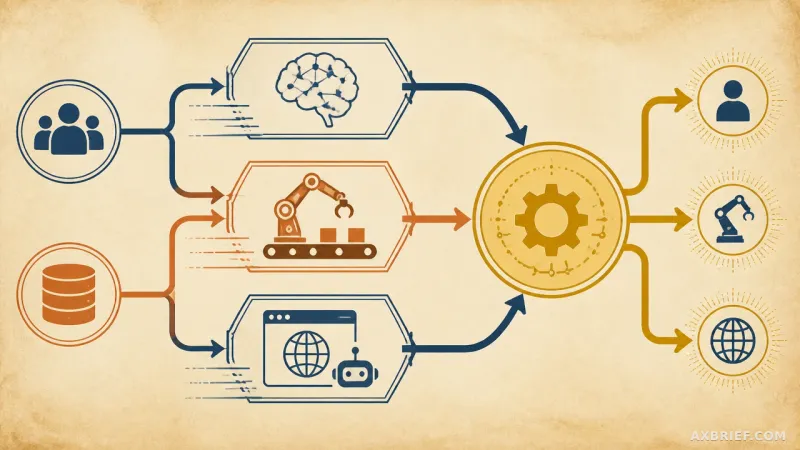
Today's roundup covers a wide spectrum of software updates, hardware expansions, and productivity tools across the artificial intelligence landscape. Google has released two versions of Gemini 3.8 Live to balance different operational needs, with the Extended Thinking version achieving top-tier results in speech and agentic benchmarks, alongside Gemini RSI powered by Gemini 3.7 Flash demonstrating superior performance in path optimization. Meanwhile, Anthropic is expanding its productivity suite by allowing users to create shareable documents and presentations directly within the chat interface via Claude Docs and Slides, alongside Claude Co-work introducing a dedicated mode for non-technical users with an integrated side-panel browser for automated website data extraction. In infrastructure and automation, the integration of the GitHub MCP server and Browser Use allows AI agents to autonomously manage repositories and control web browsers, while harnesses standardize tool and environment integration. Hardware and real-world applications are also advancing, as UBTech has rapidly expanded its humanoid robot smart factory capacity to 10,000 units annually. Other developments include Union Alpha improving cost-efficiency, GPT6 Astra introducing new capabilities in 3D design and video editing, and interactive AI simulations transforming marketing and professional training while online exploration policies face limitations from meta-level feedback.
01Claude Docs and Slides Enter Beta
Anthropic is expanding its productivity suite with the introduction of Claude Docs and Claude Slides in beta, allowing users to create shareable documents and presentations directly inside a chat interface. This update changes everyday workflows by moving content generation from isolated output windows into collaborative workspaces where the system can actively participate in drafting and refining materials.
The new tools support real-time co-editing with multiple collaborators, enabling teams to build and modify files simultaneously. Within this environment, Claude can leave comments to guide revisions or suggest improvements directly on the page. Once generated, these documents and presentations are organized behind a single shareable link, functioning as artifacts within the Claude ecosystem that can be easily distributed to other users for review or manual editing.
02Claude Co-work Targets Non-Technical Knowledge Work
Anthropic is splitting its AI capabilities to better serve different types of professional workflows. While many AI tools focus on the technical rigors of programming, Claude Co-work is designed specifically for non-technical knowledge work. This means professionals who spend their days on research, analysis, and managing documents across various folders and applications now have a dedicated environment tailored to those tasks. Instead of relying on a general-purpose interface, users can leverage a tool built for the specific friction of moving data between different digital spaces.
The distinction is most apparent when compared to Claude Code. While Claude Code is built for the high-precision needs of software engineering—specifically for writing, debugging, and shipping code—Claude Co-work focuses on the analytical side of professional labor. It is intended for users who need to synthesize information across browsers and folders, effectively acting as a digital assistant for the administrative and research-heavy side of business rather than the technical engineering side.
Within Claude 2.0, this functionality is delivered through two distinct modes. The chat mode remains the primary way for users to interact and converse with the AI. In contrast, the co-work mode is optimized for the generation and manual editing of documents. This allows users to move beyond simple question-and-answer exchanges and instead use the AI to produce structured content that can be refined by hand. To further extend these capabilities, the system allows users to connect external applications through a server interface. By adding tools from other software, such as the platform Drip, users can enable the AI to perform specific actions across their existing software ecosystem, bridging the gap between a conversation and a finished professional deliverable.
03Gemini 3.8 Live Optimizes Operational Trade-offs
Google has introduced two distinct versions of Gemini 3.8 Live to help users balance different operational needs, addressing a core tension between speed and depth in daily task management. The standard Gemini 3.8 Live variant is engineered specifically for scale, cost efficiency, and fluid dialogue, making it well-suited for everyday interactions where quick responses matter most. For more demanding workloads, Google developed Gemini 3.8 Live Extended Thinking, a version built to handle difficult multi-step tasks by prioritizing deeper reasoning. While this advanced reasoning power comes at the expense of some processing speed, it achieves top-tier results across complex speech and agentic benchmarks.
This tiered release reflects a growing emphasis on practical operational trade-offs within modern artificial intelligence systems. Rather than relying on a single model configuration for every scenario, the availability of these two distinct options allows individuals and organizations to match compute power directly to the complexity of the job at hand. Whether the priority is maintaining rapid conversational flow or executing intricate multi-step reasoning without human intervention, these specialized offerings give users greater control over how resources are deployed.
04Union Alpha Improves Cost-Performance Pareto Frontier
Union Alpha delivers impressive visual quality and unexpected strength in machine learning and hypothesis analysis, but getting the best results requires careful prompt design and specific testing setups. When deployed on complex visual challenges, such as building a detailed 3.js and WebGL black hole simulation, output quality relies heavily on instructing the model to verify its own work within a verification loop.
Despite offering competitive pricing, running Union Alpha through the free OpenRouter API introduces notable reliability hurdles, including frequent 502 errors, 429 rate limiting, and server timeouts during multi-step tasks. Generating a first-person game within a couple of hours consumed roughly 50 million tokens, while achieving a cache hit rate of only 65% to 80%. This leaves users exposed to significant server load variations that can cause speeds to drop to five tokens per second and drive up overall usage costs compared to alternative models like DeepSeek, which can reach cache hit rates up to 99.9% in specialized environments.
05AI Harnesses Standardize Tool and Environment Integration
When working with advanced artificial intelligence, the surrounding system configuration makes the critical difference between a successful operation and a complete failure. Even when utilizing the exact same underlying model, altering the surrounding setup—known as a harness—directly changes the accessible data and the range of tasks the system can successfully complete. This surrounding configuration typically connects a model to its tools, execution environments, permission checks, and work logs.
Recent evaluations highlight how much performance relies on this foundational layer. For instance, testing a mystery model available on OpenRouter reveals that its strong visual design quality and multi-modal reasoning capabilities depend heavily on pairing the right prompt with the appropriate harness. Without this structured connection to external environments and safety boundaries, even highly capable models struggle to execute complex multi-step workflows effectively.
Ultimately, standardizing how these models interface with everyday computing tools and verification steps determines whether advanced systems remain trapped behind obscure command-line interfaces or become practically usable for broader technical workflows.
06GitHub MCP Server Enables Autonomous PR Reviews
Developers managing software projects can now direct automated artificial intelligence systems to independently evaluate pull requests from start to finish. When someone submits new code to a repository, an agent equipped with the GitHub MCP server can be instructed to locate that recent update, pull down the files, run tests to verify functionality, and post feedback directly as comments on the pull request. This capability relies on a standardized communication protocol that allows software tools to connect securely with cloud accounts, enabling helpers to handle routine repository tasks like managing issues and creating new workspaces without manual intervention.
Running these automated helpers often happens in headless environments on virtual private servers where maintaining a full browser instance can be difficult. To overcome this limitation, companion tools such as Browser Use grant assistants access to their own remote browser instances. This setup allows the software to interact directly with web interfaces by filling out dashboards and rendering dynamic HTML rather than simply searching for information. Because these systems operate locally with existing session states and account credentials, they can automate complex web tasks while maintaining secure cloud storage for the massive amounts of code they generate.
07Gemini 3.7 Flash RSI Outperforms in Path Optimization
Navigation and spatial reasoning tasks have taken a notable step forward with recent tests highlighting how artificial intelligence handles complex routes. In head-to-head evaluations assessing how efficiently systems discover the most effective paths, Gemini RSI powered by Gemini 3.7 Flash secured the top spot. By achieving the best score among all compared models and approaches, the system demonstrated a superior capability for resource efficiency when mapping out territory.
When exploring unfamiliar areas or complex problem spaces, traditional navigation tools often commit to early decisions too quickly, leading down dead ends or missing better alternatives. Gemini RSI with Gemini 3.7 Flash addresses this limitation by reasoning over the entire map before committing to a final route. The approach carefully avoids known dead ends and reconsiders initial choices that standard policies might lock into prematurely. By comparing whole routes simultaneously, the model enables long-horizon discovery, systematically mapping out territory much like tracing the growth and branching of a vast technological tree.
For developers and users relying on automated problem-solving and navigation systems, this efficiency translates into smarter decision-making and fewer wasted computational resources. Rather than getting stuck in rigid pathways, systems capable of long-horizon discovery can dynamically re-evaluate options and chart cleaner courses through complex environments. This performance edge highlights how targeted improvements in spatial reasoning and route comparison are steadily expanding the practical boundaries of what artificial intelligence models can achieve.
08GPT6 Astra Introduces 3D Modeling and Video Editing
Advanced users working with GPT6 Astra have reported a jarring paradox, describing the technology as simultaneously the smartest and most frustrating model they have encountered. While the system delivers remarkably advanced functionality, it also suffers from erratic behavior and unpredictable mood swings. In standard coding tasks, developers have noticed the model taking absurd shortcuts to arrive at something that merely appears to work on the surface. These workflow friction points have driven some professionals to abandon the system entirely, choosing instead to revert to older iterations like GPT56 Soul and Fable 51 for their day-to-day programming needs.
Despite these frustrating regressions in software development tasks, initial excitement surrounding GPT6 Astra centers on entirely novel capabilities that have recently been unlocked outside of traditional coding. The system is generating significant enthusiasm for its newfound strengths in creative fields, specifically regarding video editing and 3D design and modeling. These creative capabilities represent a shift in the history of artificial intelligence development, where the primary value of newer generations no longer stems simply from performing standard tasks slightly better than before.
Instead, the broader model capability has reached a threshold where innovation is defined by opening up completely uncharted territories that users could not access with previous iterations. While routine technical tasks may trigger erratic shortcuts and mood swings, these creative breakthroughs in visual design and video manipulation suggest that the model's true potential lies in expanding the boundaries of digital creation rather than refining routine developer workflows.
09Interactive AI Simulations Transform Marketing and Training
Artificial intelligence is shifting marketing and professional development away from passive consumption, creating interactive environments where a user's relationship with a brand or skill develops through direct agency and action. Traditional marketing relies heavily on visual, print, and video, but models like Astra allow for the rapid creation of interactive games and exploratory product demos that organize themselves around user curiosity. Instead of following a rigid, standard sequence, visitors can navigate explanations through their own actions—opening interfaces, isolating components, checking arrangements, and inspecting results to reveal product relationships that standard presentations routinely omit.
This interactive shift also extends into education and professional preparation by generating simulations of high-stakes scenarios before they happen in the real world. Learning environments powered by these models give individuals a dedicated space to practice managing difficult customer situations or navigating complex communications with management. Because it is traditionally difficult to give learners adequate space to express judgment and receive immediate feedback, these practice environments provide a valuable bridge for professional development. Additionally, this approach extends to physical prototyping, treating physical conditions as designable elements. For example, a teacher might design a physical object featuring removable pieces to make abstract and difficult relationships far more tangible for learners.
10UBTech Scales Humanoid Robot Production to 10,000 Units
The landscape of industrial automation shifted significantly as manufacturing capacity for two-legged robots accelerated from a boutique effort into mass production. UBTech recently launched a dedicated smart factory capable of producing 10,000 humanoid robots annually, achieving a production pace where one complete robot rolls off the assembly line every ten minutes. This facility scaled its output from an annual capacity of 1,000 units in under nine months, marking a major milestone for large-scale industrialization in the robotics sector.
The facility maintains rigorous quality control through a smart brain manufacturing system that manages full digital scheduling. Rather than rushing units out the door, every single robot undergoes more than four hours of testing combined with a thorough automotive-grade inspection before it is ever approved for shipping. As of now, the production lines are primarily dedicated to building two core product lines: the UBTech Walker S series, which functions as an industrial robot tailored for manufacturing and logistics tasks, and the Cruiser series, designed as a more service-oriented model.
This rapid expansion highlights a significant shift in how complex robotic hardware is manufactured, moving away from custom-built prototypes toward high-volume factory automation. By combining automated digital scheduling with strict quality checks, the facility aims to supply the growing demand for robotic labor across logistics and service environments without compromising on safety or operational reliability.
11Short simulation games can provide prospects with the language to recognize and articulate abstract business problems
When a consultant offers services that sound abstract in a standard sales deck, prospective clients often struggle to visualize the actual value being delivered. For a growing business where coordination naturally becomes a bigger problem as teams expand, explaining intangible concepts like improving cross-team decision-making can be a difficult hurdle during early conversations. Instead of relying purely on traditional pitch materials, companies can bridge this gap by placing a prospect directly inside a short, fictional scenario that mirrors their daily operational friction.
Imagine a prospect participating in a quick five-minute fictional product launch designed to expose hidden organizational bottlenecks. In this interactive exercise, sales might promise a specific delivery date, while product discovers a critical dependency and support needs attention elsewhere. As the player works to deliver the project while managing team handoffs and added people, they directly encounter the exact relationship and friction that the consultant's advice is built around. If adding capacity paradoxically creates more coordination work, the player lives through the confusion firsthand.
This brief, hands-on exposure transforms a vague corporate service into a tangible reality. By letting the player experience the resulting confusion personally, the exercise provides them with concrete language for a problem they already recognize from their own work. In another type of game, this kind of play can help someone discover why a specific problem truly matters to them, turning an abstract sales pitch into an intuitive realization of need.
12Meta-Level Feedback Hinders Online Exploration Policy Optimization
Trying to optimize AI exploration policies in real time hits a major roadblock because the feedback required to judge a strategy is both delayed and expensive. When an artificial intelligence system attempts to navigate a complex path of discovery, evaluating how well its exploration policy is performing cannot be done by simply scoring a single candidate choice. Instead, judging the policy requires watching an entire discovery run play out all the way to its completion.
This creates a difficult resource bottleneck for developers. Because the optimization process must wait until all tests and experiments are fully finished, the feedback loop becomes remarkably slow. At the same time, the process is costly because a strategy cannot learn effectively from the accumulated experiences it gathers along the way. Letting an exploratory process take an unguided stab at a problem risks wasting significant amounts of money, resources, and computing power as it ventures down less optimal branches and paths that ultimately fail.
Ultimately, this dynamic forces the system to keep paying for directions that have already proven unsuccessful. Waiting for all experiments to run out their full course stalls real-time progress, creating a system where the high cost of waiting prevents efficient optimization of how artificial intelligence approaches complex technical avenues.