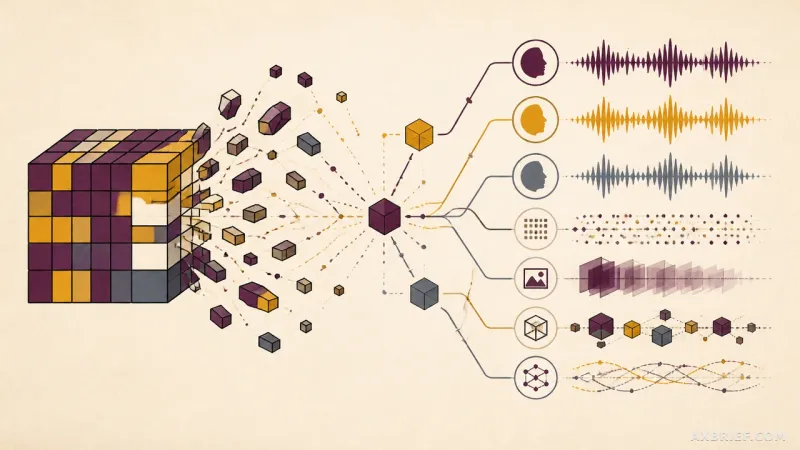
The artificial intelligence landscape shifts this week as major providers roll out large-scale models, architectural updates, and developer tools. Meta introduces Muse Spark Open, a native multimodal model designed for local execution with a 1-million-token context window, while OpenAI prepares to launch GPT-6.1 Astra following competitive pressures. Google structures separate pro tier quotas and developer APIs for Gemini 4 Argon, and local AI environments enable offline document analysis and data extraction using models like Google's Gemma 4 E4B. At the same time, OpenAI expands voice support and reliability with GPT Live 1.1, benchmarks evaluate local models against Qwen 3.8 27B, and Tesla applies artificial intelligence to real-time autonomous flight and landing maneuvers. Technical analysts also utilize tools like Ghidra for software analysis, while investors use AI models to map multiple potential market paths.
01Meta Muse Spark Open Launch Introduces Native Multimodal Model for Local Execution
Meta has released Muse Spark Open, a massive native multimodal model—one capable of processing multiple types of data—that brings advanced capabilities to local hardware. This shift allows users with powerful machines to run a model designed for complex software development and long-term thinking without relying on a cloud provider. With 816 billion total parameters and 42 billion active ones, the model is specifically optimized for programming and powering AI agents. Its most significant technical advantage is a 1-million-token context window, which allows the AI to maintain a vast amount of information in its immediate memory during a single session.
The model's practical utility is evident in its coding abilities. In a comparative test to build a playable pixel game—specifically a Vampire Survivors-style game using HTML canvas without external libraries—Muse Spark Open outperformed competitors such as Inkling, HY4 preview, and Step 5 Preview. It produced a functional version featuring a level system, enemies, and damage meters in just 20 minutes without crashing. This demonstrates a level of autonomy and precision in software generation that is particularly useful for developers building complex applications locally.
Meta's release is part of a broader industry trend toward massive, specialized multimodal systems. Microsoft has introduced MAI Base 2, a model with 2.8 trillion total parameters and 80 billion active ones, which was trained on a cluster of 16,000 Nvidia GB200 GPUs in 38 days. Meanwhile, Nvidia's Nemotron 3.5 SuperVL is designed for AI agents that must reason and write code while understanding visual information, reportedly performing programming tasks up to four times faster than other models while maintaining high accuracy in the SWE-bench Pro benchmark. These developments highlight a race to create models that can handle deeper reasoning and more complex visual and textual data, whether through sheer scale or specialized optimization for speed and local execution.
02OpenAI Prepares GPT-6.1 Astra Following Competitive Pressures
OpenAI is preparing to launch GPT-6.1 Astra, a move that follows a strategic pause in the model's development. The company had initially abandoned the project after determining that the model was not as competent as the Opus release from its competitor, Anthropic. This decision underscores the volatile nature of the current AI landscape, where the release of a superior model from a rival can force a company to scrap or delay its own roadmap to avoid launching an inferior product that fails to meet the new industry standard for performance.
The situation has shifted now that training for GPT-6.1 Astra is complete, paving the way for a likely upcoming release. This momentum is further supported by rumors surrounding a potentially newer internal image of the model, which has been revealed and suggests that the launch is imminent. Industry observers expect the model to arrive within the framework of OpenAI's release commitments, utilizing internal windows to manage the deployment of latest technological updates to the public.
For the broader AI community, the release of GPT-6.1 Astra serves as a direct response to the competitive pressures exerted by Anthropic. The fact that OpenAI felt the need to pause development until the model could be improved demonstrates how high the bar for competence has become in the race for artificial intelligence. Users can expect a model that has been refined specifically to address the gaps that previously made it less competitive than Opus. By pushing forward with this roadmap, OpenAI aims to maintain its market position in a cycle of rapid iteration where the competitive lead can change with a single model update.
03Google Gemini 4 Argon Structures Pro Tier Quotas and Developer APIs
Pro subscribers can now more efficiently distribute their AI workloads by using different models for different levels of complexity. Google has implemented a separate weekly usage quota for Gemini 4 Argon, ensuring it does not deplete the limit assigned to Gemini 3.8 Flash. Within the working environment, this allows users to route demanding reasoning tasks to Gemini 4 Argon while relying on the faster Flash model for everyday workflows, preventing high-intensity projects from blocking routine productivity.
There is a significant gap between the capabilities of the consumer chat application and the developer tools. For instance, the highly publicized 1 million token output capability—the amount of text the AI can generate in one go—is restricted entirely to the developer API. To access this, users must specifically enable a long output mode. Even with this setting, the performance is not universal; some API users have reported receiving shorter responses than promised or experiencing errors where files vanish during the generation process.
For specialized professional applications, such as the creation of AI-driven textbooks, Gemini 4 Argon is often used as a supplement rather than a standalone solution. Developers in this field emphasize that a specific toolset is necessary to manage the complexity of educational content, identifying Claude Code and Codex as the minimum essential tools required to successfully execute the textbook creation process.
The choice between models often comes down to a trade-off between speed and visual fidelity. When generating code for 3D and motion graphics, Gemini 4 Argon is notably faster and more cost-effective than Claude Opus, often finishing tasks in a fraction of the time. However, this speed does not translate to superior quality. Comparative evaluations show that Claude Opus maintains a higher level of polish, while Gemini 4 Argon's results can include unrealistic textures and floating objects.
04Local AI Environments Enable Offline Document Analysis and Data Extraction
Users can now analyze sensitive documents and extract specific data without needing an internet connection or uploading files to a remote server. Traditionally, AI tools rely on servers in a data center to process questions and send answers back, but local AI environments shift this workload directly onto the user's hardware. This transition ensures that data remains private and allows professional work to continue uninterrupted even when Wi-Fi is unavailable, removing the risks and dependencies associated with cloud-based processing.
This capability is exemplified by premium devices designed for demanding AI and creative tasks. Using specialized studio software combined with Google's Gemma 4 E4B model, hardware can perform complex document analysis entirely offline. For example, a user can take a PDF launch plan and have the AI summarize the content and extract key action items into a table without any external connectivity. Because the model runs locally, the user avoids the need to upload proprietary documents to the web, maintaining a secure and standalone workflow.
Beyond basic summarization, local AI can handle detailed data parsing and identify critical information gaps. In a practical test, a local model was able to calculate that selling 200 boxes at a set price would generate specific revenue. More importantly, the AI demonstrated the ability to recognize missing data, correctly noting that net profit could not be determined because the document lacked specifications for labor and other operating costs. By calling out these omissions, the local environment provides a level of analytical rigor that prevents errors based on incomplete information. This combination of data extraction and critical analysis, performed without an internet connection, allows users to maintain productivity and data integrity regardless of their connectivity status.
05OpenAI GPT Live 1.1 Expands Voice Support and Reliability
Users interacting with voice features will find the experience smoother and more inclusive with the release of updated live systems. The most immediate change is the expansion of language support, which now includes French, German, Hindi, Mexican Spanish, Korean, and Japanese. Beyond adding new languages, the update addresses a specific point of friction for users: verification notifications. Previously, these notifications often signaled a system hang during voice interactions or programming tasks, effectively pausing the user's workflow. By eliminating this message, developers have removed a primary cause of session freezes, allowing for a more fluid and uninterrupted conversation.
System stability has also seen a significant upgrade to prevent the AI from becoming unresponsive during peak usage. Providers have increased available processing power and implemented technical changes to minimize errors that occur when the selected model becomes overloaded. For the end user, this means that instead of the session simply freezing or hanging when the system is stressed, the session will now recover automatically. This shift from a hard stop to an automatic recovery mechanism ensures that users do not lose their place or have to manually restart their interactions when the servers are under heavy load.
While official updates focus on reliability and accessibility, the ecosystem around the tool continues to expand through community contributions. Developers have recently released open-source projects that modify the interface to act as specialized programming environments—essentially a custom AI setup optimized for writing and editing code. This allows users to utilize the capabilities of a professional coding tool while remaining within standard limits. By combining these official stability improvements with community-driven tools, the platform is becoming more resilient and versatile for both casual multilingual users and professional programmers.
06World of AI Benchmarks Local Models Against Qwen 3.8 27B
The gap between massive cloud-based AI and models that run locally on a user's own device is shrinking, bringing high-performance intelligence closer to the individual. Recent evaluations indicate that emerging local open-weights models—AI systems where the underlying mathematical weights are available for anyone to download and run on their own hardware—are now performing nearly as well as some of the industry's most capable standards. This shift means that users may no longer have to choose between the privacy of a local system and the power of a professional-grade model.
In a series of tests conducted via standardized benchmarks, which act as a measurement of a model's reasoning and knowledge, a specific local model was found to be only a few points behind the Qwen 3.8 27B. While the Qwen 3.8 27B maintains a slight lead in these specific evaluations, the proximity of the scores suggests that the efficiency of local architectures is rapidly catching up to larger, more established models.
Crucially, the utility of these models extends beyond raw benchmark scores. The local model in question performs quite well across a variety of other tasks, particularly those related to general work. This versatility is a very good sign for the trajectory of local AI, as it suggests these models are not just optimized for specific academic tests but are genuinely useful for the types of productivity tasks that professional users encounter daily. As these models continue to close the performance gap with leaders like Qwen 3.8 27B, the ability to run sophisticated AI locally becomes a more practical reality for users who need reliable tools for their workflow without relying on a constant internet connection.
07Tesla Applies AI to Real-Time Autonomous Flight and Landing Maneuvers
Tesla is integrating artificial intelligence into the physical movement of its next-generation vehicles to enable complex aerial maneuvers. This shift means the hardware can handle the delicate balance and precision required for flight and landing, moving beyond traditional mechanical controls to a system that can adjust in real time to ensure stability.
In a demonstration of these capabilities, Tesla utilized AI to manage vehicle movement and balance. This was achieved through specialized compressed air systems developed in collaboration with aerospace partners. The AI was specifically employed to control these maneuvers, as the software provided the necessary flexibility to improve the underlying systems and achieve a highly precise landing.
By applying AI to these high-stakes maneuvers, Tesla is demonstrating how software can optimize hardware performance in unpredictable environments. The ability to achieve precise landings through AI-driven adjustments suggests a new approach to vehicle stability and autonomous movement that blends automotive engineering with aerospace technology. This integration of AI into real-time physical control represents a significant step in how companies manage the complex physics of flight and landing.
08Ghidra Serves as a Prominent Free Decompiler for Software Analysis
Understanding how a piece of software works without having access to its original blueprints is a critical part of cybersecurity and software analysis. This process is made possible by tools called decompilers, which act as translators for computer code. A decompiler takes machine code—the complex binary instructions consisting of ones and zeros that a computer processor executes—and converts it first into assembler, a low-level representation of those instructions, and then into a format that is readable for humans. This allows analysts to study the logic of a program even when the original creators have kept the source code secret.
One of the most prominent examples of such a tool is Ghidra. Developed and released into the public domain for free by the US National Security Agency, Ghidra has equipped developers and security researchers with a powerful instrument for reverse engineering. Reverse engineering is the technical process of dismantling a completed program to understand its inner workings, often to find vulnerabilities or understand how a specific feature was implemented.
However, these tools are not a simple solution for perfectly duplicating software. While Ghidra can make machine code human-readable, it cannot perfectly restore the original source code of closed-source software. This technical limitation is often overlooked by those who believe that tools of this nature allow one to simply copy an application. For instance, while some enthusiasts have used reverse engineering techniques to analyze software packages, these results are not the product of a simple duplication process. The translation performed by a decompiler involves approximations; it provides a functional map of what the code is doing, but it cannot recover the exact comments, variable names, or structural nuances that the original programmers wrote. Consequently, while it is an essential tool for analyzing how an application functions, it does not allow for the seamless, one-to-one recovery of a proprietary program's original design.
09Mapping Multiple Potential Market Paths Using AI Models
AI can help investors prepare for unexpected market shifts by simulating a wide range of possible outcomes rather than relying on a single prediction. Instead of simply guessing where an index will move, a model can map out several distinct trajectories, allowing users to identify scenarios that traditional analysis might overlook. This approach transforms market forecasting from a search for one correct answer into a strategic exploration of probabilities.
In a practical application involving market indices, AI models have been used to analyze potential reactions to economic data releases, such as Consumer Price Index reports. Rather than providing a single forecast, the model can generate multiple different paths the market could take, assigning a likelihood to each. This wide thinking allows for the exploration of various possibilities, including those not widely discussed in the news. For instance, models have successfully predicted market closing drops corresponding to specific core inflation outcomes, demonstrating an ability to approximate actual market movements.
The value of this method lies in its ability to create actionable strategies based on these diverse scenarios. If a user can calculate that a specific inflation number will likely trigger a market drop, they could potentially place specific trading orders to hedge their risk or profit from the decline. By mapping these multiple paths, investors can move beyond the consensus and prepare for a broader spectrum of market behaviors.