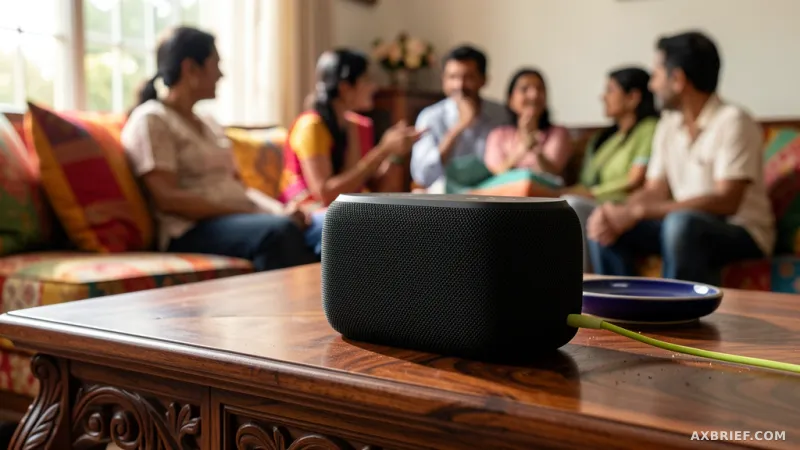
For most users in non-English speaking markets, interacting with a global AI assistant often feels like a game of linguistic telephone. You speak your native tongue, the AI translates it into a rigid internal logic, and the response returns as a grammatically correct but culturally hollow echo. This friction is exactly what Amazon is attempting to erase in one of the world's most complex linguistic landscapes. This week, the focus has shifted to India, where the company is quietly recruiting beta testers for a Hindi-localized version of Alexa+, its generative AI-powered conversational assistant.
The Global Rollout and the Indian Beta
Alexa+ represents a fundamental shift from the command-and-control nature of traditional voice assistants to a generative model capable of fluid, context-aware dialogue. First announced in 2025, the rollout of the service has been a measured progression. The United States saw the first full deployment in February of this year, after which Amazon aggressively expanded the service to the United Kingdom, Canada, Brazil, Mexico, Italy, and Germany. Each of these launches focused on integrating local context to ensure the AI didn't just speak the language, but understood the regional nuances of the users.
India is the next critical frontier in this expansion. Amazon has recently opened applications for a beta program specifically targeting Hindi speakers. To qualify for the test, potential users were required to complete a detailed survey in Hindi by June 22. According to emails verified by TechCrunch, the completion of this Hindi-language survey is a prerequisite for selection. Those chosen will receive individual notifications once the Hindi testing environment is live, allowing Amazon to use real-world interaction data to prioritize feature updates and optimize the model's performance before a general release.
Access to these advanced capabilities is tied directly to Amazon's broader ecosystem strategy. The company is implementing a tiered pricing model for Alexa+. For those already embedded in the Amazon Prime ecosystem, the generative AI features of Alexa+ are provided at no additional cost. However, users who are not Prime members must pay a monthly subscription fee to access the updated assistant. By gating the most advanced AI tools behind a membership wall, Amazon is effectively using Alexa+ as a lever to increase Prime retention and attract new paid subscribers.
The Strategic Pivot to Code-Mixing
While the sheer scale of the market is staggering—with approximately 600 million Hindi speakers—the real technical challenge is not the language itself, but how it is actually spoken. In urban India, the dominant mode of communication is not pure Hindi or pure English, but a hybrid known as code-mixing. This linguistic habit involves weaving multiple languages into a single sentence, often switching mid-thought to find the most precise word. For a standard AI, code-mixing is a nightmare of syntax and semantics; for Amazon, mastering it is the key to market dominance.
This move is the culmination of a long-term localization roadmap. Amazon did not simply drop a generative model into India; it built a foundation over nearly a decade. The company first entered the Indian market in 2017 with an English-only version of Alexa. By 2019, it had introduced basic Hindi compatibility. This sequential approach—starting with English, moving to basic native support, and finally deploying generative AI—allowed Amazon to lower the barrier to entry before introducing high-complexity tools.
In emerging markets, the interface of the future is not the keyboard, but the voice. While the West has leaned heavily into text-based LLM interfaces, the path to AI adoption in India is likely to be voice-first. The ability of a voice assistant to handle the fluid, messy reality of code-mixed speech directly correlates to its market share. By targeting the 600 million Hindi users with a model that understands the nuance of hybrid speech, Amazon is not just translating a product; it is building a localized gateway to its entire services ecosystem.
This strategy transforms the voice assistant from a novelty tool into a critical utility. When an AI can seamlessly navigate the transition between Hindi and English, it ceases to be a foreign tool and becomes a natural extension of the user's identity. The data gathered from this beta will likely dictate how Amazon prices its AI services in the Global South and how it optimizes its models for languages that do not follow the rigid structures of Western grammar.
Success in the Indian market will ultimately be measured by the conversion rate from free beta testers to paying subscribers.