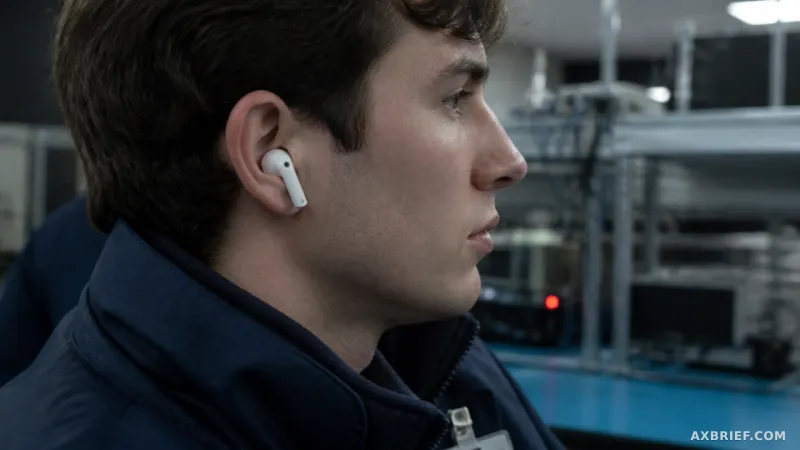
The modern smartphone interaction is defined by a repetitive, almost subconscious ritual: the reach, the unlock, and the stare. Even as generative AI transforms what we can do with our devices, the physical bottleneck remains the screen. We are trapped in a cycle of pulling a slab of glass from our pockets to ask a question about something we are currently looking at in the physical world. This friction is the primary target of Apple's latest hardware pivot, as the company seeks to move AI from a destination we visit on a screen to an ambient layer that exists in our peripheral vision.
The Leak in macOS 26.7 RC
Concrete evidence of this shift has emerged from the macOS 26.7 Release Candidate (RC), where code and internal video assets reveal a new iteration of AirPods equipped with integrated cameras. The leaked footage depicts a user holding up a book while engaging in a natural conversation with Siri. The accompanying audio explicitly mentions Visual Intelligence, describing a world where the user's environment is essentially saveable. In this workflow, a user can spot an object of interest and simply ask Siri to save it for later, bypassing the need to take a photo or manually bookmark a link.
Technical clues hidden within the system code provide a glimpse into the hardware's physical constraints. A specific error message, `Hair Detected`, suggests that the cameras are positioned in a way that makes them susceptible to obstruction by the user's hair. When the sensor's field of view is blocked, the system triggers a warning prompting the user to adjust the fit of the AirPods to ensure the device can accurately capture environmental data. This confirms that the cameras are outward-facing and designed for real-time, continuous visual data collection.
However, these cameras are not intended to replace the iPhone's lens. According to Mark Gurman of Bloomberg, the sensors embedded in the earbuds are not designed for high-fidelity photography or cinematography. Instead, they serve as the eyes for the Siri digital assistant. The hardware is optimized for low-resolution visual capture, providing just enough data for the AI to recognize objects, read text, or understand spatial context without the overhead of high-resolution image processing.
The Low-Resolution Privacy Gambit
The decision to utilize low-resolution sensors is a calculated strategic move rather than a technical limitation. For years, the wearable AI market has struggled with the creepiness factor. Meta's Ray-Ban glasses and Google's various AI glass prototypes have faced significant social pushback due to the fear of surreptitious recording. By intentionally limiting the resolution, Apple is attempting to decouple visual intelligence from the act of filming. If the device cannot produce a clear, recognizable photograph of a stranger, the social barrier to wearing it in public drops significantly.
This approach aligns with Apple's broader screen-free strategy. With the upcoming release of iOS 27 and the revamped Siri AI in September, the goal is to minimize the time users spend staring at their iPhones. When paired with camera-enabled AirPods, the interface becomes invisible. A user could look at a set of ingredients on a kitchen counter and ask for a recipe, or navigate a foreign city by receiving audio directions based on the landmarks the AirPods are seeing in real-time. The interaction shifts from a manual command-and-response loop to a fluid, context-aware experience.
To address the remaining privacy concerns, Apple is integrating a physical LED indicator that illuminates whenever visual data is transmitted to the cloud. While this provides a layer of transparency, it introduces a new design challenge. Given the diminutive size of the AirPods, the visibility of such an LED is questionable. The tension here lies between Apple's policy of transparency and the actual psychological comfort of the people surrounding the user, who may not notice a tiny light on a white earbud.
For AI practitioners and product designers, the real story is the migration of the interface from the screen to the body. We are witnessing a transition where the core value of an AI service is no longer the quality of the prompt input, but the quality of the shared context. The ability of a model to derive meaning from low-resolution, noisy visual data in real-time will be the primary determinant of whether ambient wearables achieve mass adoption.
In markets with high privacy sensitivity, the technical proof that a device is not recording high-definition video will be a more important feature than the AI capabilities themselves. The success of this product depends on whether Apple can convince the public that these cameras are tools for assistance rather than tools for surveillance. The low-resolution constraint and the LED notification are not just specs; they are the primary UX mechanisms designed to break the negative frame of the surveillance state and usher in the era of ambient intelligence.