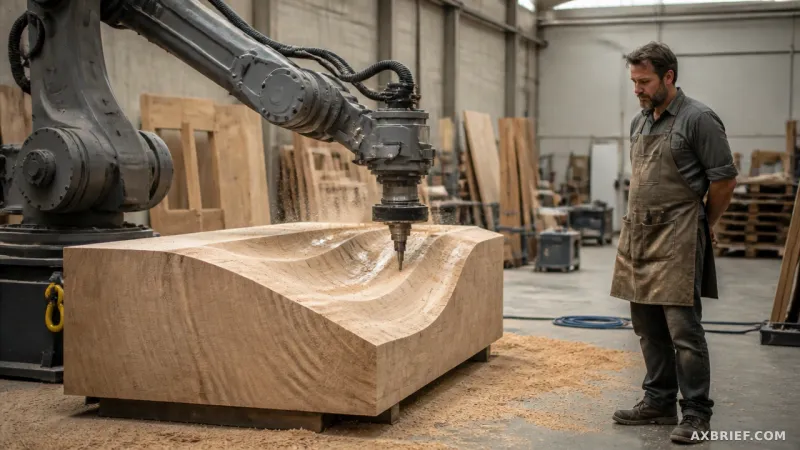
The tech industry is currently witnessing a pivot from the era of the chatbot to the era of the agent. For the past few years, the primary excitement around artificial intelligence has been confined to the browser window, where large language models synthesize text and generate images. However, a new tension has emerged among developers and venture capitalists who realize that the most profound impact of AI will not happen on a screen, but in the physical world. This shift toward embodied intelligence is transforming how we view everything from national security to biological conservation, moving the conversation from prompt engineering to hardware integration.
The Expansion of the AI Ecosystem at Moscone West
From October 13 to 15, the Moscone West center in San Francisco will host Disrupt 2026, bringing together more than 10,000 startup founders, technology executives, and venture capital leaders. The event serves as a critical nexus for the Startup Battlefield and various exhibition halls where the industry's primary decision-makers converge to identify the next wave of scalable technology. The scale of the AI ecosystem has grown so rapidly that the event organizers have determined a single AI stage is no longer sufficient to cover the breadth of the field. Consequently, Disrupt 2026 will maintain its traditional AI Stage while introducing a brand new Real World AI Stage.
This physical expansion of the event's programming reflects a broader structural shift in the industry. The new stage is designed specifically to address how AI is applied to the tangible world and the concrete consequences of those applications. By separating general AI from Real World AI, the conference acknowledges that the challenges of deploying a model in a cloud environment are fundamentally different from the challenges of deploying a model into a robotic limb or a biological organism. The focus here is not on the theoretical capabilities of a model, but on the operational reality of its execution in unpredictable environments.
The Friction Between Digital Intelligence and Physical Agency
When AI moves from a server to a physical asset, the cost of failure shifts from a hallucinated sentence to a catastrophic accident. In sectors like autonomous defense and aerospace, a system error can lead to a crashed aircraft or a failed mission with irreversible consequences. Companies such as Shield AI are currently leading the charge in establishing rigorous safety and verification standards. Their focus is on creating a culture of safety that treats AI testing not as a software debugging process, but as a mission-critical engineering requirement. The goal is to navigate the strict regulatory hurdles of defense and aviation by ensuring that autonomous systems operate within predictable, safe parameters before they ever reach the field.
This requirement for reliability extends to the architecture of the AI itself. In environments where internet connectivity is intermittent or non-existent—such as deep space, active war zones, or remote industrial sites—reliance on the cloud is a liability. This has necessitated the rise of Edge AI, where data is processed locally on the device. Industry players including FieldAI, Medra, and Eclipse Ventures are focusing on the practical lessons of implementing AI in these constrained environments. The core of their work involves managing the trade-off between performance and stability. In the high-stakes world of Edge AI, engineers must often sacrifice a degree of model complexity to ensure low latency and absolute reliability, as a delay of a few milliseconds in a physical system can be the difference between success and total failure.
Beyond robotics and defense, the Real World AI Stage explores the most extreme boundary of physical implementation: the restoration of extinct species. Colossal Biosciences is utilizing the intersection of AI and modern biology to engineer the return of lost species to the planet. This represents a shift where AI is used to design nature itself, potentially offering a new breakthrough in ecosystem preservation. However, this ambition brings its own set of tensions, sparking debates over whether the pursuit of de-extinction distracts from the urgent need to protect currently endangered species. The work of Colossal Biosciences demonstrates that the reach of physical AI now extends into the very genetic code of the earth.
For any practitioner attempting to deploy AI into the physical world, the path to success is now defined by three primary metrics. First is the establishment of safety verification standards to prevent physical harm. Second is the optimization of latency within Edge environments to ensure real-time responsiveness. Third is the management of supply chain constraints during the mass production of the hardware required to house these models. These three pillars form the foundation of the transition from digital intelligence to physical autonomy.
The convergence of digital intelligence and physical hardware is turning the world into a programmable environment.