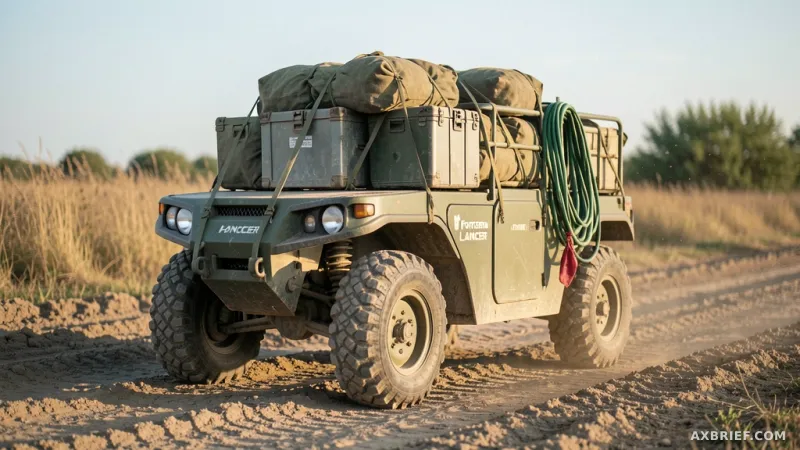
The modern battlefield has become a place of total transparency. With the ubiquity of low-cost reconnaissance drones, any movement of ground troops or supply vehicles is instantly flagged, turning routine logistics into high-risk gambles. For soldiers on the front lines, the simple act of moving ammunition or evacuating a wounded comrade has become a deadly exposure exercise. This shift in warfare has created an urgent demand for unmanned ground vehicles (UGVs) that can operate in the gap between a soldier's boots and a heavy armored transport.
The Scale of the Lancer Deployment
While many defense startups promise autonomy in controlled testing environments, Forterra has moved its hardware into the most contested airspace on earth. Over the past nine months, the company has deployed more than 100 autonomous all-terrain vehicles (ATVs) into the conflict zones of Ukraine. This represents the largest deployment of UGVs by a U.S. defense technology firm to date, transforming the Ukrainian theater into a massive, real-world laboratory for autonomous logistics.
The primary workhorse of this operation is the Lancer, a vehicle built upon the rugged Polaris ATV chassis. Unlike many of the smaller, battery-powered UGVs developed locally in Ukraine, the Lancer utilizes a gasoline-powered engine. This choice of powertrain is not merely a preference but a strategic necessity, allowing the Lancer to carry a maximum payload of 750kg. In contrast, indigenous Ukrainian UGVs typically rely on batteries and are limited to a payload of roughly 250kg. By tripling the carrying capacity, Forterra has fundamentally altered the volume of supplies that can be moved without risking human drivers.
The operational data from this deployment is staggering. Since arriving in October of last year, Forterra's fleet has completed over 1,100 missions and covered more than 2,500 miles of treacherous terrain. In total, these vehicles have transported 777,440 pounds of critical materiel and successfully executed 52 casualty evacuation missions. By integrating a custom-built sensor suite and a specialized computing stack, Forterra has maximized the hardware's potential, proving that high-capacity unmanned logistics can function under the pressure of active combat.
The Transition from Remote Control to Generative AI
Despite the "autonomous" label, there is a critical distinction between the Lancer's current operational mode and true autonomy. At present, these vehicles are primarily operated via remote control. This is a calculated compromise. The chaotic nature of a war zone—where an AI must distinguish between a fallen log, a hidden mine, and a camouflaged enemy—remains too complex for current autonomous systems to handle without human oversight. Furthermore, the high cost of these sophisticated platforms makes the risk of a software glitch leading to a total loss unacceptable.
However, the industry is currently hitting a pivot point where hardware specifications are becoming secondary to the AI models driving them. We are seeing a shift from simple robotic pathfinding to the development of foundation models for the physical world. This trend is evidenced by the broader market; for instance, Scout AI recently raised 100 million dollars specifically to train foundation models and develop autonomous platforms for the U.S. military. Other players like Field AI and Overland AI are pursuing similar paths, recognizing that the real competition is no longer about who builds the best chassis, but who builds the most adaptable brain.
Forterra is responding to this shift by blending classical robotics with generative AI. Traditional algorithms are excellent for precision and stability, but they struggle with generalization—the ability to handle a situation the programmer didn't explicitly anticipate. Generative AI offers a solution by allowing the vehicle to perceive and react to its environment in a more generalized manner. This hybrid approach is essential for solving the most dangerous problems of ground warfare, such as navigating active minefields or coordinating with complex weapon systems. By adjusting control variables in real-time based on AI-driven situational awareness, Forterra aims to move the Lancer from a remote-controlled tool to a truly autonomous agent.
The ultimate advantage in this race is not the code itself, but the data used to train it. The 1,100 missions and 2,500 miles of combat data Forterra has collected provide a density of information that cannot be replicated in a simulation or a training range. This real-world feedback loop is what will eventually allow generative AI to bridge the gap between a remote-operated ATV and a fully autonomous logistics network.
The density of actual combat data is now the primary determinant of whether an autonomous model can survive the reality of the front line.