For years, the robotics industry has been trapped in a cycle of tedious, manual labor. To teach a robot to navigate a warehouse or handle a specific tool, engineers had to collect thousands of hours of real-world data for that specific machine in that specific environment. If the lighting changed or the floor layout shifted, the model often collapsed, forcing the team back to square one. This brittleness has kept most advanced robotics confined to highly controlled factory floors, far from the chaotic unpredictability of human spaces.
The $320 Million Blueprint for Embodied AI
General Intuition is attempting to break this cycle by treating robotics not as a hardware problem, but as a data scaling problem. The company recently secured $320 million in funding, a move that values the startup at $2.3 billion. Rather than focusing on building a better robot arm or a faster actuator, General Intuition is building a robotics foundation model designed to generalize across different forms of embodiment and environments.
The core of their strategy lies in an unconventional training set: millions of hours of video game data. While previous attempts to use synthetic data focused on visual simulation, General Intuition is capturing action data. This means the model does not just observe the pixels of a game; it learns the precise correlation between a human player's controller inputs and the resulting movement within the virtual world. By mapping these actions to outcomes, the AI develops a fundamental understanding of spatio-temporal reasoning—essentially learning the physics of cause and effect before it ever touches a physical motor.
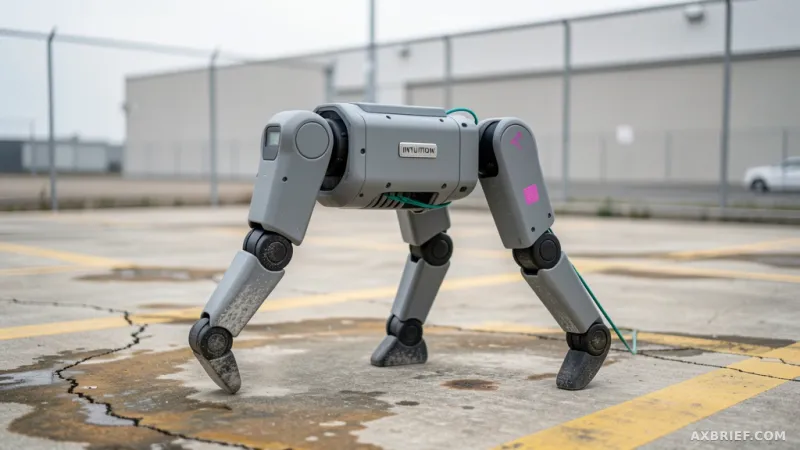
The efficacy of this approach was demonstrated in a recent validation test involving a four-legged robot. After being pre-trained on the massive video game dataset, the model required only 8 minutes of real-world data to be fine-tuned for physical movement. Once deployed, the robot exhibited zero-shot capabilities in a dynamic office environment. Using nothing more than a single front-facing camera—without the aid of expensive LiDAR or depth sensors—the robot successfully navigated around moving people and unpredictable obstacles in real-time.
The Shift from Specialized Tools to Foundation Models
This breakthrough signals a pivotal shift in the trajectory of Embodied AI, mirroring the evolution that recently transformed natural language processing. In the early days of NLP, developers built specialized models for every single task. If you wanted a sentiment analysis tool, you trained a sentiment model; if you wanted a translator, you built a translation model. This era ended with the arrival of foundation models like GPT-3, which proved that a sufficiently large, general-purpose model could be adapted to almost any linguistic task via simple prompting or minimal fine-tuning.
CEO Pim de Witte argues that robotics is now entering its own GPT moment. The industry is currently dominated by companies building specialized models tailored to specific robot shapes or narrow environments. However, General Intuition's results suggest that these bespoke efforts are becoming obsolete. If a model already understands the basic laws of spatial navigation and interaction through massive-scale synthetic action data, the specific hardware it inhabits becomes a secondary detail. The goal is no longer to build a model for a specific robot, but to build a model that can be dropped into any robot.
This transition fundamentally changes the competitive landscape of the industry. For a long time, the primary moat for robotics companies was the size of their proprietary real-world datasets. The winner was whoever could afford to run the most robots in the most rooms for the longest time. General Intuition is flipping this script. By prioritizing transferability over raw data collection, they are positioning themselves not as a robot manufacturer, but as the essential software layer—the physical AI foundation—that other companies will license to make their hardware viable.
As the cost of data collection drops from millions of hours to a few minutes of fine-tuning, the barrier to entry for autonomous systems plummets. The focus is shifting away from the precision of the hardware and toward the efficiency of the model's optimization. By proving that a single camera and a foundation model can outperform complex sensor suites, General Intuition is redefining the economics of robotics, moving the industry toward a future where intelligence is decoupled from the machine it controls.
The robotics software stack is being rewritten to prioritize general reasoning over task-specific training.