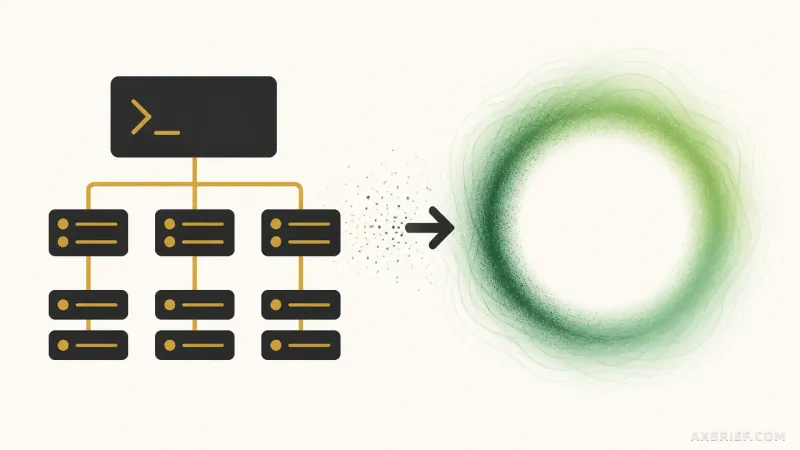
Developers building enterprise knowledge bases have long hit a ceiling with standard Retrieval-Augmented Generation. While a vanilla vector search can easily find a specific sentence in a thousand-page document, it often fails when a query requires connecting dots across multiple disparate sources. This is the multi-hop reasoning problem, where the answer does not exist in a single chunk of text but emerges from the relationship between several. For years, the industry has relied on increasing context windows or complex prompt engineering to bridge this gap, yet the fundamental limitation remains the same: vector similarity is not the same as logical reasoning.
The Benchmark Shift in Multi-Hop Retrieval
Recent data reveals that shifting from vector-based retrieval to graph-guided search fundamentally changes the success rate of complex queries. In benchmarks focusing on multi-hop QA, such as MuSiQue, HotpotQA, and 2WikiMultiHopQA, the introduction of graph-guided search pushed the average Recall@5 from 73.4% in standard RAG to 87.8%. The performance gains are most pronounced in the most difficult datasets. In MuSiQue, the recall jumped by 31 points, while 2Wiki saw an increase of 28 points. This suggests that as the complexity of cross-document retrieval increases, the efficiency of graph-based structures grows proportionally.
These findings are further supported by the GraphRAG-Bench results presented at ICLR 2026, which quantify performance based on the depth of reasoning required. For simple factual retrieval, the two methods are nearly identical, with text chunks scoring 60.9 and graphs scoring 60.1. However, the divergence appears during complex reasoning tasks. In these scenarios, the graph approach scored 53.4, outperforming the 42.9 scored by text chunks by over 10 points. A similar trend appears in contextual summarization, where the graph method led with a score of 64.4 compared to 51.3 for text chunks, a 13.1 point advantage. The data confirms a clear pattern: the deeper the reasoning required, the more critical the graph structure becomes.
The Cost of Intelligence and the Efficiency Trade-off
Despite the performance leap, the transition to GraphRAG introduces a significant economic tension. Microsoft Research has validated the global query processing capabilities of GraphRAG, measuring comprehensiveness between 72% and 83% and diversity win rates between 62% and 82%. Perhaps most impressively, when generating top-level summaries, GraphRAG reduced token usage by up to 97% compared to methods that process source text directly. This efficiency in the query phase is a direct result of a heavy investment in the indexing phase.
Building a GraphRAG index is an expensive operation. Using GPT-4o to construct an index for a medium-sized corpus costs approximately $48, a figure that dwarfs the cost of creating a standard vanilla vector index. The process requires the LLM to read every single chunk of text to extract entities, define relationships, and identify claims, which are then assembled into a weighted knowledge graph. To make this data navigable, the system employs the Leiden algorithm, a community detection method that partitions the graph into hierarchical clusters of related topics. The LLM then pre-writes natural language summaries for each of these communities. This pre-computation is exactly what allows the system to provide global context and high-level summaries with such low token overhead during the actual query.
This cost barrier has led to the development of LazyGraphRAG, which defers the extraction process to the query point. This architectural shift reduces the initial indexing cost to approximately 0.1% of the original GraphRAG expense, though it alters the performance profile. Furthermore, researchers from Michigan State and Meta have noted that for simple, single-hop factual queries—often categorized as natural questions—standard RAG actually maintains a slight edge, with an F1 score of 64.8 compared to 63.0 for GraphRAG. In contrast, for MultiHop-RAG tasks, the graph-guided approach reclaimed the lead with an overall accuracy of 70.3 against 67.0 for vanilla RAG.
There is also a cautionary note regarding how these systems are evaluated. Analysis of the LLM-as-a-judge framework has revealed inherent biases related to the position of the answer, the length of the response, and confirmation bias. This suggests that some of the comprehensiveness metrics for GraphRAG may be slightly overestimated due to the LLM judge's preference for the detailed, structured summaries that GraphRAG produces.
For teams deciding on an architecture, the choice is no longer binary. The optimal strategy is a tiered approach: utilize vector RAG for isolated fact retrieval, deploy GraphRAG for complex synthesis and global summarization, and implement a hybrid router to direct queries to the appropriate engine based on the detected reasoning depth.