Engineers pushing the boundaries of long-context windows have hit a physical wall. Even with high-end hardware like the NVIDIA H200, attempting to process a million tokens often results in the dreaded Out of Memory (OOM) error, forcing developers to choose between truncated data or prohibitively expensive infrastructure. The industry has largely relied on KV cache eviction—essentially throwing away parts of the model's memory after they are generated—to keep systems running. However, this reactive approach does little to solve the fundamental bottleneck of the prefill stage, where the model must first digest the massive input before it can utter a single word.
The Architecture of Latent Context
A collaborative research effort involving NYU, Columbia University, Princeton University, the University of Maryland, Harvard University, and the Lawrence Livermore National Laboratory has introduced a new paradigm called Latent Context Language Models (LCLM). Unlike standard LLMs that treat every input token with equal weight in the KV cache, LCLM utilizes an encoder-decoder structure designed to compress the input context before it ever reaches the decoder. The architecture consists of a 0.6B parameter encoder and a 4B parameter decoder, a configuration the researchers arrived at after discovering that scaling the decoder yielded more significant performance gains than expanding the encoder.
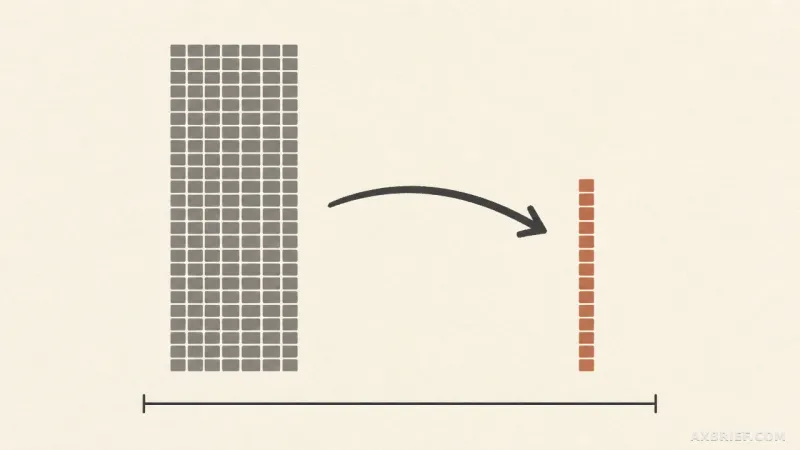
To train this system, the team utilized a massive dataset exceeding 350 billion tokens. The results, measured against the RULER long-context benchmark, demonstrate a sophisticated balance between efficiency and accuracy. At a 4x compression rate, LCLM maintained an accuracy of 91.76%, representing a negligible drop of less than 3 percentage points compared to the uncompressed accuracy of 94.41%. When pushed to 16x compression—which effectively removes 93.75% of the input tokens—the accuracy dipped to 75.06%. While this seems steep, it significantly outperforms every other KV cache compression method tested at the same ratio. Most critically, this 16x compression translates to an output speed 8.8x faster than the KV cache baseline. The model also demonstrated superior performance on the GSM8K mathematical word problem dataset, outscoring all other tested methods regardless of the compression ratio applied.
Moving Beyond KV Cache Eviction
The fundamental shift in LCLM lies in when and how compression occurs. Traditional KV cache optimization is a process of subtraction; the model generates the full cache and then evicts unnecessary items to save space. LCLM transforms this into a process of synthesis. By compressing the input token sequence directly before the decoder's prefill stage, LCLM reduces the computational load and memory footprint of the decoder from the very start. This proactive compression is what enables the dramatic leap in inference speed.
Achieving this without losing critical information required a specialized training recipe. The researchers combined three distinct data streams: continual pre-training data that alternated between compressed and uncompressed segments, supervised fine-tuning (SFT) data focused on reasoning and long-context tasks, and an auxiliary reconstruction task. This third component is the key to the model's stability; it forces the encoder to retain essential fine-grained details that are typically lost in lossy compression. By treating the input as a sequence of latent embeddings rather than raw tokens, the decoder can process a condensed representation of the information without the typical trade-off where reconstruction accuracy kills general task performance.
From an infrastructure perspective, the impact is immediate. A standard KV cache approach attempting a 1-million-token inference on a single H200 GPU typically triggers an OOM crash. LCLM, operating at 16x compression, allows the same context length to fit comfortably within the hardware's memory limits. For developers, implementing this requires replacing the standard LLM with the LCLM framework and inserting the LCLM compressor into the RAG (Retrieval-Augmented Generation) pipeline. This ensures that documents are compressed before they are fed into the model context. However, the researchers warn that teams must rigorously tune their compression settings based on specific retrieval quality metrics before moving to large-scale production.
There remains one significant hurdle: the online compression of reasoning traces. While LCLM excels at compressing static documents retrieved via RAG, it cannot yet compress the active reasoning paths an agent generates in real-time. While a periodic compression approach for these traces is a theoretical possibility, it has not yet been validated.
Resources for the model and implementation are available via Hugging Face, GitHub, and the full research paper on arXiv.
LCLM shifts the long-context challenge from a memory management problem to an architectural one, paving the way for million-token windows on consumer-grade hardware.