For years, the average consumer encountered Micron Technology as a quiet utility, the name printed on the small SD cards or USB drives used to expand the storage of a digital camera or a laptop. It was a company defined by commodities, operating in a cyclical industry where success was measured by the ability to survive the inevitable crashes of oversupply. However, the sudden ascent of generative AI has fundamentally rewritten the identity of the firm, transforming a component manufacturer into a strategic pillar of the global computing infrastructure.
The Financial Pivot to AI Infrastructure
Micron's recent financial performance signals a departure from the traditional volatility of the memory market. In the third quarter, the company reported revenue of $41.45 billion, a staggering fourfold increase compared to the same period last year. While the revenue growth is impressive, the trajectory of its profitability is even more dramatic. Profits surged from a modest $1.88 billion to $28.2 billion, indicating a massive expansion in margins that suggests Micron is no longer selling a generic commodity, but a high-value necessity. This momentum shows no sign of slowing, with fourth-quarter revenue projections set between $49 billion and $51 billion.
This growth is underpinned by a fundamental shift in how Micron does business. Historically, memory makers were vulnerable to price collapses when production exceeded demand. To hedge against this, Micron has pivoted toward Strategic Customer Agreements (SCAs). The company has secured 16 of these long-term supply contracts with a roster of elite clients, including Nvidia and Anthropic, as well as major players across the data center, consumer electronics, and automotive sectors. By locking in purchase volumes and pricing in advance, Micron has effectively insulated itself from the boom-and-bust cycles of the semiconductor industry, turning its supply chain into a predictable revenue engine.
The RAMageddon Bottleneck and the Valuation Shift
The market has responded to this strategic pivot with unprecedented enthusiasm. As of last Friday's close, Micron's market capitalization reached approximately $1.27 trillion, driven by a stock price that climbed 236% in a single month to close at $1,132. For a brief window on Thursday, Micron's valuation actually eclipsed that of Meta ($1.39 trillion) and Tesla ($1.42 trillion), a symbolic moment where a hardware supplier became as valuable as the platforms it enables. This valuation surge is not merely speculative; it is a reaction to a physical bottleneck in the AI revolution.
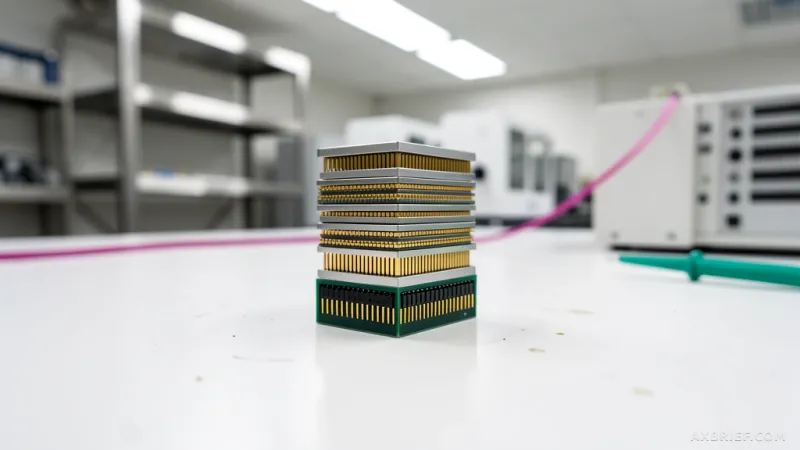
AI servers require memory capacities that dwarf those of standard personal computers. The critical component here is High Bandwidth Memory (HBM), a specialized architecture that allows massive amounts of data to move rapidly between the memory and the processor. In the world of Large Language Models, the width of this data highway determines the speed of inference and the efficiency of training. As the industry realizes that the GPU is only as fast as the memory feeding it, Micron's HBM products have become the most contested real estate in the tech world.
This scarcity has given rise to a phenomenon known as RAMageddon, a severe memory supply shortage that analysts expect to persist until 2027. The tension is driven by hyperscalers—the cloud giants including Microsoft, Amazon AWS, Google, Meta, and Oracle—who are aggressively hoarding memory to build out their proprietary AI clusters. This corporate arms race creates a vacuum in the broader market, forcing other players like Dell and HP to stockpile components just to maintain their own production lines. The ripple effect eventually reaches the end consumer, manifesting as higher price tags for Apple products and Xbox consoles. The cost of a gaming console or a smartphone is now being influenced by the invisible war for AI server memory.
Ultimately, the shift in Micron's value reflects a broader realization in the AI ecosystem: compute power is useless without the memory to support it. The company has moved from the periphery of the hardware stack to the center, where its ability to solve the memory bottleneck dictates the pace of AI deployment globally.
The new gold standard for AI hardware valuation is no longer based on simple demand, but on the ironclad nature of long-term supply guarantees.