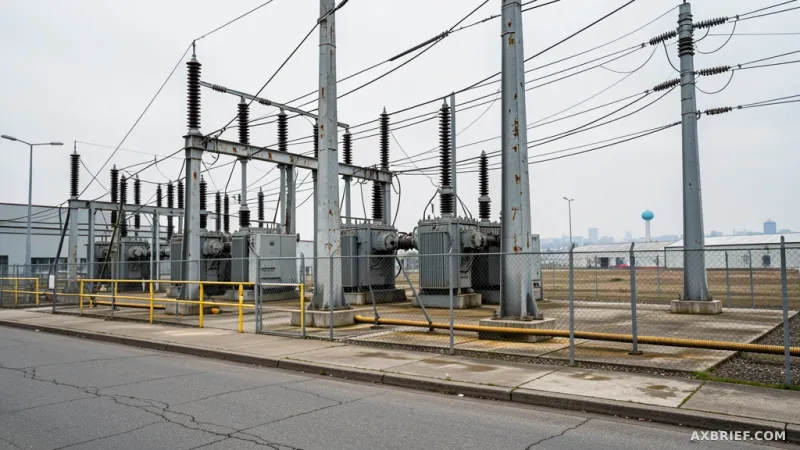
European enterprises are currently trapped in a geopolitical paradox. To remain competitive in the generative AI race, they require massive compute power, yet the infrastructure providing that power is almost exclusively owned by American hyperscalers. This dependency creates a systemic risk where data sovereignty is not a legal guarantee but a contractual hope. For the C-suite in Paris, Berlin, and Amsterdam, the fear is no longer just about data leaks, but about the physical location of the silicon and the jurisdiction of the power grid. This tension has transformed data sovereignty from a compliance checkbox into a physical infrastructure war.
The Billion Dollar Blueprint for Compute
Mistral AI is responding to this tension by evolving from a pure-play model laboratory into a foundational infrastructure provider. The scale of their ambition is quantified by a target of 1 gigawatt (GW) of computing capacity by 2030. According to analysis from Epoch AI, achieving a 1GW AI data center footprint requires an estimated initial capital expenditure of 38 billion dollars. This staggering figure explains why Mistral AI is not attempting to fund this growth through traditional venture capital alone, but through a strategic alliance of European industrial powerhouses.
To bridge the gap between their current capacity and the 2030 goal, Mistral AI has established a phased roadmap. The immediate objective is to secure 200 megawatts (MW) of capacity by the end of 2027. Currently, the company's operational footprint is modest, totaling less than 200MW across three primary hubs: 44MW near Paris, 23MW in Sweden, and 10MW in Les Ulis, France. While these sites provide a foothold, they are insufficient for the training and inference demands of a continent-scale AI economy.
To finance the leap to 1GW, Mistral AI introduced the European Compute Unit (ECU). This is not merely a pricing metric but a financial instrument. Mistral AI has formed an Anchor Group consisting of European industrial giants including ASML, Amadeus, Capgemini, and CMA CGM. These companies are entering into long-term commitments, often spanning five years or more, to purchase ECUs. These contracts are designed to be non-cancelable, providing Mistral AI with the guaranteed revenue streams necessary to secure the massive financing required for data center construction. These ECUs are then deployed by the member companies for critical workloads, including model training, inference, and specialized optimization.
The Pivot to an AI Operating System
While the hardware expansion is impressive, the strategic shift lies in how Mistral AI intends to use this silicon. The company is moving beyond the development of its own weights to become a hosting environment for the broader open-model ecosystem. The most telling evidence of this pivot is the introduction of third-party open model hosting on the Mistral AI platform. The first partner in this initiative is Z.ai, the Chinese AI research institute formerly known as Zhipu, which will bring its GLM-5.2 model to the platform.
By hosting GLM-5.2, Mistral AI is signaling that it no longer views itself solely as a competitor to other model labs, but as the essential layer of infrastructure where those models run. This is a fundamental shift in positioning. If Mistral AI can control the environment where multiple world-class models are deployed, it ceases to be just a vendor and becomes the sovereign cloud for AI in Europe. This allows European firms to run a variety of state-of-the-art models while ensuring the data never leaves the jurisdiction of the Mistral-managed infrastructure.
To make this operational, Mistral AI has introduced Regional Inference Endpoints. This feature allows customers to explicitly choose whether their AI workloads execute in Europe or the United States, giving them direct control over the physical path of their data. For mission-critical deployments where downtime is not an option, the company has launched a Priority Tier. This tier moves beyond best-effort service by including a formal uptime guarantee, effectively bringing the reliability of enterprise cloud SLAs to the agile world of LLM inference.
However, the reality of modern AI is that models rarely act in isolation. The use of tool calls, such as web searches or external API integrations, creates potential leaks in the sovereignty shield. Mistral AI addresses this through feature gating. When a user enables in-region inference, they must navigate a specific checklist to determine if data can be transmitted to external sub-processors during a tool call. This granular control ensures that the physical location of the compute is not undermined by the logical flow of the application.
This transition from a model-centric company to an infrastructure-centric one suggests that the ultimate winner of the AI race may not be the one with the smartest model, but the one who owns the power and the land where the models live.