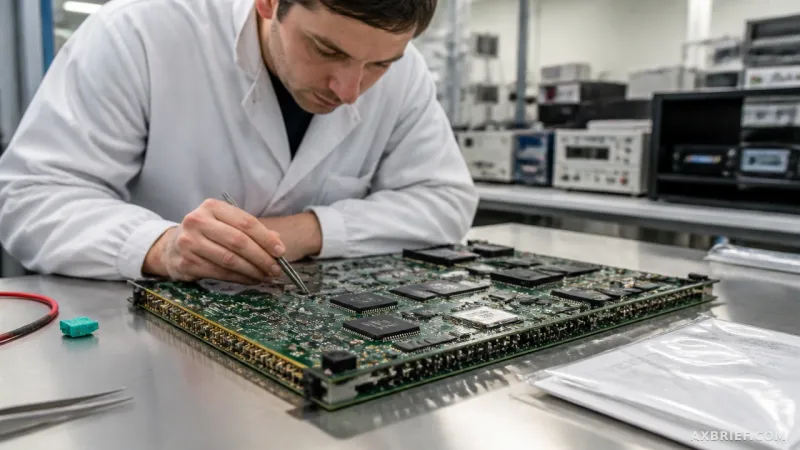
The era of the singular AI gold rush, where the only question was how many H100s a company could secure, is quietly evolving into a more calculated era of diversification. For the past two years, the industry operated under a perceived monopoly of necessity, treating Nvidia hardware as the only viable foundation for generative AI. However, a subtle but significant shift is occurring in the procurement offices of the world's leading enterprises. The conversation is no longer just about acquiring the fastest chip available, but about finding the right chip for a specific workload, signaling a move toward an infrastructure strategy defined by optionality rather than dependency.
The Diversification of the AI Hardware Stack
Recent data from the VB Pulse survey, which polled 170 AI infrastructure respondents in July, reveals a surprising pivot in hardware priorities. According to the findings, 39.4% of respondents indicated a high likelihood of evaluating non-Nvidia accelerators within the next 12 months. This figure notably eclipses the 25.3% of respondents who plan to evaluate Nvidia's next-generation GPUs, including the highly anticipated Blackwell GB300. This 14 percentage point gap suggests that the market is beginning to look beyond the industry standard to mitigate risk and optimize performance.
The alternatives gaining traction are not monolithic. Enterprises are actively exploring a spectrum of options including AWS Trainium, Google TPU, AMD Instinct, and Intel Gaudi, alongside custom-designed ASICs tailored to specific corporate needs. This trend is most pronounced among those with the actual power to sign the checks. Among C-level executives, the intent to evaluate non-Nvidia accelerators jumped from 42.9% in June to 57.1% in July. Final decision-makers followed a similar trajectory, rising from 35.4% to 50%. The shift is even more aggressive within the small-to-medium enterprise sector, specifically companies with 101 to 250 employees, where the intent to evaluate alternative silicon surged from 33.3% to 57.7%.
From General Purpose Power to Workload Precision
This movement toward non-Nvidia hardware is not a wholesale abandonment of the current ecosystem, but rather a sophisticated refinement of how AI infrastructure is deployed. While the desire to evaluate new chips is rising, the actual production adoption of major platforms remains strong. Microsoft Azure saw its production adoption rate climb from 29% in June to 47.1% in July, while Google Gemini grew from 41.1% to 47.6%. OpenAI and Anthropic also maintain significant footprints, with adoption rates of 49.4% and 24.7% respectively. The tension here is not between platforms, but between the desire for stability and the need for efficiency.
The metrics used to judge success are also transforming. The industry is moving away from broad financial metrics like Total Cost of Ownership (TCO), which saw its priority drop from 34.6% to 21.8%. In its place, enterprises are adopting granular, operational KPIs. The importance of uptime and reliability rose from 42.1% to 51.2%, and the focus on throughput increased from 21.5% to 24.7%. Most tellingly, the priority placed on cost per million tokens more than doubled, jumping from 7.5% to 15.9%. This indicates that the market has moved past the experimental phase and is now treating AI as a production utility where unit economics matter more than the total bill.
This shift explains why the urgency to completely switch platforms is actually decreasing. The percentage of companies planning a platform change within three months dropped from 38.3% in June to 28.8% in July. Instead of a risky migration, 40% of respondents now prioritize integration with existing cloud and data stacks. This is the strategy of optionality: maintaining a stable core while selectively adding specialized accelerators to handle specific tasks. It is a move from a monolithic architecture to a modular one.
Beyond the silicon, this drive for control is manifesting in the software layer. A staggering 79.2% of respondents now prefer using independent tools or maintaining their own control over the AI harness—the operational layer that connects models to data, tools, and security—rather than being locked into a single provider's native stack. This is a significant increase from 65.3% in June. The primary driver for this independence is the battle against hallucinations. Approximately 68.3% of respondents reported instances where agents provided confidently wrong answers due to poor context. As a result, the use of mixed retrieval architectures to solve these context issues grew from 12.9% to 28.7%.
As enterprises realize that model performance is only one part of the equation, the focus is shifting toward the architecture surrounding the model. This has led to a rise in interest in Neoclouds—specialized providers that offer flexible access to diverse GPU and accelerator pools—with interest growing from 33% to 38%. The modern AI stack is becoming a hybrid environment where the goal is not to find the one perfect chip, but to build a flexible orchestration layer that can swap hardware and models based on the specific requirements of the workload.
The industry is transitioning from a period of blind scaling to a period of architectural precision.