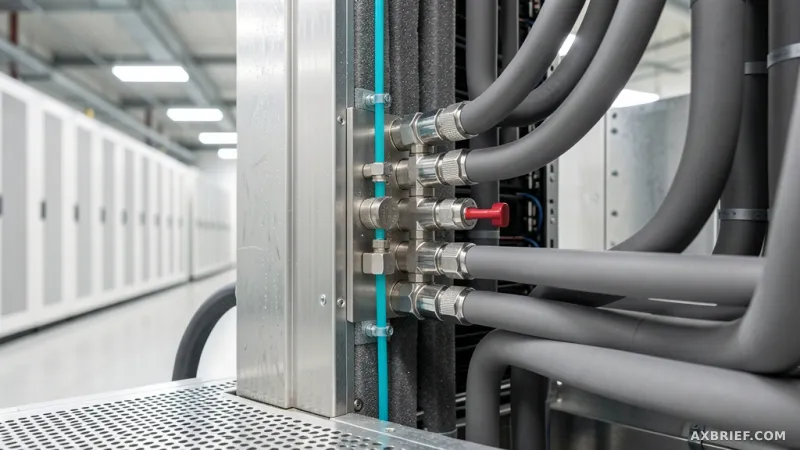
The modern data center is a paradox of invisible consumption. While users interact with a clean, digital interface to prompt an LLM, the physical reality is a sprawling complex of servers generating immense heat that must be stripped away in real-time. For years, the industry has relied on evaporative cooling, a process that essentially trades millions of gallons of water for thermal stability. As AI clusters scale toward unprecedented densities, the thirst of these facilities has become a primary friction point between tech giants and the municipalities that host them.
The Mechanics of the Closed Loop
Nvidia is attempting to break this dependency with a new cooling architecture designed to bring internal water consumption down to nearly zero. The core of this innovation is a closed-loop system, a fundamental departure from the traditional open-loop models that constantly replenish and discharge water. In this new configuration, the cooling medium is filled once at the start of the facility's lifecycle and recirculated indefinitely, eliminating the need for a continuous external water supply.
Technically, the system operates by pumping cooling water at 45°C directly into the server racks. This water flows through the hardware, absorbing the intense heat generated by the GPUs and chipsets. By the time the fluid exits the server, its temperature has risen to 55°C. This specific thermal window is critical because a 55°C output allows the heat to be rejected into the ambient external air using passive radiators or dry coolers, removing the need for energy-intensive fans or water-evaporating cooling towers in most climates. Nvidia claims that under favorable environmental conditions, this approach can reduce on-site water usage by up to 100%.
The Hidden Water Footprint
While the elimination of on-site water use is a significant engineering milestone, it reveals a deeper, more complex tension in the AI supply chain. The internal cooling loop only addresses a fraction of the total water footprint—the total volume of water consumed from raw material extraction to final operation. When the scope expands to include chip manufacturing and the generation of the electricity required to run these servers, the internal savings are dwarfed by external costs. In many cases, the external water footprint is two to three times larger than the water used inside the data center walls.
This discrepancy becomes acute when analyzing the energy mix. According to the International Energy Agency (IEA), more than 40% of the new power capacity needed to meet data center demand by 2030 will be supplied by natural gas and coal. The water intensity of these power sources is staggering compared to renewables. A coal-fired power plant consumes approximately 2.2 liters of water per 1kWh produced, and natural gas plants consume 1.17 liters per 1kWh. In stark contrast, wind and solar power require only 0.01 liters and 0.03 liters per 1kWh, respectively, including the water used for panel cleaning and manufacturing.
Consequently, a data center that uses zero water for cooling but relies on a coal-heavy grid is still contributing to massive regional water depletion. The efficiency of the cooling loop is a necessary optimization, but it only solves roughly one-quarter to one-third of the total water equation. The real sustainability metric is not just how the heat is removed from the chip, but how the electron was generated in the first place.
True sustainability in the AI era requires a shift in transparency, moving beyond the walls of the server room to audit the entire energy pipeline. Only when the power source is as lean as the cooling loop can the industry claim a genuine reduction in its environmental toll.