
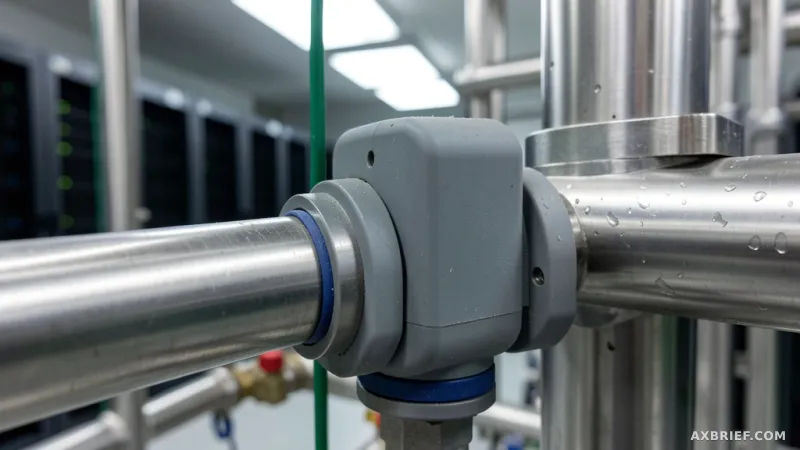
The modern AI data center is essentially a massive heat exchanger. As GPU clusters grow in density to support larger LLMs, the industry has shifted from air cooling to liquid cooling to prevent thermal throttling and hardware failure. Yet, this transition has introduced a silent, invisible risk: the chemistry of the coolant itself. For most operators, knowing if their cooling loop is contaminated or if a pump is eroding requires a manual sample, a courier, and a multi-day wait for a laboratory report. In an environment where a single hour of downtime can cost millions of dollars, this latency is a critical vulnerability.
The Spectrometer Shift in Infrastructure
Omen AI is attempting to eliminate this blind spot by moving the laboratory directly into the server rack. The company recently secured $31 million in Series A funding to scale its real-time monitoring solution, bringing its total capital raised to $40 million since its founding in 2024. The funding round was led by Nava Ventures, with participation from CRV, Vanderbilt University, Mann+Hummel, Starhill Holdings, and Hard Launch Capital.
At the core of Omen AI's offering is a compact spectrometer designed to live within the liquid cooling loop. Unlike traditional sensors that only track temperature or flow rate, this device analyzes the chemical composition of the coolant in real-time. Its primary objective is the immediate detection of bacterial growth and chemical instability. When bacteria proliferate in a cooling system, they create biofilms that reduce heat transfer efficiency and can lead to catastrophic blockages. By identifying these biological threats the moment they appear, Omen AI allows operators to treat the system before a full-scale shutdown becomes necessary.
This shift toward on-premises analysis is becoming a competitive battlefield. The traditional model of mailing samples to external labs is being replaced by immediate, site-specific data. This trend is validated by the recent entry of Pyxis, a water monitoring specialist that launched its own data center coolant monitoring product earlier this month. The arrival of established water-management firms indicates that the infrastructure layer of the AI boom is now viewed as a high-value vertical for precision sensing.
From Heavy Machinery to AI Clouds
The most striking aspect of Omen AI's trajectory is that its technology was not originally designed for the cloud. The company's early success came from a surprising source: Caterpillar dealerships. Omen AI initially focused on monitoring the hydraulic fluid systems of heavy construction and mining equipment, where fluid contamination can destroy an engine in hours. As they expanded their client base to include turbines and power generators, the team noticed a recurring pattern. Whether it was a massive industrial generator or a corporate HVAC system, the entire facility was essentially a network of pipes filled with critical fluids.
This realization led Omen AI to pivot toward the AI data center market, where the stakes for fluid purity are even higher. The company now counts 12 data center customers, including TensorWave. As an AI computing cloud built on AMD chips, TensorWave operates in an environment where chip density is so high that even a minor chemical shift in the coolant can impact service availability. For these clients, the spectrometer acts as a continuous blood test for the hardware.
Beyond biological contamination, the system identifies physical wear through metal detection. The spectrometer can isolate specific elements within the fluid to diagnose exactly which component is failing. The detection of copper or chromium serves as a signature for pump wear, while the presence of silicon indicates that a seal is degrading. This allows operators to move from scheduled maintenance to predictive maintenance. Instead of shutting down a system to inspect a pump based on a calendar date, they can wait until the chemical signature of chromium reaches a specific threshold, maximizing uptime and reducing unnecessary labor.
By replacing the physical sampling gap with high-fidelity data, Omen AI is transforming cooling from a passive utility into a proactive telemetry stream. The ability to detect a failing seal via silicon particles before a leak occurs changes the risk profile of liquid cooling entirely.
Infrastructure reliability now depends on the ability to see what is happening inside the pipes without ever having to open them.



