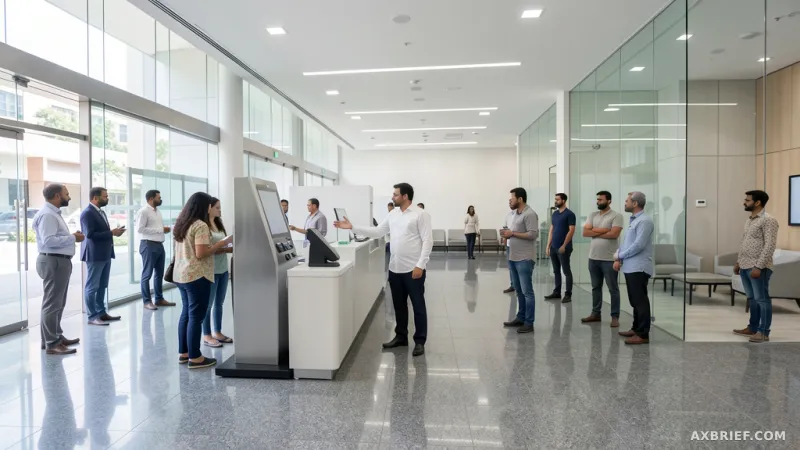
The enterprise software landscape is currently weathering a quiet but violent transition. For a decade, the industry standard was the SaaS dashboard—a collection of tabs and forms that required a human to move data from one screen to another. But this week, the conversation in the developer and executive community has shifted toward the agentic era. Financial institutions, in particular, are moving past the novelty of generative AI chatbots that merely summarize documents. They are now hunting for autonomous agents capable of executing complex banking workflows without constant human hand-holding. This shift has created a high-stakes race to define what autonomous banking actually looks like in a regulated environment.
The Financial Architecture of a Strategic Bet
ServiceNow has signaled its intent to lead this transition by investing $40 million into BusinessNext, a veteran Indian banking software firm. This investment secures approximately a 5% stake in the company, valuing BusinessNext at $700 million. While many AI-era investments are based on speculative growth or prototype demos, the fundamentals here are grounded in established revenue. Based in Noida, India, BusinessNext has spent 24 years building a footprint in the financial sector and reported approximately $32 million in revenue for the most recent fiscal year. This revenue stream provides a critical anchor for the $700 million valuation, distinguishing the company from the wave of pre-revenue AI startups currently flooding the market.
The scale of BusinessNext's operational reach is significant. The company currently provides services to more than 70 banks globally, establishing a presence that spans India, Southeast Asia, the Middle East, and the United States. Its client roster includes some of the most influential financial entities in the world, most notably the Reserve Bank of India, which dictates the nation's monetary policy. Furthermore, the company has penetrated both the public and private sectors of the Indian banking market, counting the State Bank of India and HDFC Bank among its core customers. By securing a foothold in these institutions, BusinessNext has already solved the hardest part of financial software deployment: gaining the trust of central banks and systemic lenders.
The Convergence of Front-End Agents and Back-Office Logic
On the surface, this looks like a standard venture investment, but the underlying logic is a calculated move to solve the fragmented nature of banking automation. Most banks currently operate in a state of digital schizophrenia. They use one set of tools for customer-facing interactions—the front office—and a completely different, often legacy, set of tools for internal processing—the back office. This gap is where efficiency dies, as human employees are forced to manually bridge the two systems.
The strategic twist in the ServiceNow and BusinessNext partnership is the creation of a unified, autonomous loop. BusinessNext brings the front-end expertise, specifically its autonomous banking platform where AI agents handle customer-facing workflows. ServiceNow brings the world-class back-office automation engine. By combining these, the two companies are offering a single integrated package: an AI agent that can take a customer's request at the front door and trigger the necessary internal workflow to fulfill it in the back office without a human intermediary.
This integration addresses the primary anxiety of the modern CFO: the declining value of traditional SaaS. As AI-native alternatives emerge, enterprises are questioning why they pay high subscription fees for tools that still require massive amounts of manual labor. ServiceNow is effectively insulating itself from this disruption by absorbing AI-native capabilities. Instead of fighting the shift toward agentic workflows, they are integrating the very tools that could have rendered traditional workflow software obsolete.
Crucially, this partnership solves the regulatory paradox of financial AI. Banks cannot simply plug their customer data into a public LLM due to strict privacy laws and national security concerns. BusinessNext has addressed this by utilizing private AI infrastructure. By keeping sensitive data within a controlled, private environment, they allow banks to leverage the power of autonomous agents while remaining compliant with the stringent requirements of institutions like the Reserve Bank of India. The tension between innovation and regulation is resolved not by compromising on either, but by building the AI into the private infrastructure itself.
Financial institutions looking to replace legacy SaaS with AI-native solutions must now prioritize this specific technical capability: the ability to deploy autonomous agents within a private, compliant infrastructure. This deal proves that the future of banking is not a public AI interface, but a private, integrated ecosystem where the front and back offices operate as a single, autonomous entity.