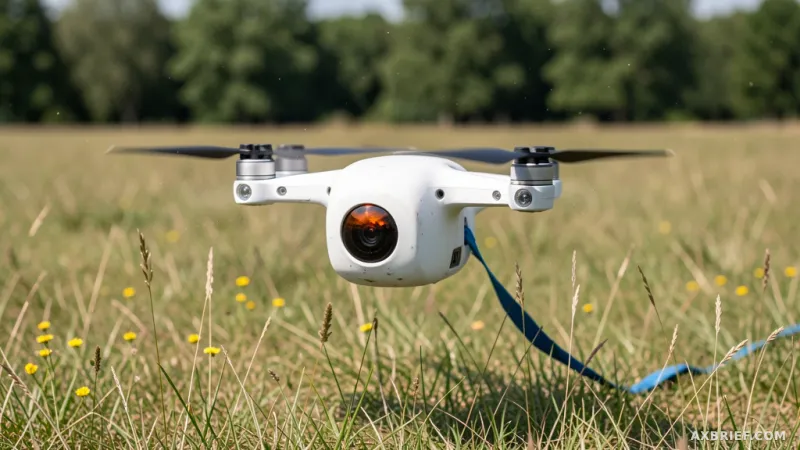
For years, the utility of industrial drones has been governed by an invisible leash. Whether it is a radio frequency limit or the instability of a local mesh network, the pilot has always been tethered to the aircraft. This physical proximity requirement creates a persistent bottleneck in industrial deployment; if a site needs inspecting, a qualified operator must travel to that specific coordinate, set up a ground station, and remain within a strict signal radius. The operational cost is not just the flight time, but the logistics of human presence.
The End of the Proximity Bottleneck
Skydio has effectively severed this tether by demonstrating a control architecture that ignores continental geography. In a recent showcase, a drone operating in the California Bay Area was piloted in real-time from a podcast studio in New York City. The hardware interface was stripped down to a single laptop, removing the need for bulky transmitters or specialized field equipment. This is not merely a feat of long-distance radio; it is a fundamental shift in how command and control are structured in robotics.
As a leading American manufacturer of autonomous drones, Skydio focuses on aircraft that do not simply follow remote-control inputs but perceive and navigate their environments independently. The ability to maintain precision control across thousands of miles proves that Skydio has solved the latency problem at the algorithmic level. In traditional remote piloting, a few hundred milliseconds of lag between a command in New York and a reaction in California would result in a catastrophic crash. Skydio solves this by decoupling the high-level intent of the pilot from the low-level execution of the flight. The pilot provides the destination or the objective, while the drone's onboard autonomy handles the millisecond-by-millisecond adjustments required to stay airborne and avoid obstacles.
This architecture transforms the drone from a remotely piloted vehicle into a remote autonomous agent. By integrating the control structure into a standard computing environment, Skydio provides a blueprint for deploying drones in hazardous or inaccessible regions without risking human personnel on-site. The success of this deployment hinges on the synergy between latency suppression and autonomous decision-making, which serves as the primary benchmark for whether autonomous drones can move from novelty demos to scalable industrial infrastructure.
From Open Skies to GPS-Denied Interiors
While long-distance control solves the problem of geography, the environment itself remains a challenge. Most drones are designed for the open sky, where GPS provides a reliable coordinate system for stability. However, the true utility of a drone in a corporate or industrial setting is often found indoors—inside warehouses, server rooms, or manufacturing plants—where GPS signals vanish and obstacles like desks, walls, and machinery are densely packed. Skydio has expanded its operational envelope by developing indoor drones capable of navigating these complex, GPS-denied environments.
This shift from outdoor to indoor autonomy changes the value proposition of the hardware. When a drone can navigate a cluttered office or a facility interior without human intervention, it ceases to be a camera in the sky and becomes a mobile security and inspection sensor. The tension here lies in the complexity of spatial mapping; the drone must build a real-time understanding of its surroundings to avoid collisions while simultaneously receiving high-level commands from a remote operator. By mastering indoor flight, Skydio allows facility managers to collect critical internal data without ever needing a pilot to physically enter the building.
This strategic direction is driven by Adam Bry, the CEO of Skydio. Under Bry's leadership, the company has pursued a strategy of vertical integration, embedding autonomous software directly into the hardware manufacturing process. Rather than treating the software as an add-on, Skydio optimizes the flight controller and the sensor suite to work in tandem. This integration ensures that software updates translate directly into improved flight performance and expanded capabilities. When the software evolves to better handle indoor obstacles or reduce telemetry lag, the hardware's utility increases instantly across the entire fleet.
By combining the ability to fly in complex interiors with the ability to be controlled from across the country, Skydio is shifting the center of gravity for drone operations. The operational focus is moving away from the field and toward a centralized control system. The hardware is no longer a tool that requires a local expert; it is a node in a wider network that can be managed from a central hub.
This convergence of remote telemetry and onboard autonomy effectively eliminates the physical constraints of drone operation. As software updates continue to erode the limitations of hardware, the industry is moving toward a standard where the location of the operator is entirely irrelevant to the success of the mission.