
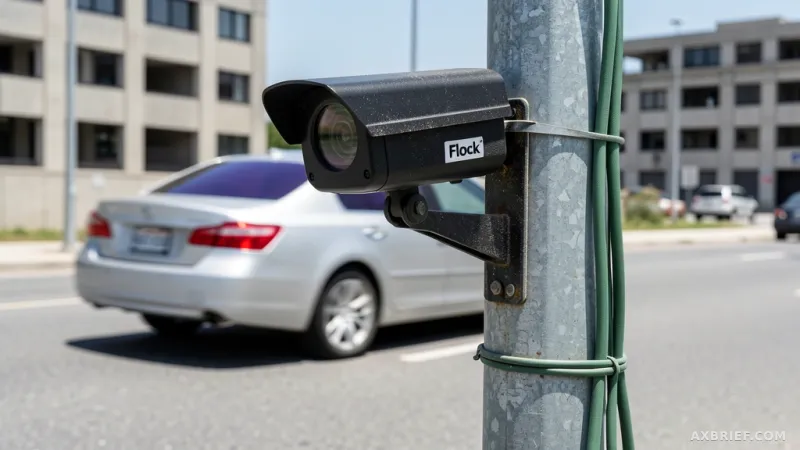
The invisible net of Automatic License Plate Recognition (ALPR) has become a staple of modern urban policing, promising a future where criminals cannot hide behind a steering wheel. For most citizens, these cameras are mere background noise in the city landscape, perceived as silent guardians of public safety. However, for a growing number of individuals, these tools have transformed from crime-fighting assets into instruments of personal obsession and state-sponsored stalking. The tension between the perceived utility of surveillance and the reality of its misuse has reached a breaking point, as the very tools designed to protect the public are being turned against them by the people sworn to uphold the law.
The Architecture of Algorithmic Surveillance
Flock operates on a network of ALPR cameras that capture license plate data in real-time, creating a searchable database of vehicle movements. The operational integrity of a Flock network is defined by four critical design decisions: the scope of information collected, the specific individuals granted search authority, the duration of data retention, and the boundaries of information sharing. These parameters are not merely technical settings but are the institutional guardrails that determine the balance between operational efficiency and the infringement of civil liberties. To prevent the system from becoming a tool for unauthorized surveillance, Flock implements mandatory safeguards, most notably the requirement that officers input a valid crime case number for every search performed.
Beyond the case number requirement, the system employs flagging software designed to identify abnormal search patterns. This software acts as a digital tripwire, alerting administrators when a user's behavior deviates from standard investigative norms. By forcing officers to justify every query and monitoring those queries for anomalies, the system aims to create a transparent audit trail. In theory, this structure ensures that the power to track any vehicle in the city is tethered to a legitimate legal necessity, transforming the database from a general surveillance tool into a targeted investigative resource.
The Loophole of the Fake Case Number
Despite these technical safeguards, the gap between policy and practice has proven dangerously wide. A comprehensive investigation by the Washington Post uncovered 50 distinct instances of system abuse, revealing that Flock and its competitors were used to stalk and harass women. The most egregious example emerged from Wisconsin, where a woman discovered that her ex-boyfriend, a police officer, had used the system to track her vehicle 179 separate times. In another instance, a woman was stalked by a police chief, only to find that there was no viable internal channel to report the abuse of power. These cases illustrate a systemic failure where the authority granted for public safety is weaponized for private vendettas.
The investigation highlighted a critical vulnerability in the system's security: the honor system. Officers discovered they could easily bypass the mandatory case number requirement by entering fake or fraudulent case numbers. Because the system accepts any alphanumeric string as a valid case number without verifying it against an actual police report database, the primary safeguard became a mere formality. This revelation transforms the audit log from a tool of accountability into a facade of compliance. When the technical control mechanism can be neutralized by a simple lie, the entire security architecture collapses, leaving the public vulnerable to the whims of any operator with a login.
This shift from targeted investigation to mass surveillance has drawn the ire of civil liberty and privacy advocacy groups. They argue that the original sales pitch for Flock—solving crimes and recovering stolen vehicles—has been used as a Trojan horse to establish a permanent, wide-reaching surveillance grid. The realization that the system's safeguards are easily circumvented has shifted the conversation from how to improve the tool to whether the tool should exist at all. The risk is no longer just about data leaks, but about the active, intentional misuse of state power through AI-driven tracking.
As a direct result of these abuses, the tide is turning against ALPR deployments. Several cities have already moved to cancel their contracts with Flock, citing the unacceptable risk of officer misconduct. Simultaneously, various state governments are drafting and pushing legislation to either strictly limit the use of license plate recognizers or ban them entirely. These administrative and legal actions signal that the convenience of rapid vehicle identification is no longer worth the cost of systemic privacy erosion.
For organizations still considering the adoption of surveillance AI, the lesson is clear: performance benchmarks and crime-solving rates are irrelevant if the access control is flawed. The only viable standard for deployment is the implementation of automated cross-verification, where the system automatically validates every entered case number against actual investigative records in real-time. Without this hard-coded link between the search and a legal record, surveillance AI remains a liability rather than an asset.



