
The global race for AI supremacy is often framed as a battle of algorithms and model parameters, but the real frontline is far more physical. Every cutting-edge H100 or B200 chip depends on a fragile, highly centralized supply chain where a single company in Veldhoven, Netherlands, holds the keys to the kingdom. For years, the industry has operated under the assumption that while the most advanced tools are restricted, the foundational machinery of semiconductor production remains a global commodity. That assumption is now colliding with a new wave of American geopolitical strategy, turning a technical bottleneck into a diplomatic crisis.
The Diplomatic Clash Over the MATCH Act
This week, the tension shifted from corporate boardrooms to the halls of power in Washington. Sjoerd Sjoerdsma, the Dutch Minister for Foreign Trade and Development Cooperation, traveled to the United States with a singular, urgent objective: to prevent the passage of the MATCH Act. This proposed legislation seeks to fundamentally rewrite the rules of engagement for semiconductor equipment, aiming to systematically block Chinese chipmakers from accessing Western lithography tools. Sjoerdsma's itinerary included high-stakes meetings with U.S. Commerce Secretary Howard Lutnick and various members of Congress, where he warned that the act would create unsustainable risks for both the Dutch government and its private sector.
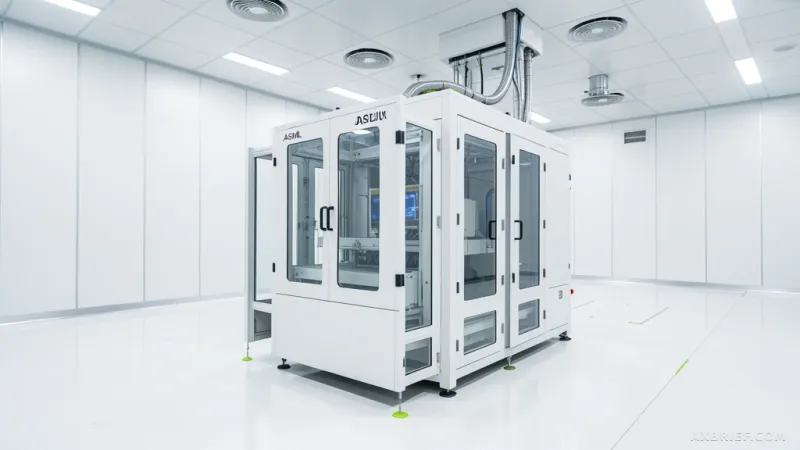
At the heart of this dispute is the financial vulnerability of ASML, the world's sole provider of the extreme ultraviolet (EUV) lithography machines required for the most advanced chips. The stakes are not theoretical. Currently, China accounts for 19% of ASML's total net system sales. For a company that serves as the primary engine for the entire world's semiconductor progress, losing nearly one-fifth of its revenue in a single stroke would be a seismic financial shock. The Dutch government views this not merely as a corporate loss, but as a trade conflict that could destabilize the economic relationship between the EU and the US.
While the MATCH Act was introduced in April, it has not yet cleared the full vote of the House or the Senate. It currently exists in a state of legislative limbo, likely to be bundled into a larger, more comprehensive policy package rather than passing as a standalone bill. However, the mere prospect of its enactment has forced semiconductor manufacturers to reconsider their long-term production roadmaps, as the bill threatens to transform a regulated market into a completely severed one.
From EUV Scalpels to DUV Hammers
To understand why the MATCH Act is viewed as a critical escalation, one must look at the distinction between the tools being targeted. Until now, the primary focus of export controls has been Extreme Ultraviolet (EUV) lithography. EUV is the bleeding edge of technology, used to etch the smallest transistors for the most powerful AI accelerators. Because EUV is so specialized and rare, its restriction was a surgical strike—limiting China's ability to reach the 3nm or 2nm frontier.
The MATCH Act, however, moves the target from the scalpels to the hammers. It expands the scope of regulation to include Deep Ultraviolet (DUV) immersion lithography tools. DUV immersion technology, while an older generation than EUV, uses a liquid medium between the lens and the wafer to increase resolution. It is the workhorse of the industry, essential for the mass production of the general-purpose chips that power everything from automotive systems to mid-tier AI inference.
This shift creates a profound reversal in the logic of the chip war. By targeting DUV tools, the US is no longer just trying to prevent China from building the *next* generation of chips; it is attempting to degrade their ability to maintain and expand *current* production lines. ASML CEO Christophe Fouquet has explicitly stated that these legacy tools would become immediate targets for prohibition if the act passes. This means that the last remaining lifeline for Chinese semiconductor autonomy—the ability to buy older, proven machinery—could be cut entirely.
The ripple effects of such a move extend far beyond the borders of China. When the supply of essential production machinery is artificially constrained, the result is a global increase in hardware lead times and a spike in production costs. If Chinese firms are forced to scramble for alternative, less efficient machinery or if ASML's revenue collapse forces a shift in their R&D spending, the entire ecosystem feels the friction. The volatility of the hardware supply chain becomes a variable as critical as the efficiency of a model's weights.
As the Dutch government attempts to steer the US away from this hardline approach, the industry is realizing that the era of the globalized foundry is ending. The ability to secure AI infrastructure now depends less on who has the best code and more on who can navigate the geopolitical minefield of lithography equipment. The final decision on the MATCH Act will determine whether the AI hardware race remains a competition of innovation or becomes a war of attrition based on who can survive the most restrictive supply chain.



