
The current atmosphere in the tech world is defined by a strange, widening gap between the capabilities of the models and the sentiment of the people using them. While developers celebrate new benchmarks and enterprises integrate agents into every workflow, a quiet rebellion is taking hold in the physical world. It manifests as a sudden surge in the popularity of 20-year-old iPods, the return of film cameras, and a growing preference for devices that do intentionally less. This is not merely a nostalgic trend for the sake of aesthetics; it is a visceral reaction to an era where intelligence is being forced into every corner of the human experience, often without an invitation.
The High Cost of Infrastructure and Public Skepticism
The friction between AI ambition and public acceptance is now quantifiable. According to data from Pew Research, 52 percent of Americans now report that their concerns about the use of AI in daily life outweigh their expectations. This represents a significant climb from 37 percent in 2021, suggesting that as the technology becomes more visible, it becomes less trusted. The sentiment is even more acute among the 18-to-34 demographic, where a majority of respondents expressed a fundamental lack of belief that the leaders of the AI industry are acting responsibly.
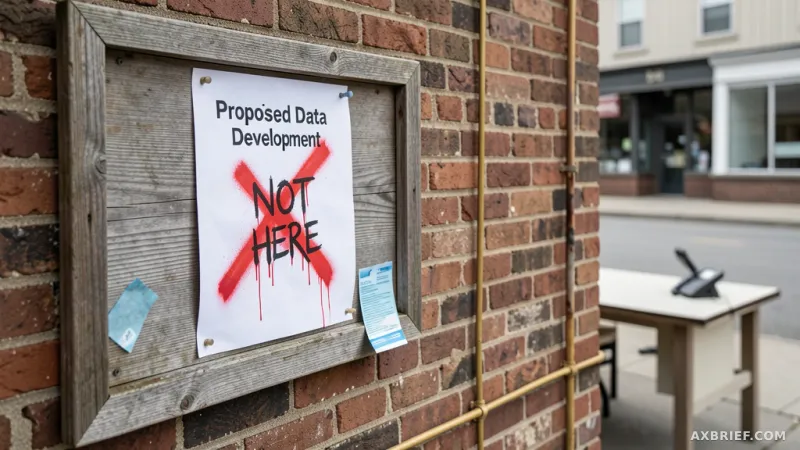
This distrust has migrated from online forums to local zoning boards and political battlegrounds. The physical footprint of AI—the massive, power-hungry data center—has become a lightning rod for community anger. The political risk is now so high that the National Republican Senatorial Committee (NRSC) issued a warning to major AI firms, noting that the construction of data centers is negatively impacting key election outcomes in Ohio. To mitigate this, tech giants have pivoted from talking about the future of humanity to offering immediate, transactional bribes to local municipalities. As reported by the Wall Street Journal, companies are promising job guarantees and investments in clean water infrastructure to secure building permits. In one Louisiana parish, the desperation to appease the community reached a point where the deal included providing 50,000 dollar bonuses to local teachers.
Further compounding this tension is the perceived velocity of the rollout. A May survey by Economist/YouGov revealed that over 70 percent of Americans feel the pace of AI development is simply too fast. The industry is moving at a speed that exceeds the public's ability to process the social and economic consequences, turning technical progress into a source of anxiety rather than excitement.
The Collapse of the Ubiquity Hypothesis
For years, the prevailing logic in Silicon Valley was the ubiquity hypothesis: the belief that once a technology becomes omnipresent, it is naturally accepted as a utility. The industry assumed that by embedding AI into email clients, television interfaces, and smartphones, the friction of adoption would vanish. However, the opposite is happening. Instead of seamless integration, users are experiencing a profound sense of fatigue. The forced penetration of AI into everyday products is being perceived as an intrusion rather than an upgrade.
This fatigue is driving a cultural pivot toward the analog. The rise of the dumbphone—basic handsets stripped of apps and algorithms—alongside a resurgence in knitting, quilting, and mahjong, signals a desire to escape the predictive nature of AI. When algorithms dictate what we see, hear, and buy, the act of engaging in a non-algorithmic hobby becomes a form of psychological resistance. The tension is further heightened by the perception of AI as a tool for exploitation, whether it is helping students cheat on essays or training on the intellectual property of artists and musicians without consent.
Even the architects of this era are beginning to acknowledge the failure. Brian Chesky, CEO of Airbnb, recently admitted in a podcast that the backlash against AI is real and stems from the industry's inability to create products that ordinary people actually enjoy. Dario Amodei, CEO of Anthropic, went further on X, explicitly defining the current moment as a crisis of trust. Amodei argued that the public suspects corporations and governments of deception, and that the only way to bridge this gap is by delivering on massive, tangible promises—such as the eradication of cancer—rather than incremental software updates.
Currently, the perceived utility of AI remains trapped in the realm of convenience. Summarizing a webpage or interacting with a conversational TV interface does not provide enough value to offset the perceived risks of job displacement and privacy loss. When the trade-off for a slightly faster email draft is the potential loss of a livelihood, the value proposition collapses. The industry has focused on the upside of efficiency while ignoring the downside of instability.
For AI practitioners and enterprises, the era where adding a feature automatically increased adoption has ended. The path forward no longer lies in technical superiority or the sheer scale of compute, but in the reduction of the trust cost. The critical signal to watch will be the moment AI moves beyond being a convenience tool and proves its worth by solving problems that individuals cannot solve on their own, such as expanding healthcare access or curing intractable diseases.
The survival of the AI era depends on whether the industry can transition from selling efficiency to proving essential, life-altering value.



