For the last two decades, the corporate morning has followed a rigid ritual. Employees log into a CRM, navigate through a series of nested menus, manually input lead data, and drag tickets across a Kanban board to signal progress. This reliance on the user interface as the primary gateway to productivity has defined the SaaS era. However, by the first quarter of 2026, this landscape is undergoing a violent correction. We are moving past the era of the AI chatbot—a tool that merely suggests text in a side panel—and entering the age of autonomous agents. These entities do not just suggest; they execute, maintaining state across sessions and operating tools independently to achieve high-level goals. This is not a marginal increase in efficiency but a structural discontinuity in how software is built and consumed.
The Technical Architecture of the Agent Economy
The transition to an agent-centric economy is powered by two critical shifts in connectivity: the Model Context Protocol (MCP) and Agent-to-Agent (A2A) communication protocols. For years, SaaS companies protected their market share through three primary moats: proprietary data, complex business logic, and a polished user interface. In the new paradigm, the UI has been relegated to a decorative layer. When an autonomous agent can utilize MCP to connect securely to a data layer, update records, and generate reports without ever opening a browser, the dashboard ceases to be a competitive advantage. The value shifts from the visual presentation of data to the accessibility of the data itself.
This shift is further accelerated by A2A protocols, which allow a primary orchestrator to delegate specialized sub-tasks to a fleet of subordinate agents. Instead of a human manager coordinating between a billing tool, a legal contract tool, and a marketing platform, a single orchestrator agent spawns and manages these functions autonomously. The friction of human mediation is removed from the workflow. Consequently, the criteria for enterprise software procurement are changing. Forward-thinking buyers are no longer asking if a vendor has a sleek mobile app or an intuitive dashboard; they are asking if the vendor supports MCP servers and provides the necessary hooks for agentic orchestration.
The Structural Collapse of the Dashboard Era
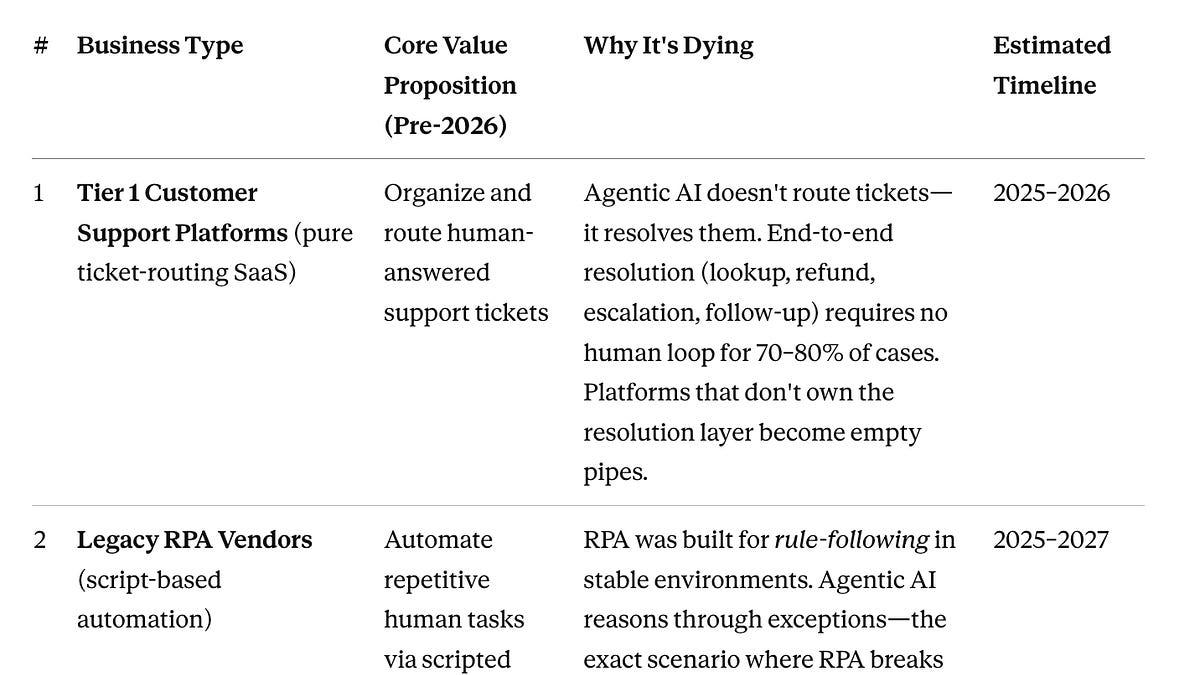
The rise of the orchestrator creates a vacuum that will swallow several established business models by 2027. The most immediate casualties are platforms that exist primarily to route tickets or execute scripts—tasks that agents now handle with superior reasoning and speed. Support platforms that rely on human-led ticket routing and legacy RPA tools based on rigid, rule-based automation are facing a terminal decline. Similarly, outbound agencies that depend on human SDRs to manage the top of the sales funnel are being replaced by agents that can personalize outreach and qualify leads at a scale no human team can match.
Even more precarious is the position of manual ETL consulting and BI dashboards that lack an integrated agent layer. Without ownership of the underlying data pipeline or the query layer, a BI dashboard is effectively expensive wallpaper. It provides a view of the data but offers no mechanism for the AI to act upon it. In contrast, companies like LinkedIn or Veeva, which possess genuine data network effects, will survive this transition. While the way users access their data will change—shifting from a screen to an API call handled by an agent—their structural moat remains intact because they own the source of truth.
This evolution creates a new frontier for investment and development centered on agent governance. As agents begin making thousands of autonomous decisions per hour, the industry requires robust identity protocols and immutable audit trails to establish accountability. In highly regulated sectors such as healthcare, law, and finance, the winners will not be the providers of general-purpose models, but the creators of vertical platforms with compliance baked into the agentic logic. We are seeing a move toward performance-based orchestrator models where companies pay for guaranteed outcomes (SLAs) rather than per-seat licenses, effectively disrupting the traditional outsourcing market.
The transition to agentic AI is less about adopting new software and more about redesigning organizational governance. The goal is to move away from a human-in-the-loop system, where every action requires manual approval, toward an on-the-loop architecture. In this model, humans do not execute the work; they codify the policies and permissions that govern the agents. The companies that master this shift in oversight will dictate the terms of the next economic cycle.