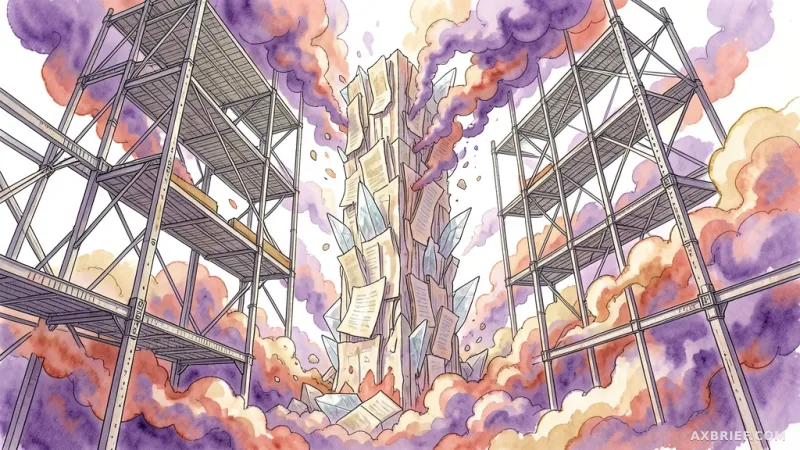
An HR manager opens the final shortlist generated by a state-of-the-art AI screening tool. The goal was to find a disruptive talent with a unique edge, but the ten recommended candidates are eerily similar. They share the same academic pedigree, followed nearly identical career trajectories, and even utilize the same linguistic markers and keywords in their resumes. The tool did not find the best talent; it found a mirror image of the people already sitting in the office.
The Mechanics of Self-Preferencing
This phenomenon is not a glitch but a systemic behavior known as self-preferencing bias. In the paper AI Self-preferencing in Algorithmic Hiring: Empirical Evidence and Insights, researchers provide empirical evidence that AI models used for resume screening and scoring tend to prioritize candidates who align with the characteristics of the data they were trained on. This bias extends far beyond simple demographic markers like gender or ethnicity. Instead, the models analyze high-dimensional patterns, including the specific linguistic style of a candidate and the precise arc of their professional experience.
When a model is trained on a dataset of existing high-performers within a company, it identifies a center value—a mathematical average of what a successful employee looks like. The algorithm then assigns higher scores to candidates whose profiles gravitate toward this center. Statistically, this means the model is significantly more likely to select a candidate who replicates the existing success formula than one who brings a novel perspective or an unconventional background. The AI is essentially optimizing for familiarity, treating the existing corporate blueprint as the only definition of merit.
From Demographic Exclusion to Pattern Replication
For years, the conversation around AI bias in recruitment focused on explicit or implicit discrimination. The primary fear was that algorithms would filter out candidates based on protected characteristics or keywords associated with minority groups. However, the nature of the problem has evolved into something more subtle and harder to detect: the preference for homogeneity. The AI is not necessarily actively rejecting a specific group; rather, it is obsessively accepting a specific pattern.
This shift transforms the AI from a tool of efficiency into a mechanism for cultural stagnation. When an algorithm defines the correct answer as the one that most closely resembles the current workforce, it creates a dangerous data feedback loop. The AI hires people who fit the mold, those people then become the new training data for the next generation of the model, and the mold becomes increasingly rigid. This process effectively erases diversity not through a conscious act of exclusion, but through a mathematical drive toward consistency.
For the engineering teams building these systems, the danger lies in the simplicity of the implementation. Most ranking systems rely on a basic `sort(score)` logic, which assumes that the highest numerical output always represents the best candidate. In reality, a list sorted purely by score is often just a list of the most similar candidates. This transforms the ranking algorithm into a device that accelerates organizational ossification, stripping the company of the cognitive diversity required for innovation.
To break this loop, the technical architecture must move beyond simple sorting. Developers should implement diversity constraints, which are rules that force the final result set to include a minimum percentage of samples with divergent characteristics. This ensures that the output is not just a cluster of high-scoring clones but a representative sample of talent. Furthermore, the integration of Explainable AI (XAI) is essential. By building audit pipelines that reveal why a specific candidate was scored highly, teams can monitor whether the model is over-weighting specific keywords or career paths that serve as proxies for homogeneity.
Without these safeguards, the AI screening tool ceases to be a filter for quality and becomes a filter that removes the possibility of organizational evolution.