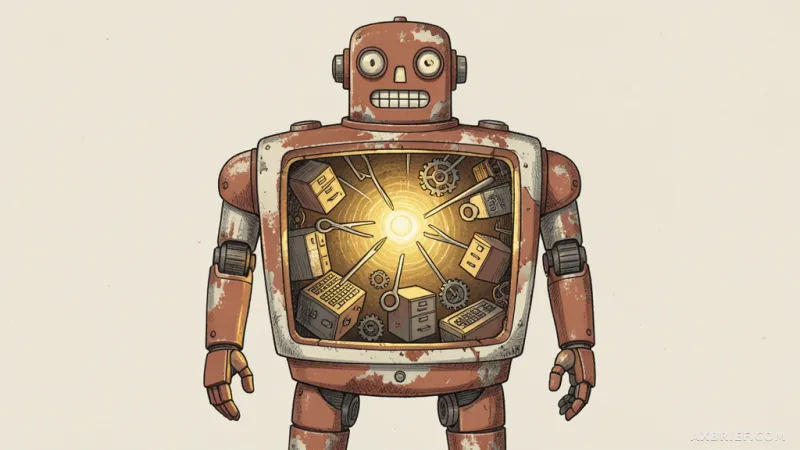
Every morning, the digital ritual for the modern developer begins the same way. A quick scroll through X, a glance at the latest trending repositories on GitHub, and a scan of specialized Slack channels. In years past, these feeds were the lifeblood of the industry, filled with meticulously crafted technical guides, passion projects born from late-night debugging sessions, and tools that solved specific, painful problems. Today, that experience has shifted. The feed is now saturated with a strange, polished void: articles that sound authoritative but say nothing, and repositories that look complete but fail to run. The community is no longer sharing knowledge; it is drowning in a tide of synthetic noise.
The Mechanics of AI Slop
This phenomenon is known as AI slop. It refers to the mass production of low-quality, AI-generated content designed to occupy digital space without providing actual value. The scale of this issue has accelerated sharply in the first half of 2026, coinciding with the wider accessibility of high-performance models like Claude Opus 4.5 from Anthropic. While these models provide immense utility for legitimate development, they have also lowered the barrier to entry for content farming to nearly zero. Anyone can now generate a functional-looking piece of code and a corresponding technical blog post in seconds, without ever having executed a single line of that code in a real-world environment.
The contamination is systemic. On GitHub, the world's primary hub for collaboration, there is a growing graveyard of ghost projects—repositories that exist only to inflate a profile's activity graph, generated entirely by AI. In developer-centric social platforms and professional Slack groups, the signal-to-noise ratio has collapsed. Meaningless technical summaries and AI-authored tutorials are posted at a frequency that human moderators cannot match. This creates a paradox where the abundance of information actually makes it harder to find the truth. When the cost of production drops to zero, the value of the output follows, leaving the community to sift through mountains of synthetic debris to find a single piece of verified, human-tested insight.
The Death of the Contribution Standard
To understand why this is a crisis, one must look at the traditional cost of contribution. Historically, sharing a tool or a technical insight was an act of labor. A developer would identify a problem, spend hours or days iterating on a solution, rigorously test the edge cases, and then spend even more time writing documentation that would be useful to others. This process acted as a natural filter. The effort required to publish served as a proxy for the quality of the content. If someone took the time to write a comprehensive guide, it was usually because the solution actually worked and the author was willing to stand behind it through community feedback.
AI slop has completely inverted this incentive structure. The new workflow is a closed loop of automation: a user prompts an AI to generate a project, asks the same AI to summarize that project into a blog post, and then uses automated tools to distribute that post across multiple channels. In this cycle, the goal is no longer the resolution of a technical problem, but the optimization of engagement metrics. The act of sharing has been decoupled from the act of understanding. When a contribution requires no effort, it carries no accountability. The human element—the responsibility to ensure that a piece of code is maintainable or that a tutorial is accurate—has been replaced by a desire for visibility. This shift transforms technical communities from spaces of mutual growth into billboards for synthetic presence.
The result is a growing fatigue among senior engineers and experienced contributors. These users, who provide the critical peer review and mentorship that sustain the ecosystem, are increasingly withdrawing from public forums. When the effort to filter out slop exceeds the reward of participating in the conversation, the experts leave. This creates a dangerous vacuum. As the human experts exit, the community risks devolving into a digital dystopia where AI agents simply generate content for other AI agents to summarize, creating a feedback loop of hallucinations and errors with no human oversight to correct the course.
Technology should function as a force multiplier for human intelligence, not a replacement for human judgment. The utility of AI lies in its ability to handle the mundane, freeing the developer to focus on high-level architecture and complex problem-solving. However, when automation is applied to the act of sharing without a foundation of verification, it destroys the very trust that makes open-source and community-driven development possible. The survival of these ecosystems depends on a return to intentionality. Before hitting publish, the essential question is no longer whether the AI can write the text, but whether the human can vouch for the result.
The future of the technical community depends on whether we value the signal of human experience over the noise of synthetic volume.