A client leans across the conference table and slides a smartphone toward the center of the room. On the screen is a competitor's homepage, where a small, pulsing chat bubble flickers in the bottom right corner. The client does not discuss the bot's response accuracy or its integration with the CRM. Instead, they point to the widget as a piece of evidence, insisting that their own site needs the same feature immediately. This moment reveals a recurring pattern in corporate procurement where the adoption of technology is driven not by functional utility, but by a strange, collective inertia.
The Cycle of Digital Decoration
This obsession with visual markers of modernity is not new. The corporate web has a long history of adopting features that serve as ornaments rather than tools. Years ago, the industry succumbed to the carousel trend, filling homepages with heavy, slow-loading image sliders stocked with generic photography. Visitors almost universally ignored these banners, scrolling past them in a frantic search for a phone number or a contact form. Once the carousel lost its luster, the cookie consent banner took its place. Even websites that utilized no tracking cookies installed these intrusive overlays simply because every other site had one.
Then came the era of the Google Tag Manager. It became a mandatory requirement for any professional web build, often demanded by clients who had never once opened an analytics report. In one instance, a business owner requested the tool's implementation but could not remember their own login credentials eighteen months after the site launched. The tool existed, but the data remained untouched.
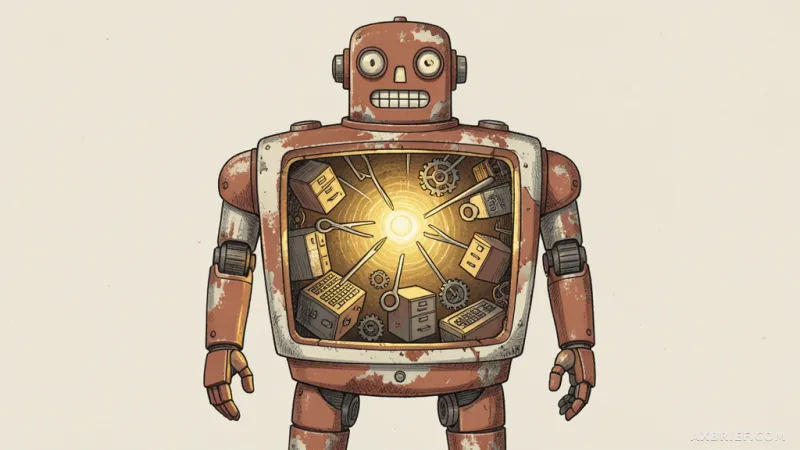
Now, the AI chatbot has become the latest piece of digital jewelry. Many of these implementations are fundamentally broken, providing incorrect business hours or hallucinating answers that have nothing to do with the user's query. Users typically close these windows the moment they appear. Yet, the rush to implement them continues unabated. The driving force is not a desire for better customer service, but a deep-seated fear that a website in 2026 without a chatbot will look unfinished. The chatbot has transitioned from a utility to a social signal, a way for a company to broadcast that it is keeping pace with the current technological zeitgeist.
The Conflict Between Efficiency and Prestige
This trend creates a direct collision with the philosophy of Smolweb, a movement advocating for lightweight, fast, and stripped-down websites that prioritize content over clutter. A site built on Smolweb principles functions differently. It removes the pop-ups, the flickering widgets, and the heavy scripts, delivering information to the user instantly. When tested, users consistently report that these sites are easier to read and more pleasant to navigate due to the sheer speed of the experience.
However, the perspective of the corporate decision-maker is entirely different. When presented with a lean, high-performance site, executives often describe it as too simple. In this context, simplicity is not viewed as a user-experience victory, but as a lack of visual impact. There is an underlying anxiety that a site which loads instantly and lacks bloated features does not look expensive. A minimalist design fails to provide visible proof of the effort and capital invested in the project.
Adding a chatbot widget is a visible act of investment. It is a tangible addition that can be pointed to during a board meeting. Conversely, the rigorous work required to optimize a site for maximum speed and accessibility is invisible labor. It is the act of removing things, which is far harder to sell to a client than the act of adding them. For the last decade, the web has been distorted by a competition between bloated pages and dark patterns, creating a standard where the appearance of complexity is equated with professionalism. Clients are not ignoring the market; they are simply reading a market atmosphere that has been calibrated toward vanity.
This phenomenon extends beyond corporate landing pages and into the developer community and the Fediverse. A feature arms race has emerged where the desire to showcase capability outweighs the actual needs of the user. The result is a landscape of websites where AI chatbots sit patiently in the corner, unaware of the company's pricing or operating hours, blinking in unison with every other site on the internet.
The ultimate survival of the AI chatbot will not be decided by corporate anxiety or the need for social signaling, but by the speed at which frustrated users abandon the experience.