The air at the University of Central Florida graduation ceremony on May 8 was thick with the usual mixture of relief and anticipation. Thousands of graduates, clad in traditional caps and gowns, gathered to mark the end of their academic journeys. For a moment, the atmosphere was celebratory, until a single phrase from the podium transformed the festive gathering into a scene of collective hostility. A wave of boos surged through the crowd, drowning out the speaker and turning a rite of passage into a visceral protest.
The Confrontation at UCF
Gloria Caulfield, the Vice President of Strategic Alliances at the Tavistock Group, a global investment and strategy firm, stood before the graduates of the College of Arts and Humanities and the Nicholson School of Communication and Media. As she delivered her address, Caulfield framed the rise of artificial intelligence not merely as a tool, but as the next industrial revolution. The reaction was instantaneous. The murmur of disagreement quickly escalated into a roar of boos from thousands of students.
When a visibly startled Caulfield paused to ask what was happening, the response from the crowd was blunt: shouts that AI is terrible echoed through the venue. This was not a random outburst of student restlessness, but a targeted rejection of a specific technological narrative delivered to a group of students whose entire career trajectory is currently being redefined by the very technology Caulfield praised.
The Shift from Muscle to Mind
To understand why a phrase as common as next industrial revolution triggered such a reaction, one must look at the historical precedent of industrialization. The first industrial revolution was defined by the steam engine, a technology that replaced human and animal muscle. It automated the heavy lifting, the weaving of fabric, and the transport of goods, shifting the burden of physical labor from the body to the machine.
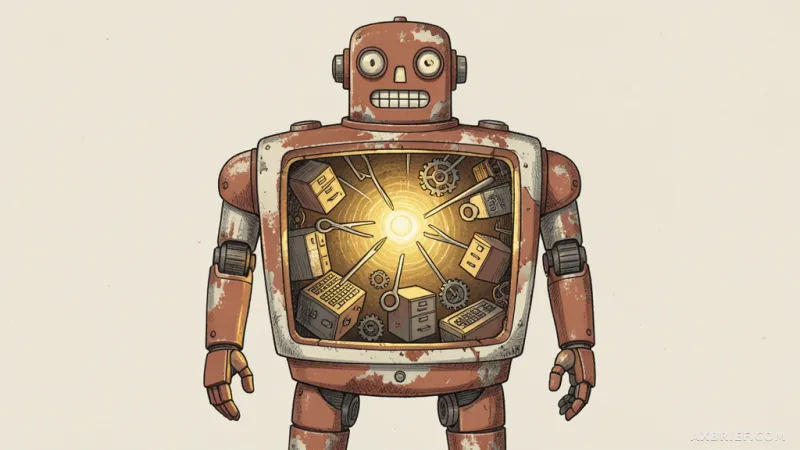
What Caulfield described is a fundamental shift in the nature of automation. We are no longer replacing the arm; we are replacing the cognitive process. Large Language Models (LLMs) are designed to mimic the human ability to synthesize information, write prose, and generate ideas. While the first revolution targeted the physical world, this new wave targets the intellectual and creative domains. For the graduates of the Nicholson School of Communication and Media, this is not an abstract economic theory. It is a direct threat to the core competencies they spent years mastering.
The tension lies in the gap between how a strategist views AI and how a practitioner of the humanities views it. To a corporate executive, the ability of a model to generate a report in seconds is an efficiency gain. To a student of journalism or media, that same process is the erasure of the critical thinking, contextual understanding, and lived experience that define their profession. Generative AI does not understand meaning; it calculates the probability of the next token in a sequence. When the act of writing is reduced to a probabilistic exercise, the value of the writer is called into question.
This shift creates a dangerous new hierarchy in the labor market. In the previous era, a skilled artisan was replaced by a machine operator. Today, the skilled writer or researcher is being repositioned as an AI operator. The market is increasingly prioritizing the speed of output and the reduction of cost over the depth of insight. In this environment, a plausible summary generated in one second is often preferred over a nuanced analysis that takes a week to produce. The boos at the UCF ceremony were not merely a rejection of software, but a protest against a world where the process of human thought is treated as an inefficiency to be optimized away.
When the drive for technical efficiency attempts to overwrite human uniqueness, the classroom and the graduation stage become the first lines of resistance.