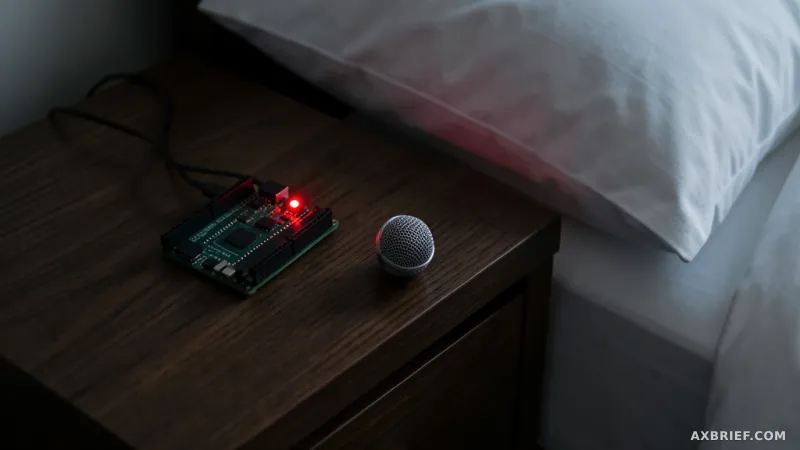
"s completely disabled, no microphone access at all." This specific assurance regarding privacy defines the current frontier of the hobbyist developer. It is a world where a user can decide that their microphone should only activate during a precise window of time, triggered by a Home Assistant automation that detects when they have actually climbed into bed. This level of granular, personalized control used to require weeks of architectural planning and a deep dive into API documentation. Now, it is the result of a few hours of collaboration between a human with a problem and an AI agent with the keys to the server.
The Architecture of an 8-Hour Build
The project centers on the integration of a Raspberry Pi and Home Assistant, a powerful open-source platform for smart home automation. In a concentrated eight-hour window, the developer successfully aggregated a diverse array of health and environmental metrics into a single, cohesive analysis pipeline. The data stream is multifaceted, pulling sleep stages, heart rate, and heart rate variability (HRV) from a Garmin smartwatch, while simultaneously ingesting real-time data from a network of home sensors. These sensors track motion, door states, temperature, humidity, and CO2 levels, providing a comprehensive snapshot of the bedroom environment.
The implementation process highlighted a significant shift in the developer-AI relationship. Rather than simply generating snippets of code for the human to copy and paste, the AI coding agent was granted SSH access to the Raspberry Pi. This allowed the agent to operate directly within the environment, writing code, executing it, and observing the results in real-time. The AI took an active role in quality assurance; it requested the developer to create specific sounds—shouting or dropping objects—to generate audio samples. The agent then analyzed the resulting spectrograms to fine-tune the audio detection thresholds, effectively acting as both the lead programmer and the test engineer.
The final delivery mechanism is a Progressive Web App (PWA). By choosing a PWA architecture, the developer ensured that the tool remains entirely within the local home network, eliminating the privacy risks associated with cloud-based data storage. The system operates autonomously, processing the night's data and sending a web push notification to the developer every morning once the analysis is complete.
Lowering the Implementation Threshold
To understand the significance of this project, one must consider the traditional cost of such a build. In the pre-AI era, identifying a specific sleep disturbance required a grueling process of manual labor. A developer would have to record hours of audio, listen through the tapes manually, or spend days mastering complex digital signal processing (DSP) libraries to automate the detection of noise spikes. For many, the effort required to build the tool would outweigh the benefit of the insight gained. This is the classic problem of the implementation threshold: when the cost of creating a solution is higher than the pain of the problem, the project is abandoned.
AI agents have fundamentally collapsed this threshold. The workflow has shifted from the developer reading and verifying every line of code to a loop of testing and feedback. The AI handles the boilerplate and the initial implementation of unfamiliar libraries, while the human provides the high-level direction and validates the output. When the AI can see a screenshot of an error or a visualization of a spectrogram, it can self-correct without the developer needing to explain the technical nuance of the failure. This allows a developer to venture into domains where they lack professional expertise—such as audio processing—and still produce a production-ready prototype over a single weekend.
The practical utility of this shift became evident when the tool identified a recurring noise spike around 3:00 AM. Instead of guessing whether the disturbance was internal or external, the developer had the data to confirm it was caused by neighbor activity and passing trucks. This clarity transformed the solution from a vague desire for "better sleep" into a targeted intervention. Rather than investing in expensive soundproofing or unnecessary medical consultations, the developer implemented simple, effective fixes: a white noise machine and earplugs. The AI did not solve the sleep problem directly; instead, it drastically lowered the cost of building the tool necessary to diagnose the problem.
We have entered the era of hyper-personalized software, where the gap between identifying a personal inconvenience and deploying a custom technical solution has shrunk to a matter of hours.