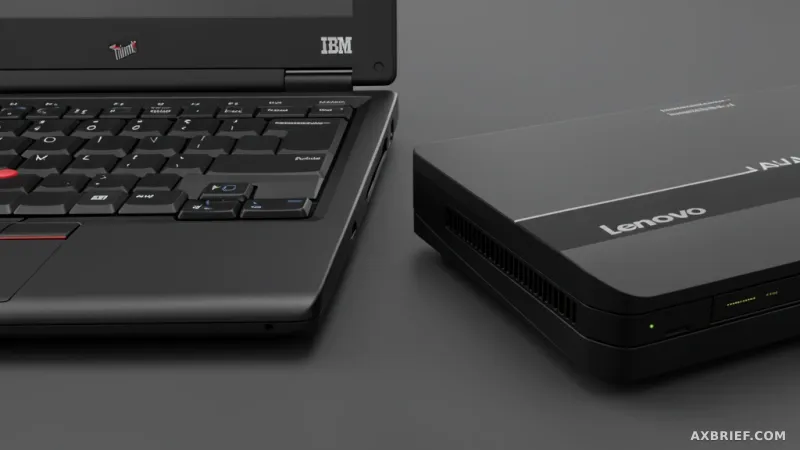
In a Japanese design studio in 1992, a stark, matte-black box sat on a drafting table. It lacked the flashy curves or vibrant colors of the era's emerging consumer electronics, yet it commanded attention through a single, defiant detail: a small red dot embedded in the center of the keyboard. To the observers of the time, the device resembled a bento box—the traditional Japanese lunch box designed to pack a variety of elements into a compact, efficient space. This was not merely an aesthetic choice, but a manifesto. The device was designed to transform the laptop from a fragile portable computer into a reliable weapon for the professional.
For decades, this black box defined the gold standard for business computing. However, the identity of the ThinkPad is currently undergoing its most radical transformation since its inception. The machine is no longer just a vessel for word processing and spreadsheet management; it is being reimagined as an AI workstation. Beneath the iconic chassis that has remained largely unchanged in spirit, a revolution in silicon architecture and AI acceleration is rewriting what it means to work on a portable device.
From the 1992 Bento Box to the Modern AI Workstation
When IBM introduced the first ThinkPad in 1992, it challenged every existing convention of laptop design. The bento box inspiration was literal in its philosophy: just as a bento box maximizes a limited volume to provide a complete, balanced meal, IBM sought to pack maximum performance and utility into a dense, portable form factor. While competitors chased ornamental designs, ThinkPad embraced a utilitarian minimalism. The goal was not to be beautiful, but to be infallible. It was a tool built for the professional who required a machine that would function regardless of the environment.
Central to this utility was the TrackPoint, the signature red pointing stick. By allowing users to control the cursor without lifting their hands from the home row of the keyboard, IBM eliminated the friction of switching between typing and mousing. This design mirrored the efficiency of a pilot who adjusts aircraft controls without removing their hands from the yoke. Over time, the TrackPoint evolved from a clever input method into a cultural totem, a symbol of a specific kind of power-user productivity that persists to this day.
The stewardship of the brand eventually shifted from IBM to Lenovo. While the corporate entity and nationality changed, the core DNA—the black chassis, the rugged build, and the TrackPoint—remained untouched. Lenovo recognized that the value of the ThinkPad lay not in its brand name, but in its reputation as a trusted instrument for experts. By layering modern hardware performance and slimmer profiles over this legacy of durability, Lenovo solidified the line's dominance in the enterprise market.
Today, the trajectory of the ThinkPad has shifted again, moving beyond the role of a business laptop toward that of an AI workstation. The objective has evolved from simple data management to local high-performance computing. The machine is being engineered to run complex AI models and process massive datasets natively on the device. The journey that began with a small, efficient box in 1992 has expanded into a vast computational landscape, marking the arrival of a new era of hardware.
The Pivot from Physical Durability to NPU Optimization
For the better part of thirty years, the engineering priority of the ThinkPad was physical resilience. The focus was on a chassis that could survive a drop and a keyboard that provided tactile certainty. Physical reliability was the primary metric of success because it guaranteed business continuity. In essence, the design philosophy was akin to building an armored vehicle; the goal was to ensure that the machine would power on and operate perfectly regardless of the terrain. Physical durability was the absolute core of the hardware's value proposition.
However, the center of gravity in hardware design has shifted from the exterior shell to the interior silicon. The new protagonist in this architecture is the NPU, or Neural Processing Unit. While the CPU acts as the general manager of the system and the GPU handles graphics and specific parallel tasks, the NPU is a specialist—a mathematical genius dedicated exclusively to the matrix multiplications required by artificial intelligence. As AI workloads have surged, relying on the CPU or GPU to handle these tasks has become inefficient, necessitating a dedicated accelerator.
This has transformed the internal architecture from a simple dependency model into a hybrid engine. In the past, the CPU issued commands and the GPU assisted with rendering or heavy lifting. Now, the CPU, GPU, and NPU operate as a triad, with the NPU absorbing the AI workload to maximize efficiency. This is the difference between a single manager handling every task and a specialized team where each member is an expert in their field. The result is a dramatic reduction in battery consumption and a massive leap in AI response speeds.
Consequently, the definition of a professional workstation has changed. The competitive edge is no longer just about whether a laptop can survive a fall, but whether it can run a sophisticated AI model locally without needing a cloud connection. The value of the hardware has migrated from the strength of the steel to the intelligence of the computation. We have entered an era where computational durability—the ability to process vast amounts of data without fatigue or lag—is the ultimate measure of a product's quality.
On-Device AI and the New Professional Workflow
For a developer or a data scientist, the latency of a cloud-based AI can be a significant cognitive tax. When a prompt is sent to a remote server, the response time fluctuates based on network congestion and server load, creating a stutter in the creative process. On-device AI removes this friction entirely. If cloud AI is like ordering food from a distant restaurant and waiting for delivery, on-device AI is like having a private chef standing right at your desk. By unifying the computational hardware and the software algorithms within the same chassis, the physical distance data must travel is eliminated, resulting in near-instantaneous responses. This allows a professional to maintain a state of deep flow, where the tool becomes an invisible extension of their thought process.
Beyond speed, the shift to local AI addresses the most critical concern for the modern enterprise: security. Cloud-based AI models inherently require data to be transmitted to external servers, creating a risk that proprietary code, trade secrets, or sensitive client data could be leaked or used for further training. On-device AI keeps all data within the local storage of the machine. It is the difference between mailing a confidential document to a third-party consultant and reviewing that document inside a secure, private vault. This technical foundation allows industries with extreme security requirements, such as finance or national defense, to fully integrate AI into their daily operations without compromising their security protocols.
This evolution extends beyond simple chatbots into systemic optimization. AI is now beginning to manage the workstation's own resources, learning a user's specific patterns to pre-allocate memory or automate repetitive configuration tasks. Developers are being freed from the drudgery of environment setup and routine code cleanup, allowing them to focus entirely on core logic and problem-solving. The tool is no longer something the user must master; instead, the tool is beginning to anticipate the user's intent.
As integrated optimization technologies push hardware to its limits and software automation handles the overhead, the ceiling for professional productivity is rising. AI is transitioning from a peripheral assistant to the very environment in which work happens. The ThinkPad, once a simple black box for the organized professional, has become an intelligent platform that expands the actual capabilities of the human operating it.