
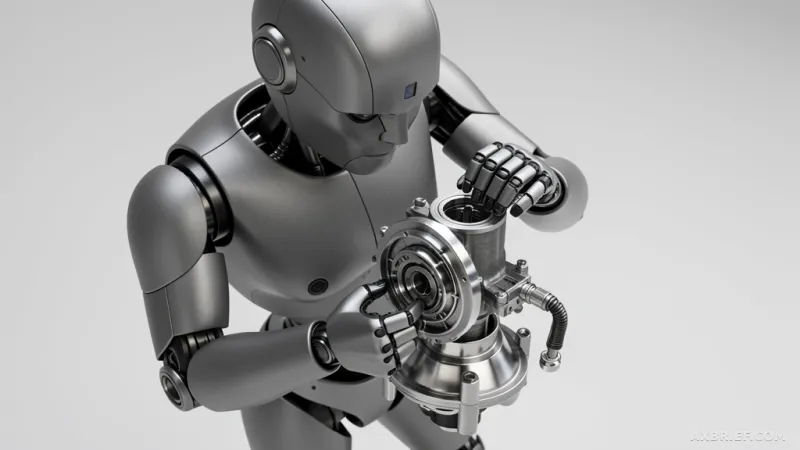
For the past few years, the AI revolution has largely been a ghost in the machine, confined to the glowing rectangles of our smartphones and monitors. We have grown accustomed to LLMs that can write poetry or generate photorealistic images, but these intelligence layers remain decoupled from the physical world. The tension in the developer community has shifted from how to prompt a model to how to give that model a body. The industry is now hitting a critical inflection point where the intelligence of the cloud must merge with the physics of the factory floor, moving AI from the realm of digital assistants to the realm of physical agents.
The Four Pillars of Physical AI Implementation
This transition takes center stage at the 2026 Physical AI Industry Outlook Conference, scheduled for the 19th at the FKII Tower Conference Center's Sapphire Hall in Yeouido. Hosted by Seminar Hub and supported by the Korea AI & Robot Industry Association and Robotidle, the event operates as a hybrid gathering of researchers and practitioners. The conference is structured around four critical axes: humanoids, robotics, autonomous manufacturing, and semiconductors. Rather than treating these as isolated fields, the summit examines them as a single, integrated value chain required to move AI into the physical environment.
At the technical core of this movement is the challenge of Sim-to-Real transfer. Ko Gukwon, a technical advisor at T-Robotics, emphasizes that the primary hurdle in robotics is the gap between an ideal simulation and the messy uncertainty of the physical world. To bridge this, the industry is moving toward Software Defined Robotics (SDR) platforms. By abstracting control logic away from specific hardware specifications, engineers can update a robot's behavior via software patches rather than mechanical overhauls. This structural flexibility allows for rapid iteration, enabling robots to adapt to new environmental variables through code rather than hardware redesigns.
Parallel to the software shift is a fundamental change in compute architecture. Jung Young-jun, head of a division at ETRI (Electronics and Telecommunications Research Institute), points to the necessity of on-device AI semiconductors. For a robot to operate safely in a dynamic environment, millisecond-level latency is non-negotiable. Relying on a round-trip to a cloud server introduces delays that can lead to physical collisions or operational failure. By integrating Neural Processing Units (NPUs) directly into the robot's chassis and optimizing model weights through aggressive quantization, the industry is achieving real-time inference at the edge. This ensures that the robot remains functional and stable even during network outages, effectively moving the brain from the data center to the limb.
However, hardware and low-latency compute are useless without a sustainable data pipeline. Lee Hyun-dong, Vice President of Superb AI, argues that the transition from a laboratory prototype to a commercial solution requires a rigorous readiness assessment and a dedicated MLOps (Machine Learning Operations) framework. The focus is shifting from simple model accuracy to the creation of a feedback loop where unstructured data from the factory floor is collected, refined, and fed back into the training cycle. This pipeline transforms a static AI model into an evolving system that learns from the specific idiosyncrasies of its physical environment.
From Cost Reduction to the Profit-Maximizing Dark Factory
While the technical components are impressive, the true disruption lies in the shift in industrial philosophy. For decades, factory automation has been about the bright factory—environments designed for human visibility and safety, where robots perform repetitive, hard-coded tasks to reduce labor costs. The 2026 Physical AI Industry Outlook Conference proposes a reversal of this logic through the concept of the Dark Factory. In a fully unmanned system, lighting becomes unnecessary, and the center of control shifts from human supervision to an integrated AI orchestrator.
Professor Jang Young-jae of KAIST argues that this is not merely about removing humans to save money, but about transforming the factory into an active profit-generating asset. Traditional automation focuses on execution efficiency—doing the same thing faster and cheaper. In contrast, a Physical AI-driven factory focuses on operational optimization. By analyzing market demand, raw material availability, and equipment health in real-time, the AI can autonomously reroute production paths to maximize revenue. The factory ceases to be a rigid sequence of steps and becomes a fluid, data-driven organism that optimizes its own output based on economic variables.
This shift necessitates a complete architectural overhaul of industrial control. For years, the industry has relied on PLC (Programmable Logic Controller) logic, which consists of thousands of lines of if-then-else statements to handle every possible exception. This hard-coded approach is brittle and cannot scale to complex, unpredictable environments. The new paradigm, as analyzed by Ko Kyung-chul, Executive Vice President of Koh Young Technology, replaces these fragmented logic gates with a centralized AI orchestrator. Instead of following a script, robots use model-based control to perceive their environment via sensors and adjust their trajectories in real-time. The competitive advantage is no longer the mechanical precision of a single arm, but the system integration capability—the ability to orchestrate a fleet of AI agents to solve a complex task.
This technological race is now inextricably linked to global geopolitics. Park Chan-sol, a research fellow at Hana Securities, notes that the competition between the United States and China has migrated from the cloud to the physical layer. Physical AI is no longer just a tool for efficiency; it is a strategic national asset. The companies and nations that control the vertical stack—from the semiconductor design to the robot hardware and the proprietary models that drive them—will establish insurmountable moats. In this environment, the most valuable resource is not just big data, but high-quality physical data.
Son Byung-hee, Director of the maum.ai research center, introduces the concept of the AI Data Factory to address this. While the previous era of AI relied on scraping static web data, Physical AI requires the systematic capture of edge cases—those rare but catastrophic failures that occur in the real world. The ability to simulate these edge cases and then validate them in the physical world creates a proprietary data loop. The AI Data Factory becomes the engine that reduces the Sim-to-Real gap, ensuring that the model's reasoning is grounded in physical reality rather than digital approximation.
As the industry moves toward this convergence, the boundary between the digital and physical worlds continues to dissolve. The goal is no longer to build a robot that can mimic a human, but to build an intelligent system that can optimize the physical world with a level of precision and autonomy that humans cannot achieve alone.