
It is 2:00 PM at a busy urban tire shop. A technician strains to lift a heavy wheel, sweat beading on his forehead while the piercing shriek of a pneumatic wrench echoes through the garage. Despite the rapid evolution of automotive engineering, the service bay remains a stubbornly analog environment. While engines have transitioned to high-efficiency electric motors and software now handles lane-keeping and parking, the actual act of swapping a tire still relies almost entirely on raw human muscle and the endurance of a technician's lower back. This scene has remained virtually unchanged for decades, creating a dangerous bottleneck in an era of hyper-mobility.
The arrival of electric vehicles has only intensified this friction. Because EVs carry massive battery packs, they are significantly heavier than their internal combustion counterparts, leading to tire wear that is up to 30% faster. Demand for tire services is surging, yet the workforce is evaporating. Young workers avoid the grueling physical toll, and veteran technicians are retiring in droves, leaving shop owners in a desperate scramble for talent. Customers are left waiting longer, and the industry is facing a systemic collapse of its service capacity. This stagnation ends where physical AI meets heavy robotics, as Automated Tire (ATI) introduces a platform designed to digitize the service bay.
The Architecture of the ATI SmartBay Platform
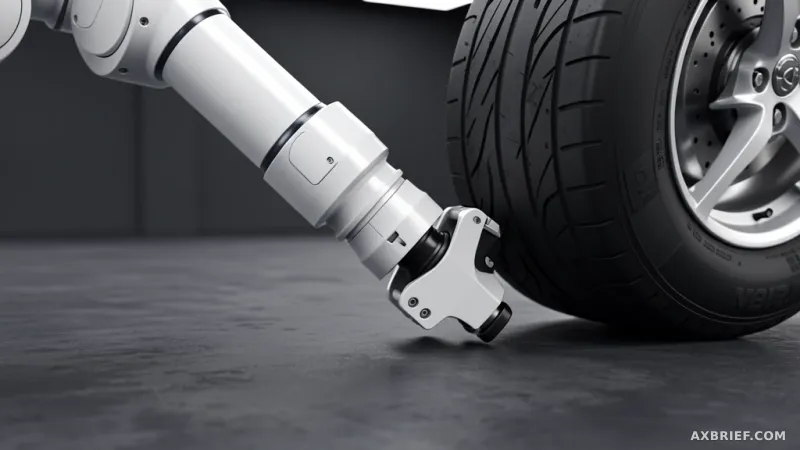
Tire replacement is traditionally a manual gauntlet where a technician must physically enter the vehicle's underside to loosen bolts and maneuver heavy equipment. ATI SmartBay transforms this process into an AI-driven robotic workflow. Rather than acting as a simple tool, SmartBay functions as a comprehensive platform that integrates real-time vehicle diagnostics, robotic execution, and precision wheel balancing. The system does not merely follow a script; it utilizes computer vision to read the vehicle's state and machine learning to execute movements with surgical precision. This allows the platform to handle the entire lifecycle of a tire change, including the critical wheel balancing process that eliminates vibrations and ensures a smooth ride.
The impact on operational efficiency is quantifiable. While manual tire services fluctuate based on a technician's experience or fatigue, SmartBay standardizes the entire process to approximately 30 minutes. This represents a nearly 50% reduction in service time compared to traditional methods. More importantly, the system fundamentally alters the labor ratio within the shop. In a conventional setup, one technician is tethered to one vehicle for the duration of the job. With SmartBay, a single technician can oversee up to three service bays simultaneously. The human role shifts from performing high-strain physical labor to acting as a system manager who supervises the AI and verifies the final output.
Integration is often the primary barrier to adopting new garage technology, but ATI has designed SmartBay to fit within the existing physical constraints of the industry. The entire system is engineered to fit within a standard service bay footprint of approximately 3.6 meters. This built-in approach allows shop owners to upgrade their capabilities without the prohibitive cost of a full facility remodel. By maintaining the physical dimensions of the bay while replacing the internal logic with an intelligent system, shops can maximize their throughput without expanding their real estate. The inclusion of precision wheel weight tools further optimizes the process, distributing complex weights with extreme accuracy to minimize material waste and maximize ride quality.
From Pre-Programmed Routines to Adaptive Intelligence
To understand why SmartBay is a departure from previous automation, one must look at the limitation of traditional industrial robots. Most factory robots operate on fixed coordinates; they move to point A and then point B with absolute rigidity. If a part is shifted by a few millimeters, the robot fails or causes damage. SmartBay abandons these pre-programmed routines in favor of a combination of computer vision and machine learning. The robot does not simply follow a path; it sees the environment and decides how to move in real time. It is the difference between a cook following a rigid recipe without tasting the food and a master chef who adjusts the seasoning based on the actual state of the ingredients.
When a vehicle enters the bay, the computer vision system scans the current orientation of the car and the exact position of the wheels. The machine learning algorithms then analyze this visual data to generate an optimal motion path on the fly. This adaptability is critical because vehicles are rarely parked with mathematical perfection. Whether a car is slightly crooked or the wheel size varies by model, the AI recognizes the physical task and adjusts its movements accordingly. This removes the need for manual calibration or human intervention to align the vehicle, ensuring that the quality of service remains consistent regardless of the car's make or model.
This shift from intuition to data also solves the problem of quality variance. In a traditional shop, the quality of a wheel balance depends on the "feel" and experience of the technician. A veteran might nail it every time, but a novice or a tired worker might leave a slight imbalance, leading to customer complaints and costly re-work. SmartBay replaces this human variability with a technology-first system. By using data-driven precision to determine the exact placement of wheel weights, the system eliminates the guesswork. The result is a standardized, high-quality output that is decoupled from the skill level of the individual operator.
Solving the 37,000-Technician Labor Gap
The necessity of this automation is underscored by data from the National Automobile Dealers Association (NADA), which reports a chronic shortage of at least 37,000 skilled technicians annually in the United States. The industry is trapped in a vicious cycle: the work is physically punishing, leading to high injury rates in the wrists and lower back, which in turn discourages new entrants. This is not merely a convenience issue; it is an existential threat to the automotive aftermarket. As the volume of work increases due to the heavier weight and faster tire wear of EVs, the gap between demand and available labor widens.
For the shop owner, the cost of this gap is measured in wasted training hours and lost revenue. Hiring a new technician is an expensive gamble, as many leave the profession before they reach full proficiency due to the harsh working conditions. SmartBay breaks this cycle by removing the most hazardous and repetitive elements of the job. By automating the heavy lifting and the precision bolting, the platform reduces the physical barrier to entry and protects the health of the remaining workforce. The technician is no longer a manual laborer but a supervisor of a robotic fleet.
The economic logic extends beyond labor costs to total throughput. When one person can manage three bays, the shop's capacity triples without increasing the headcount. This allows businesses to slash customer wait times and increase their daily vehicle count, directly impacting the bottom line. By shifting human energy away from the wrench and toward high-value customer service and complex diagnostics, the service bay evolves from a site of physical struggle into a center of precision engineering. The automation of the tire change is the first step in a broader transition toward the fully autonomous service center.
This transition marks the end of the era where automotive maintenance was a craft based on individual experience and the beginning of an era where it is a scalable, data-driven utility.