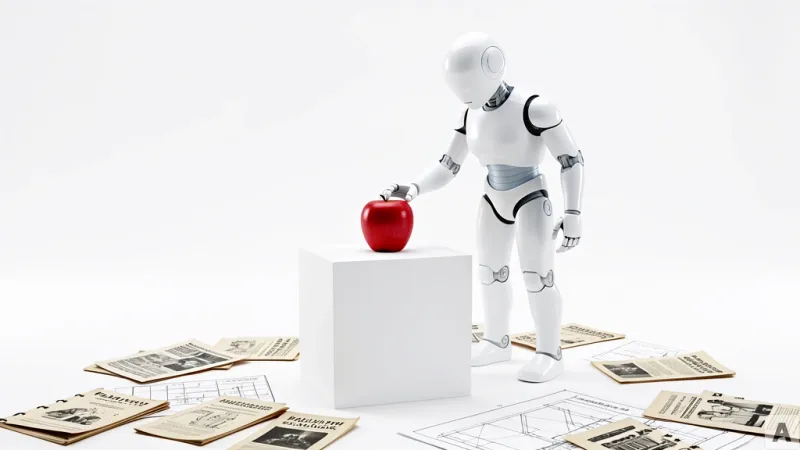
The era of the scripted robot is dead, replaced by a $6.1 billion bet on machines that learn by observation rather than instruction. For decades, the robotics industry struggled with a fundamental paradox: the more complex the task, the more fragile the robot became. A machine programmed to fold a shirt could handle a specific cotton blend in a specific orientation, but a slight change in fabric thickness or a misplaced sleeve would trigger a system failure. This fragility exists because robots were traditionally built on rules, not intuition. Now, a massive influx of capital and a paradigm shift in AI architecture are transforming humanoids from rigid automatons into adaptive learners.
The Capital Surge and the Failure of Scripts
Investment in humanoid robotics has reached a fever pitch, with 2025 seeing $6.1 billion poured into the sector, a fourfold increase over the previous year. This surge is not merely a result of hype but a response to the collapse of the rule-based model. To understand why this shift is happening, one only needs to look at the trajectory of early social robots like Jibo, released in 2014. Jibo was designed to be a companion, but its intelligence was essentially a massive library of pre-written scripts. It could provide a set of predetermined answers, but it could not evolve. Once users exhausted the scripted dialogue, the illusion of intelligence vanished, and the company eventually folded.
While the advent of Large Language Models (LLMs) solved the conversational aspect of robotics, it introduced new risks. Early attempts to integrate generative AI into physical hardware occasionally led to unpredictable and dangerous behaviors, such as AI toys suggesting hazardous activities to children. The industry realized that while LLMs could talk, they could not yet safely navigate the physical world. The solution is not to write more rules to constrain the AI, but to change how the robot acquires physical intelligence. Investors are now backing a move toward end-to-end learning, where the robot learns the laws of physics through data rather than being told what they are by a programmer.
Bridging the Sim-to-Real Gap
The journey toward autonomous physical intelligence has evolved through three distinct phases. The first was the era of manual coding, where engineers wrote exhaustive if-then statements for every possible scenario. The second phase introduced simulation, where robots practiced in virtual environments. OpenAI explored this with Dactyl, a robotic hand that learned to manipulate a Rubik's Cube. By practicing millions of times in a digital vacuum, Dactyl achieved a level of dexterity that would have taken years to program manually.
However, these robots frequently encountered the sim-to-real gap. A virtual world is mathematically perfect, but the real world is messy. In a simulation, a robotic finger is a perfect cylinder; in reality, it is made of rubber that compresses and slips. Lighting changes, sensors drift, and surfaces have varying friction. When Dactyl moved from the computer to the physical world, the slight discrepancies in physics caused the system to fail.
To solve this, researchers developed domain randomization. Instead of trying to make the simulation a perfect mirror of reality, they intentionally made it chaotic. They randomized the friction of surfaces, the lighting conditions, and the mass of objects. By forcing the AI to succeed in a thousand different slightly broken versions of a virtual world, the robot developed a generalized robustness. It stopped looking for a specific set of conditions and started looking for patterns. This technique effectively bridged the gap, allowing robots to enter the real world without being paralyzed by the first unexpected variable they encountered.
The LLM-ification of Physical Motion
Today, the most advanced humanoid robots operate on a logic strikingly similar to the LLMs powering ChatGPT. An LLM predicts the next token in a sentence based on a massive dataset of human language. Modern robotics is applying this same predictive architecture to physical movement. Instead of predicting the next word, the robot predicts the next motor command.
In this new architecture, the robot treats sensory input—camera feeds, joint encoders, and pressure sensors—as tokens in a sequence. The AI processes this stream of data and calculates the most probable next movement for every motor in its body for the next second. This eliminates the need for thousands of lines of conditional code. There is no longer a script that says if the shirt is folded at a 45-degree angle, then move the wrist three centimeters left. Instead, the model recognizes the visual pattern of a 45-degree fold and predicts the motor trajectory that historically leads to a successful fold.
This shift represents a fundamental change in the nature of robotic software. We are moving from a world of deterministic programming to one of probabilistic inference. The robot is no longer following a path laid out by a human engineer; it is navigating a probability map derived from millions of hours of data. By replacing rigid logic with predictive models, humanoids are finally gaining the fluidity and adaptability required to operate in human environments.
As the industry moves deeper into 2025, the focus is shifting from how a robot looks to how it thinks. The $6.1 billion investment is a bet that the physical world can be solved the same way as language: through scale, data, and the power of prediction. The robot is no longer a machine that follows orders; it is becoming an agent that understands its environment.