
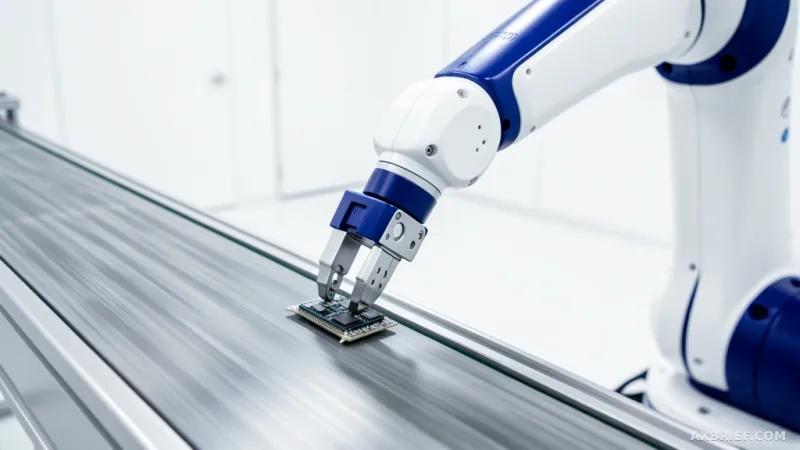
Midnight at a semiconductor assembly plant is defined by a rhythmic, metallic symphony. Robot arms move with such velocity that they leave ghostly blurs in the air, transferring microscopic chips with a precision that defies human capability. In this environment, the difference between a record-breaking shift and a mediocre one is measured in fractions of a second. For the engineers overseeing these lines, the struggle is a constant battle against physics. Increasing speed usually invites instability, while increasing the weight of the components increases inertia, which inevitably drags down the cycle time. In sectors like medical device manufacturing or electronics, where a single spark of static electricity or a speck of dust can scrap an entire batch, the hardware must be as resilient as it is fast.
This delicate balance of speed, power, and environmental stability is the primary target of the new LS-C series from Epson Korea. By rethinking the relationship between the robot's physical reach and its control system, Epson is attempting to break the traditional trade-off between payload capacity and operational velocity.
Expanding Payload and Precision Reach
The LS-C series arrives as the successor to the established LS3-B and LS6-B lines, bringing a significant upgrade to the robot's physical strength. The most immediate improvement is the expanded payload capacity, which now supports 4kg and 8kg options. In practical terms, this means the robots can handle heavier components or more complex end-of-arm tooling without sacrificing the agility that defines the SCARA architecture. Where previous models were limited to lighter tasks, the LS-C can now manage heavier industrial parts, effectively expanding the range of processes that can be fully automated.
To ensure these robots fit into diverse factory layouts, Epson has diversified the arm lengths across four distinct models. The LS4-C401S, designed for a 4kg payload, features a 400mm arm optimized for high-precision work in confined spaces. For heavier lifting, the LS8-C series offers three different reach options to maximize flexibility: the LS8-C502S with a 500mm arm, the LS8-C602S with a 600mm arm, and the LS8-C702S with a 700mm arm. This tiered approach allows manufacturers to select a robot that matches their specific line geometry, avoiding the inefficiency of using a robot that is either too large for the space or too short for the required reach.
This granularity in specification is a response to the reality of the modern factory floor, where no two assembly lines are identical. Some processes require moving heavy parts over short distances, while others require moderate weights to be transported across a wider radius. By offering a spectrum of payloads and arm lengths, Epson has moved away from the one-size-fits-all approach, allowing the robot to be tailored to the process rather than forcing the process to adapt to the robot. The jump to an 8kg payload in the LS8-C series is particularly notable, as it enables the automation of tasks that previously required human intervention or much larger, slower robotic systems.
The 0.1 Second Gap and the RC800-A Synergy
The true disruption of the LS-C series lies not in its strength, but in its timing. In industrial automation, the cycle time—the duration it takes for a robot to complete one full operation and return to its starting position—is the ultimate metric of success. For the LS4-C401S, the cycle time has been slashed from 0.42 seconds to 0.336 seconds. Similarly, the LS8-C502S has seen its time drop from 0.39 seconds to 0.298 seconds. Other models in the lineup, such as the LS8-C602S and LS8-C702S, have achieved cycle times of 0.314 seconds and 0.344 seconds, respectively.
While a difference of 0.1 seconds seems negligible to a human observer, it is transformative when scaled across millions of repetitions in a 24-hour production cycle. This acceleration is made possible by the integration of the RC800-A controller, which serves as the robot's nervous system. By optimizing the way commands are calculated and executed, the controller eliminates unnecessary acceleration and deceleration phases, smoothing out the robot's trajectory. This hardware is paired with the Epson RC+ 8.0 software, which acts as the brain, calculating the most efficient path for the arm to travel. Together, they reduce the physical distance the arm must move and the time it takes to do so.
One of the most significant technological leaps in this integration is the Catch on Fly feature. Traditionally, a robot had to wait for a part on a conveyor belt to come to a complete stop before picking it up. The Catch on Fly technology allows the LS-C to synchronize its movement with the moving belt, snatching the part without stopping the flow of production. This removes the acceleration and deceleration lag entirely. To prevent the high-speed movement from damaging fragile parts, Epson has integrated force sensors that allow the robot to detect the exact moment of contact and adjust its grip with surgical delicacy. The result is a system that combines the speed of a high-velocity machine with the tactile sensitivity of a human hand.
These optimizations culminate in a 20% average increase in productivity across the entire LS-C lineup. By reducing the cycle time while simultaneously increasing the payload, Epson has solved the classic dilemma of industrial robotics. The 20% efficiency gain does more than just increase output; it removes bottlenecks in the production line, reducing the overall cost of manufacturing and allowing companies to produce more units with the same amount of energy and floor space.
Shielding Against the Invisible Killers
Beyond speed and power, the LS-C series addresses the environmental hazards that plague high-tech manufacturing. In semiconductor and electronics production, the two greatest enemies are dust and electrostatic discharge (ESD). A single microscopic particle or a tiny spark of static electricity can incinerate a circuit or render a chip useless. To combat this, Epson has introduced dedicated Clean and ESD specifications for the LS-C series.
ESD specifications involve specialized surface treatments and internal grounding designs that prevent the buildup of static electricity, ensuring that charges are safely dissipated rather than discharging into a sensitive component. This is critical for the assembly of modern electronics, where components are becoming smaller and more susceptible to electrical failure. Simultaneously, the Clean specification ensures that the robot does not emit particles or attract dust, making it suitable for sterile environments. This allows the LS-C to be deployed in medical device manufacturing and cosmetics production, where purity is a non-negotiable requirement.
Previously, achieving this level of cleanliness often required building expensive cleanroom enclosures around the robot or applying costly third-party coatings. By integrating these standards into the robot's native design, Epson has lowered the barrier to entry for high-speed automation in the pharmaceutical and beauty industries. This expansion into non-electronic sectors demonstrates a strategic shift toward a broader range of automated applications, from the sterile labs of a biotech firm to the high-speed lines of a food processing plant.
For the Korean manufacturing sector, these advancements arrive at a critical juncture. The industry is currently grappling with rising labor costs and a dwindling supply of skilled technicians. As the demand for precision increases—particularly in the automotive electronics sector for electric and autonomous vehicles—the need for robots that can handle smaller, more complex parts at higher speeds has become urgent. The LS-C series represents a shift toward a new era of automation where the robot is no longer just a tool for repetition, but a precision instrument capable of adapting to the most demanding environmental and temporal constraints of modern industry.
This evolution in SCARA technology suggests a future where the gap between human dexterity and robotic speed finally closes, turning the fraction of a second into a competitive advantage.