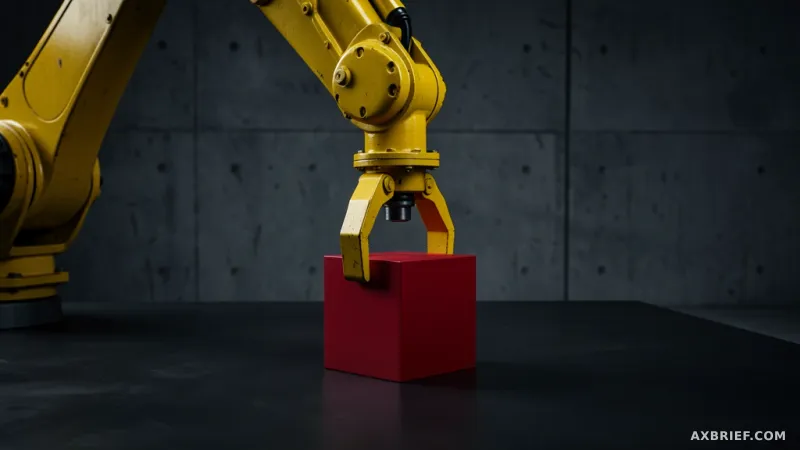
Imagine a high-precision assembly line where a robotic arm moves with millimetric accuracy, repeating the same arc thousands of times a day. Now imagine a single component is shifted just one centimeter to the left. In the current state of industrial automation, that tiny discrepancy is a catastrophe. The robot does not see the shift; it simply follows its hard-coded coordinates, grasping at empty air or, worse, crushing the part into scrap. This rigidity has been the invisible ceiling of the manufacturing world for decades, creating a tension where precision is bought at the cost of total inflexibility. The entire environment must be bent to the will of the robot, because the robot cannot bend to the environment.
The Strategic Integration of Google AI Agents
FANUC, the world's largest supplier of industrial robots and factory automation, is attempting to shatter this ceiling through a strategic partnership with Google. The core of this collaboration is the deployment of Physical AI—artificial intelligence that does not merely process data in a vacuum but interacts directly with the physical world. Rather than adding a simple layer of software, FANUC is integrating Google's AI agents into the very heart of its robot operations. An AI agent differs from a standard program in its ability to set its own goals, plan the necessary steps to achieve them, and execute those steps using available tools. In the context of a factory floor, this means the robot evolves from a blind machine following a script into an intelligent entity capable of real-time perception and decision-making.
To facilitate this, FANUC is pivoting toward an open platform strategy. Historically, industrial robotics has been a closed ecosystem. Engineers had to use proprietary languages and rigid frameworks to program every single joint movement. By opening its platform, FANUC is creating a standardized environment where Google's latest AI models can be deployed flexibly across the entire product lineup. This transition is akin to the shift from feature phones to smartphones. Just as the App Store allowed phones to evolve from simple calling devices into multipurpose tools, FANUC's open platform allows robots to be updated with new capabilities via software without requiring a complete hardware overhaul. This integration extends from simple assembly bots to high-performance automation systems, ensuring that the speed of automation is no longer limited by the speed of manual programming.
For those seeking technical specifics on the hardware being enhanced, the official FANUC America portal provides the baseline for the machinery now receiving these intelligence upgrades. The goal is a manufacturing environment where a human operator can give an intuitive command to an AI agent, and the agent, in turn, translates that high-level goal into the precise physical movements required to complete the task.
From Hard-Coded Coordinates to Cognitive Mapping
The fundamental shift occurring here is the move from coordinate-based control to cognitive-based control. For years, the industry has relied on hard-coding, where a robot is told to move from Point A to Point B to Point C. This is essentially a train on a track; it is incredibly fast and efficient as long as the track is perfect, but a single pebble on the rail causes a derailment. When a product's shape changes slightly or a part is misaligned, the entire sequence fails, requiring a human engineer to rewrite thousands of lines of code to adjust the coordinates. This creates a massive operational bottleneck, as the cost of flexibility is prohibitively high.
Physical AI changes the paradigm by introducing a mapping process that mimics the relationship between a biological brain and its muscles. When a human decides to pick up an apple, the brain does not calculate the exact X-Y-Z coordinates of every finger joint in advance. Instead, it sends a high-level command, and the nervous system handles the real-time adjustments based on visual and tactile feedback. Google's AI agents bring this capability to the factory. The AI uses visual data to identify the object's current position and orientation, then translates that understanding into the physical language of motor speeds and joint angles.
This process is governed by a continuous feedback loop. The AI agent does not just send a command and hope for the best; it observes the result of the movement in real-time and corrects the trajectory mid-action. If the part slips, the AI perceives the error and adjusts the grip instantly. This is where the open platform becomes critical. Because different robots have different physical constraints, the platform acts as a universal adapter, translating the AI's high-level cognitive decisions into the specific mechanical requirements of the hardware. The intelligence is decoupled from the machine, meaning the same AI logic can be applied to a small collaborative robot or a massive automotive welding arm, provided they share the same open interface.
Redefining Operational Efficiency and the Human Role
This transition fundamentally alters the economics of the factory floor. The most immediate impact is the drastic reduction in setup and calibration time. In a traditional setup, the developer is a coder, spending hours calculating trajectories and debugging coordinate errors. With AI agents, the developer becomes a system architect. Instead of defining how the robot should move, they define what the robot should achieve. This shifts the workload from the tedious task of joint-angle calculation to the high-level design of the production flow.
Operational efficiency increases because the system gains an inherent ability to handle variance. In a Physical AI-driven plant, a misaligned part is no longer a system-stopping error; it is a variable that the robot solves on the fly. This introduces a level of process flexibility that was previously only possible with human workers. Much like a skilled technician who can adapt to a new part based on experience, the AI-powered robot uses its learned models to determine the most stable angle for a grip or the most efficient path to a target. This reduces the need for expensive, ultra-precise jigs and fixtures that were previously required to ensure parts were always in the exact same spot.
Furthermore, the integration of AI across the entire product line allows for organic cooperation between different types of robots. When multiple machines operate on a shared AI framework, they can coordinate their movements and hand off parts with a level of fluidity that hard-coded systems cannot match. The factory ceases to be a collection of isolated machines and becomes a single, integrated organism. The role of the operator shifts from manual troubleshooting to supervisory management, where they review the AI's proposed optimizations and approve them, rather than manually correcting coordinates in a terminal.
This evolution marks the end of the era of rigid automation and the beginning of the era of autonomous manufacturing. By bridging the gap between digital intelligence and physical action, the partnership between Google and FANUC is turning the factory floor into a programmable environment where hardware is as flexible as software.