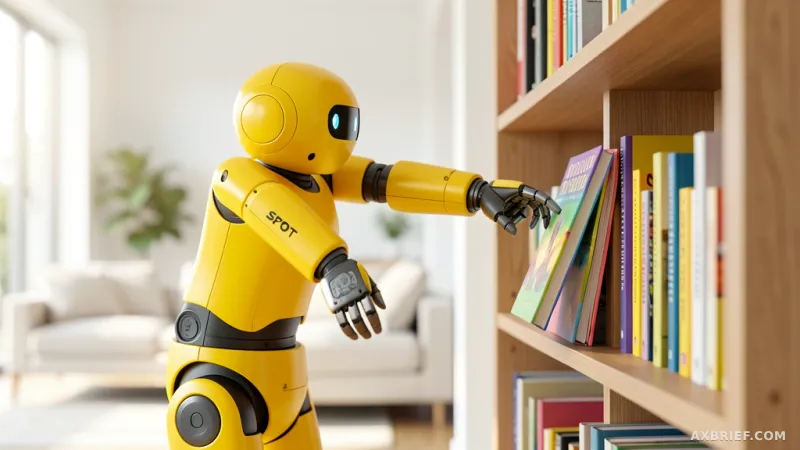
A yellow robotic canine navigates a cluttered living room floor in a Boston Dynamics laboratory. Scattered shoes and empty beverage cans litter the carpet, but there is no human operator clutching a tablet or steering the machine through a joystick. Instead, the robot pauses, processes a text command written on a nearby whiteboard, and begins to methodically clear the room. This is not a pre-programmed routine or a scripted demonstration, but the result of a vision-language model interpreting the physical world and translating human intent into robotic action.
The Technical Integration of Gemini Robotics-ER 1.5 and Spot
This capability emerged from a project showcased at the 2025 Boston Dynamics Hackathon, where researchers integrated Gemini Robotics-ER 1.5 into the Spot platform. At its core, Gemini Robotics-ER 1.5 is a vision-language model (VLM) designed to process visual data and linguistic instructions simultaneously. By applying this model to Spot, the team provided the robot with embodied reasoning, which is the ability of an AI to understand its environment and execute physical actions based on that understanding. To make this possible, the developers built a specialized intermediary layer that connects the Gemini Robotics framework with the Spot SDK.
Gemini Robotics does not control the robot's motors directly; instead, it operates through a restricted set of tools. In this architecture, a tool is a lightweight script that executes internal logic and converts the high-level inputs from Gemini Robotics into actual API calls that the robot can understand. For this specific implementation, the researchers limited the AI to five core actions: moving to a specific location, capturing an image, identifying an object, grabbing an item, and placing an item. By constraining the model to these verified tools, the system ensures that the AI remains within the operational boundaries of the hardware while still maintaining the flexibility to sequence these actions dynamically.
From Rigid State Machines to Natural Language Prompts
For years, the standard for robotic task execution has been the state machine. In a state machine architecture, every possible movement and reaction must be defined in advance. Developers write exhaustive logic trees where if the robot encounters condition A, it must perform action B. While reliable, this approach is incredibly brittle; if a shoe is placed two inches outside the expected zone or a new obstacle appears, the entire sequence often fails because the specific state was not pre-defined by the programmer.
The integration of Gemini Robotics-ER 1.5 fundamentally reverses this workflow. Rather than writing software logic, the operator provides a natural language prompt. The model interprets the goal, analyzes the visual feed, and decides which of the five available tools to call and in what order. This shift transforms the developer's role from a coder of movements to a curator of intent. However, the experiment revealed that the precision of the language used is critical to the robot's success. Simple commands to place an object often failed to produce the desired result. The performance improved significantly only when the prompt included environmental context, such as noting that the robot's front camera is positioned low and may struggle to capture images of objects placed on higher surfaces.
This nuance demonstrates that the model is not merely translating words to code, but is actually accounting for the physical limitations of the robot's hardware within its reasoning process. This shift also redefines the human-robot relationship. Previously, a human operator acted as the pilot, using a tablet to precisely guide the robot and a grabbing wizard to designate targets. With Gemini Robotics-ER 1.5, the AI assumes the role of the pilot and the tablet, leaving the human to act as a high-level manager who provides a task list rather than a set of coordinates.
In practice, this manifests as a real-time feedback loop. When commanded to pick up an object, Gemini Robotics requests a current image, identifies the shoe or can in the frame, and then triggers the pickup command. If the API returns an error indicating that the robot is already holding an object, the model does not crash or loop indefinitely. Instead, it processes that feedback and immediately adjusts its next action, such as moving to drop the current item before attempting the new pick-up. Despite this autonomy, the system is strictly gated; the AI cannot invent new capabilities or bypass the API limits, ensuring that the robot remains safe and predictable.
For developers, this architecture serves as a force multiplier. The ability to bypass the manual implementation of complex task logic in favor of dynamic AI orchestration allows for much faster application scaling. Instead of spending weeks mapping out every possible state for a warehouse or home environment, developers can define a robust set of APIs and let the VLM handle the situational logic.
The true utility of embodied AI lies not in its ability to create new functions, but in its capacity to orchestrate existing, proven APIs with human-like precision.