
Imagine a 911 dispatch center in a congested American city. A high-priority emergency call comes in, and as the police and fire departments scramble, their vehicles immediately hit the wall of rush-hour traffic. In the traditional model, the first responder is a human in a vehicle, fighting through physical friction to reach a scene. But in a growing number of jurisdictions, the first responder is already in the air. Before the sirens even reach the neighborhood, a quadcopter has launched from a rooftop, navigated the skyline, and provided a live, high-definition feed of the situation to dispatchers. This shift from human-led response to Drone as First Responder (DFR) is no longer a pilot program; it is becoming the new standard for urban safety.
The Industrial Scale of the DJI Vacuum
Skydio has recently secured $110 million in Series F funding, a move that signals a strategic pivot from venture-backed growth to industrial scaling. While the funding amount is a nine-digit figure, it is relatively modest compared to the company's $4.4 billion valuation. This disparity is intentional. According to CEO Adam Bry, the smaller relative size of the raise indicates that Skydio has entered a phase of self-sufficiency, where external capital is no longer needed for basic survival but is instead used as a precision tool for expansion. The company is no longer chasing a valuation peak; it is building a factory.
This financial foundation supports a massive industrial ambition: a $3.5 billion investment over the next five years to expand manufacturing within the United States. This is not merely a patriotic gesture but a calculated response to a massive market void. As the US federal government pushes public and private agencies to decouple from DJI, the dominant Chinese drone manufacturer, a vacuum has opened in the domestic market. Skydio is positioning itself not just as a replacement product, but as a sovereign infrastructure provider. By investing billions into a domestic supply chain, the company aims to create 3,000 new jobs and eliminate the geopolitical risks associated with foreign hardware.
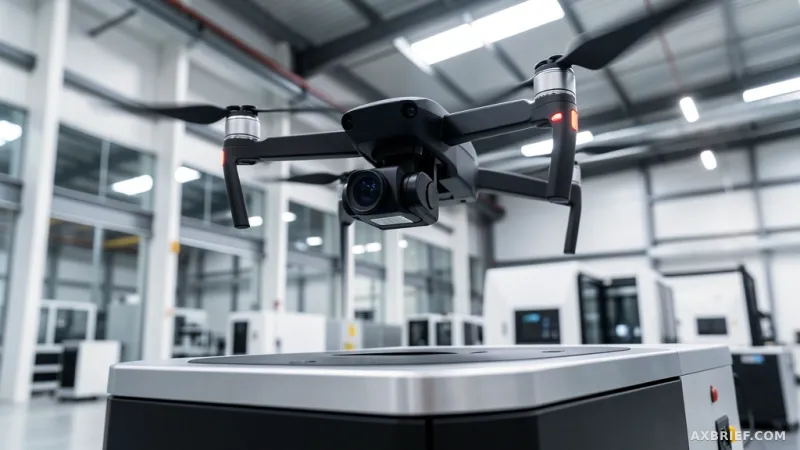
Central to this expansion is the pursuit of extreme manufacturing efficiency. Skydio is focusing heavily on automation to slash lead times and respond to market demand in real-time. The benchmark for this efficiency is the R10 quadcopter. The company has set an aggressive goal to bring the assembly time for the R10 down to under one hour. By automating the production line, Skydio intends to drive down unit costs and increase throughput, ensuring that the transition from DJI to US-made hardware is seamless and economically viable for municipal budgets.
From Robot Chauffeurs to Remote Deployment
To understand why Skydio is investing so heavily in hardware, one must look at the friction of traditional drone operations. For years, using a drone meant hiring a pilot who had to physically transport the aircraft to a site, unpack it, and launch it. Skydio describes this legacy model as essentially hiring an Uber driver for a robot. The drone might fly at 60 miles per hour, but it only moves as fast as the human carrying it in a car. This human-centric bottleneck rendered drones useless for true emergency response, where seconds determine outcomes.
Skydio has solved this friction through the implementation of the automated charging Dock. The Dock is a remote, weather-proof base station that keeps a quadcopter in a state of constant readiness. When a 911 call is received, a remote pilot does not need to drive anywhere; they simply trigger the launch from a command center. This transforms the drone from a tool carried by a person into a piece of permanent urban infrastructure. The result is a dramatic compression of response times: launch times in urban environments are now under 20 seconds, and the drone can arrive at the scene in less than 90 seconds.
This capability is amplified by a sophisticated software stack that acts as a force multiplier. The Pathfinder flight optimization and control software, combined with NightSense for low-light visualization, reduces the cognitive load on the operator. Instead of fighting with manual controls, the pilot manages the mission via high-level commands. This allows a single remote operator to manage multiple drones across a city, shifting the operational ratio from one-to-one to one-to-many.
The physical footprint of this network is already substantial. Approximately 16 million people in the United States now live within a two-mile radius of a Skydio Dock. This coverage area represents a strategic moat. Once a city installs the Dock infrastructure and integrates the software into its emergency workflow, the cost of switching to another provider becomes prohibitively high. The 2-mile radius is not just a distance metric; it is a boundary of serviceability that Skydio intends to expand aggressively by the end of the year.
The Strategy of Vertical Integration
Skydio's approach is defined by a commitment to full-stack control. By designing the hardware, writing the firmware, and developing the operational software, the company avoids the bottlenecks inherent in modular systems. In a typical drone setup, a company might use a third-party flight controller, a separate camera module, and a generic cloud platform. When a customer requests a specific feature or a bug is found, the manufacturer must coordinate across multiple vendors, leading to slow iteration cycles.
By owning the entire stack, Skydio can perform micro-adjustments across the whole system. If a new sensor is added to the R10, the software team can immediately optimize the Pathfinder algorithms to leverage that sensor's data without waiting for a third-party update. This vertical integration is what enables the 90-second arrival time and the high reliability required for public safety. The hardware is designed specifically to fit the Dock, and the software is designed specifically to maximize the hardware's endurance and visibility.
This strategy also serves as a hedge against the volatility of the global electronics supply chain. By investing $3.5 billion into US-based manufacturing, Skydio is insulating itself from the same trade tensions that crippled its competitors. The goal is a closed-loop system where the design, production, and deployment of the DFR network happen entirely within a controlled domestic ecosystem. This is no longer just about selling drones; it is about owning the aerial layer of city management.
As the boundary between robotics and urban infrastructure blurs, the ability to deploy sensors remotely and instantly becomes a critical utility. Skydio is betting that the future of the industry lies not in the aircraft themselves, but in the network that sustains them.