
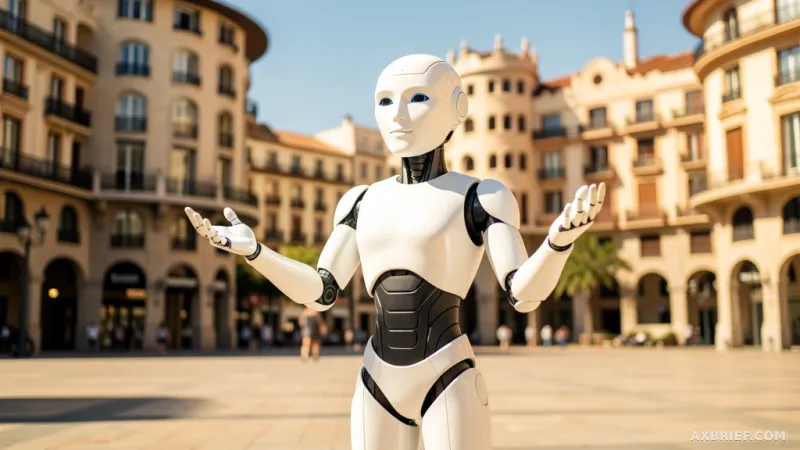
The atmosphere at a high-profile international event in Barcelona is typically defined by polished slide decks, rehearsed speeches, and the static hum of corporate booths. This week, however, the routine was broken by a figure clad in traditional Chinese attire, moving with a fluidity that defied the typical rigidity of robotics. As hundreds of political, economic, and technical leaders looked on, the figure didn't just deliver a speech; it performed a three-minute dance, blending rhythmic precision with cultural storytelling. This was not a pre-recorded animation or a remote-controlled puppet, but a live demonstration of a machine attempting to navigate the most unpredictable environment of all: a public social gathering.
The Lingxi X2 and the Shanghai Summer 2026 Showcase
The robot is the Lingxi X2, the latest humanoid offering from AgiBot. It made its high-profile European debut at the Shanghai Summer 2026 event, a strategic initiative hosted by the Shanghai Municipal Government and the Shanghai Municipal Commission of Commerce. The event was designed to strengthen international ties with the city of Barcelona and promote the cultural and economic value of Shanghai to a global audience. In this context, the Lingxi X2 was not positioned as a mere piece of hardware on display, but as the primary interface for the city's branding efforts.
The robot's primary mission was to communicate a specific, complex administrative detail: Shanghai's 240-hour visa-free transit policy. This policy, designed to attract foreign tourists and investors by allowing short-term stays without a traditional visa, requires clear communication to be effective. The Lingxi X2 handled this by switching seamlessly between Chinese and Spanish, explaining the nuances of the policy to an audience of international dignitaries.
Beyond the linguistic task, the robot executed a three-minute dance performance. For the casual observer, this was entertainment; for the developers in the room, it was a stress test of motion control. The robot maintained balance and rhythm while wearing traditional clothing, which adds physical variables and potential snag points that typically plague humanoid movement. Following the performance, the Lingxi X2 entered a real-time Q&A session, responding to spontaneous questions from the crowd with a speed and contextual awareness that suggested a deep integration of large language models (LLMs) and hardware interfaces.
Bridging the Gap Between Lab Prototypes and Field Agents
The technical significance of the Lingxi X2's performance lies in the transition from controlled environments to the wild. In a laboratory, a robot operates in a vacuum of predictability where lighting is constant and noise is filtered. A public event in Barcelona, however, is a chaos of acoustic interference, varying floor surfaces, and unpredictable human interaction. The fact that the Lingxi X2 could maintain its balance during a dance and process auditory input for a Q&A session indicates a significant leap in edge-case handling.
From a motion perspective, the fluidity of the dance suggests a sophisticated approach to actuator response and torque control. Most humanoids suffer from a jerky, stop-and-go motion profile because their control loops struggle to manage the momentum of their own limbs. The Lingxi X2's ability to modulate acceleration and deceleration to match a musical rhythm implies that AgiBot has optimized the interplay between its hardware joints and its software control algorithms. The robot is not simply following a set of coordinates; it is managing its center of gravity in real-time to maintain stability while executing complex gestures.
Even more critical is the integration of the linguistic pipeline. The process of taking a spoken question in Spanish, converting it to text, processing it through an LLM to generate a logically sound answer about visa policy, and then synthesizing that answer back into speech—all while maintaining a natural conversational cadence—requires extremely low latency. Any delay over a few hundred milliseconds breaks the illusion of intelligence and turns the interaction into a frustrating exchange with a slow computer. The Lingxi X2's ability to handle this flow suggests that AgiBot has optimized the inference pipeline, likely using a combination of edge computing and highly efficient model quantization to ensure the robot feels present and responsive.
This shift represents a fundamental change in the role of the humanoid. For years, the industry has focused on the robot as a tool for physical labor—moving boxes in a warehouse or assembling parts on a line. By deploying the Lingxi X2 as a diplomatic agent, AgiBot is arguing that the true value of a humanoid lies in its ability to serve as a high-fidelity interface. It is the difference between a kiosk and a concierge. The robot is no longer just a machine that does work; it is a machine that manages an experience.
The Expansion into Retail, Logistics, and Manufacturing
While the Barcelona debut focused on the soft skills of diplomacy and culture, AgiBot has made it clear that the Lingxi X2 is part of a broader industrial strategy. According to company representatives, these robots have already moved past the prototype stage and are being deployed within China across the retail, logistics, and manufacturing sectors. This is where the theoretical precision of the lab meets the brutal reality of the factory floor.
In retail environments, the robot must navigate crowded aisles and interact with customers who do not follow a script. In logistics, it must handle varying weights and dimensions of cargo while avoiding collisions with human workers. In manufacturing, it must maintain micron-level precision over thousands of repetitions. These are the true benchmarks of humanoid viability. The ability to perform a dance in Spain is a signal to the market that the underlying stability and intelligence systems are robust enough to handle these industrial demands.
For AI practitioners, the Lingxi X2 serves as a case study in the convergence of embodied AI and generative AI. The robot is essentially a physical manifestation of an LLM, where the output is not just text on a screen, but a gesture, a step, or a spoken word in a foreign language. This convergence allows the robot to handle the ambiguity of human language and the complexity of physical space simultaneously. When the robot explains a visa policy, it isn't just reciting a database; it is using a reasoning engine to ensure the information is delivered in a way that makes sense to the specific person asking the question.
This trajectory suggests that the next generation of humanoid robots will not be defined by their strength or their speed, but by their reliability in the face of uncertainty. The move from the lab to the field is the hardest transition in robotics, and by placing the Lingxi X2 in the middle of a diplomatic event in Spain, AgiBot is claiming that it has solved the most difficult part of that equation: the ability to function predictably in an unpredictable world.
The era of the humanoid as a laboratory curiosity has ended, replaced by the rise of the autonomous service agent.