
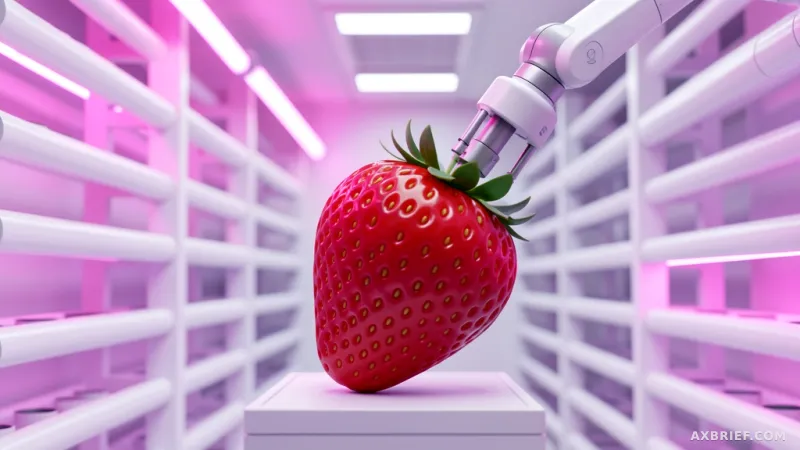
The vertical farming industry is currently weathering a brutal winter. Across the globe, high-profile indoor farming ventures have collapsed under the weight of astronomical energy costs and the harsh reality that growing leafy greens in a warehouse is often a losing game of margins. While the sector struggles with a crisis of profitability, a different kind of narrative is emerging from the intersection of robotics and luxury agriculture. One company is not just surviving this downturn but is aggressively expanding its footprint by treating the strawberry not as a commodity, but as a high-precision engineering challenge.
The $150 Million Blueprint for Commercial Scale
Oishii Farm Corp. recently closed a Series C funding round, securing $150 million to accelerate its robotic vertical farming operations. This latest injection of capital brings the company's total funding to $370 million. While the headline figure is impressive, the composition of the investor group reveals a calculated strategy to solve the physical bottlenecks of indoor farming. The round was led by Sparks Asset Management, but the inclusion of Nomura Real Estate Development, the MISUMI Group, and Mizuho Bank suggests that Oishii is building more than just a farm. By aligning with real estate giants, automation component suppliers, and major financial networks, the company is securing the three pillars of industrial scaling: physical space, a reliable hardware supply chain, and long-term capital stability.
This capital is earmarked for a specific transition from research and development to commercial dominance. Since its founding in 2017, Oishii focused heavily on the R&D of pollination and indoor cultivation systems. The Series C funds are now being deployed to expand farm infrastructure and refine robotic integration across its facilities in the United States and Japan. A central piece of this strategy is the Open Innovation Center in Tokyo, which serves as the technical nerve center where the company iterates on its automation software before deploying it to production sites. To further bolster its technical moat, Oishii acquired Tortuga AgTech, a move that internalized critical harvesting robotics and engineering expertise, ensuring that the company owns the entire intellectual property stack from seed to shelf.
Digitizing the Art of the Strawberry
Most vertical farming failures stem from a lack of differentiation; growing lettuce in a controlled environment offers little value-add over traditional farming when energy costs are factored in. Oishii pivoted toward the strawberry, one of the most difficult crops to grow indoors due to the complexities of pollination, fragility, and strict freshness requirements. The core tension in robotic farming is the gap between environmental control and biological precision. While competitors focused on adjusting temperature and humidity, Oishii focused on the reproductive cycle of the plant. By digitizing traditional Japanese farming techniques, they have replaced the intuitive, manual work of expert farmers with robotic precision and data-driven algorithms, effectively removing human error from the pollination process.
This engineering approach extends to the harvest. Strawberries are notoriously delicate, and traditional mechanical grippers often bruise the fruit, rendering it unsellable in the premium market. Through the integration of Tortuga AgTech's robotics, Oishii has implemented advanced vision systems and precision grippers that can identify ripeness and harvest the fruit without compromising its structural integrity. However, software precision is useless without hardware reliability. This is where the partnership with MISUMI becomes critical. By utilizing standardized, high-precision automation parts, Oishii reduces system downtime and avoids the lead-time risks associated with custom-built hardware. They have essentially transformed a biological process into an automated pipeline, combining traditional agricultural wisdom with industrial robotics.
This technical evolution has enabled a radical shift in market positioning. For years, Oishii was known for its Omakase Berry, a luxury product that commanded prices as high as $50 per pack. While this established the brand as a symbol of ultra-premium quality, it limited the company's total addressable market. The current strategy is a pivot toward mass-premium accessibility. With the introduction of the Koyo Berry and Nikko Berry, Oishii has introduced price points ranging from $4.99 to $15. This is not a race to the bottom, but a move toward economies of scale. By lowering the barrier to entry, Oishii is transitioning from a niche luxury provider to a scalable food technology brand.
Scaling the Cold Chain and the Plastic Problem
Expanding a fresh produce business requires more than just growing the crop; it requires solving the physics of logistics. Oishii has expanded its distribution network to 18 U.S. states and recently entered the Canadian market via Toronto. To support this geographic expansion, the company had to solve the problem of shelf-life and waste. Fresh strawberries are highly perishable, and the traditional plastic clamshell packaging is both environmentally detrimental and inefficient for long-distance transport.
In a strategic move to optimize its supply chain, Oishii introduced top-seal packaging for its Nikko Berry line. This transition reduced plastic usage by 80% and, more importantly, improved the seal's integrity, which extends the freshness of the berries and reduces spoilage during transit. This packaging shift is a pragmatic solution to the logistics of scaling; by increasing the window of viability for the product, Oishii can push its distribution further from the farm without increasing the waste ratio. This allows the company to maintain a consistent presence in diverse markets while improving the overall profitability of each shipment.
To hedge against the inherent risks of fresh produce, Oishii is also diversifying its product portfolio. The launch of a Premium Preserves line of high-end jams allows the company to monetize surplus production and capture a share of the luxury pantry market. This strategy mitigates the volatility of the fresh fruit market and ensures that the high-cost infrastructure of the vertical farm is utilized at maximum capacity. By blending fresh retail, preserved goods, and a tiered pricing strategy, Oishii is building a diversified revenue stream that protects it from the boom-and-bust cycles of agricultural production.
With its R&D hub in Tokyo feeding into a massive distribution network across North America, Oishii is proving that the future of vertical farming lies not in competing with the field, but in engineering a superior biological product. The company has successfully moved past the proof-of-concept stage, turning the art of the strawberry into a scalable, robotic industry.