
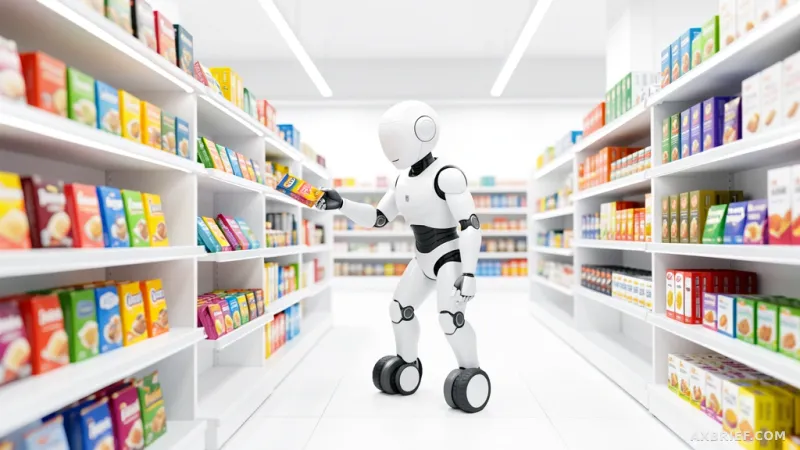
Ten seconds. That is the precise window between a customer placing an order and a humanoid robot navigating to a shelf, gripping a bottle of cola, and delivering it to the checkout counter. This speed matches or exceeds that of a trained human clerk, but the real breakthrough is not the velocity itself. It is the fact that this entire operation occurs within a cramped 15-square-meter footprint, operating 24 hours a day without a single human employee on site. In the heart of Hefei, China, this tiny storefront is proving that the physical constraints of urban real estate can be overcome by integrating high-precision robotics into the retail experience.
The Mechanics of the Zerith H1
The storefront in Hefei operates on a modest 3x5 meter plot, yet it manages a density of over 1,000 visitors per day. The operation is managed by a robot employee named Xiaomai, powered by the Zerith H1, a wheel-based humanoid robot developed by Zerith. Unlike traditional automated retail, which relies on static shelving and customer self-service, the Zerith H1 handles the entire fulfillment chain: identification, picking, sorting, and transport. The robot is equipped with a 3D multimodal sensing system that integrates visual and tactile data to identify products and navigate the tight environment with millimeter precision.
This technical foundation was built by a team of Tsinghua University graduates who founded Zerith with a specific strategic goal. Rather than chasing general-purpose humanoid capabilities, they focused on maximizing automation efficiency within the specialized constraints of micro-retail. By shrinking the logic of a massive automated logistics center into a 15-square-meter space, they created a system where the robot can pivot and stop instantly, avoiding the balance issues associated with bipedal movement. The result is a seamless loop where a product is delivered in under 10 seconds, regardless of whether it is a standardized soda bottle or a freshly brewed cup of coffee.
Commercial viability is already appearing in the data. In March, Zerith deployed three identical models in Shanghai. During the early May holiday period, one of these stores recorded weekly revenue exceeding 20,000 yuan. With peak daily orders surpassing 1,000 units, the operational data suggests a remarkably short investment recovery period. Zerith estimates that the return on investment (ROI) for a single unit is approximately one year, a figure that transforms the humanoid robot from a high-tech novelty into a sustainable business asset.
Shifting the Burden of Labor
To understand why the Zerith H1 is a departure from existing trends, one must look at the definition of unmanned retail. Until now, most unmanned stores have focused on automating the payment phase. In those models, the customer still performs the physical labor of browsing, picking, and carrying the item to a kiosk. The automation is passive, existing only to remove the cashier. The Zerith H1 flips this dynamic by automating the physical labor itself. The robot becomes the active agent, shifting the burden of picking and transport from the consumer to the machine.
This shift enables a radical reimagining of store layout. Traditional stores require wide aisles to accommodate human movement and browsing. Because the Zerith H1 operates on a mathematically optimized path within a 3x5 meter area, it eliminates the need for customer-accessible aisles entirely. The store ceases to be a place where people walk and becomes a high-density logistics node where products are pushed to the edge for pickup. This spatial efficiency is a critical competitive advantage in high-rent urban centers where every square centimeter impacts the bottom line.
Furthermore, the Zerith H1 overcomes the rigidity of traditional vending machines. A vending machine is limited by its hardware; changing the product size often requires a total mechanical overhaul. The H1, however, uses its 3D multimodal sensing system to calculate the volume and center of gravity of any object within its reach. This allows the store to change its inventory on the fly. Whether the robot is handling a fragile snack bag or a liquid-filled coffee cup, the system adjusts its acceleration and grip strength in real-time to prevent spills or damage. This software-defined flexibility allows the retailer to pivot their product mix based on daily demand without touching a single screw of the hardware.
Beyond the logistics, Zerith has integrated social interaction capabilities into the H1. The robot can engage in light conversation and tell jokes, transforming a sterile transaction into a service experience. This layer of emotional interaction is designed to bridge the gap between a mechanical dispenser and a retail clerk, ensuring that the efficiency of automation does not come at the cost of customer engagement. By combining high-speed logistics with social AI, the Zerith H1 functions as both a warehouse manager and a storefront ambassador.
The ROI of Robotic Precision
The financial success seen in the Shanghai deployments is a direct result of reducing operational volatility. Human staffing involves shift rotations, management overhead, and variable performance. The Zerith H1 provides a constant, predictable output 24 hours a day. When a store can process 1,000 orders daily without labor costs, the revenue generated during off-peak hours—which would typically be unprofitable for a human-staffed store—becomes pure margin. This constant availability is what drives the estimated one-year ROI.
However, the scalability of this model depends on the standardization of the goods. The current success with drinks and snacks is possible because these items fit within the robot's optimal gripping range and weight tolerances. As Zerith looks to expand the variety of goods, the challenge will shift from basic movement to advanced manipulation. The 3D multimodal system must evolve to handle non-rigid objects or items with irregular textures. Despite this, the current data proves that for a specific subset of retail, the humanoid form factor is no longer an experimental luxury but a tool for operational optimization.
For the broader retail industry, the Zerith H1 represents the transition from passive automation to active robotic agency. It proves that the most valuable application of humanoid robotics may not be in the home or the factory, but in the hyper-dense, high-turnover environment of the urban micro-store. By treating the retail floor as a miniature warehouse and the robot as the sole operator, Zerith has created a blueprint for a low-overhead, high-density commerce model.
This evolution suggests a future where the physical storefront is no longer a place for browsing, but a precision delivery point for automated agents.