The modern professional feed is currently a minefield of predictable patterns. Anyone who spends an hour on LinkedIn or X can spot the telltale signs of a generative AI prompt: the overly polite transitions, the repetitive structural cadence, and the hollow enthusiasm of phrases like in today's fast-paced digital landscape. For a while, the prevailing narrative was that these tools were an inevitable tide, and the only way to survive was to swim with the current. Tech executives and venture capitalists framed AI adoption as a binary choice between evolution and extinction. But a subtle, sharp shift is occurring. The novelty has worn off, and in its place is a growing cynicism toward the quality of the output and the insistence that AI is a panacea for every business failure.
The Great Divide: Boardroom Faith vs. User Fatigue
This disconnect is most visible where massive capital meets desperate corporate restructuring. Billionaire investor Byron Allen recently acquired a 52% stake in BuzzFeed, the viral media giant, effectively taking control of the company. The move is less a traditional acquisition and more an attempt to deploy a financial lifeboat to a sinking ship. The core premise of this investment is the belief that AI can pivot the company back to profitability. This faith is so absolute that the organizational structure was overhauled to reflect it, with founder Jonah Peretti stepping down as CEO to take on the specialized role of President of BuzzFeed AI. To the board and the investors, AI is the only viable exit strategy from a financial crisis.
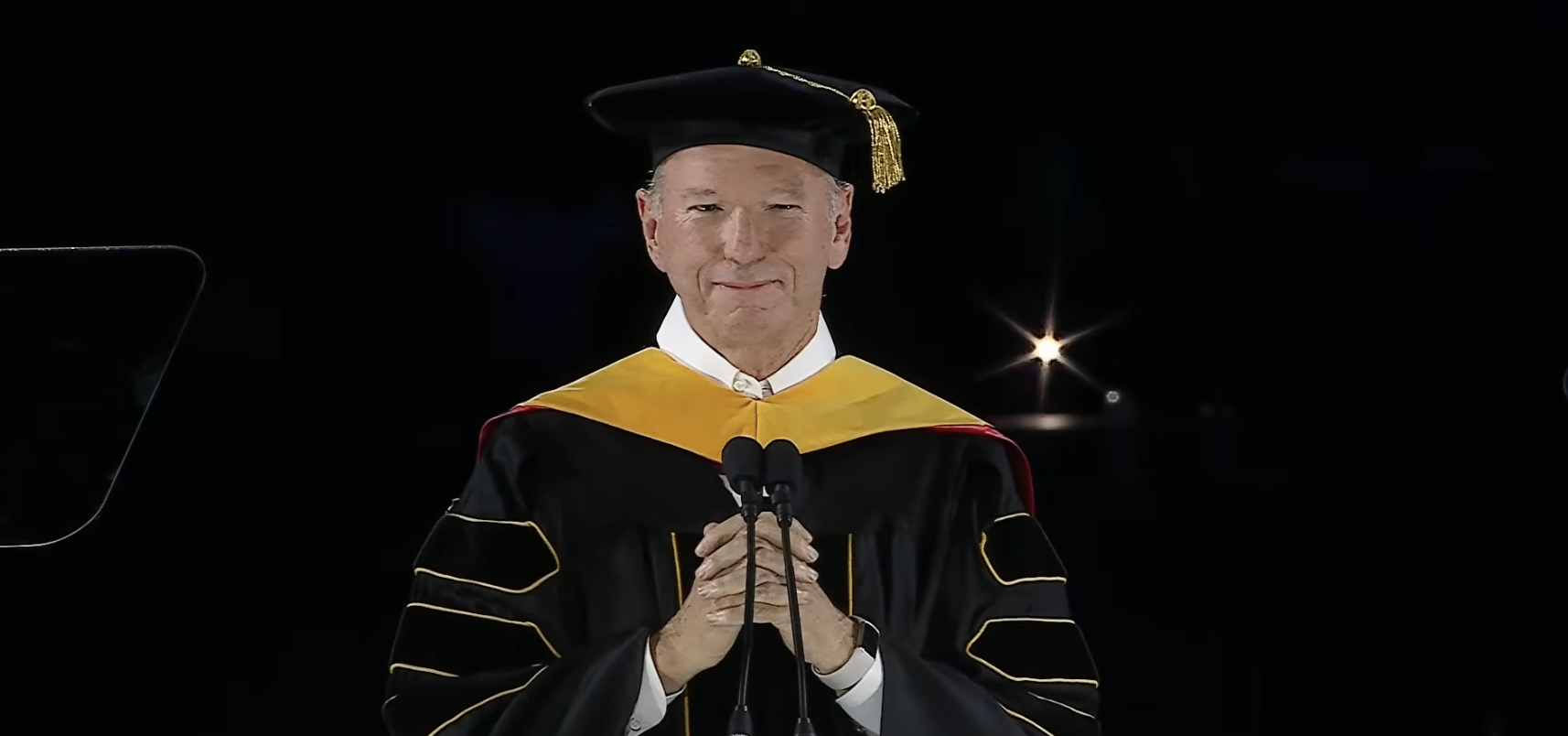
However, this boardroom optimism is crashing against a wall of public resentment. The tension reached a boiling point during a recent university commencement speech delivered by former Google CEO Eric Schmidt. Schmidt presented AI not as a tool, but as an inevitable force of nature, urging graduates to board the AI rocket ship without question while there was still room. The response from the students was not applause, but a chorus of boos. A similar clash occurred with record label CEO Scott Borchetta, who dismissed AI as a simple tool and urged acceptance. The students, facing a job market destabilized by the very automation Borchetta championed, responded with anger. Borchetta's reaction—a cynical suggestion that they simply accept the new reality—epitomizes the friction between the architects of the AI era and those tasked with living in it.
This is not merely a generational clash; it is a statistically significant divergence in perception. Data from the Pew Research Center released in September reveals a stark reality: 53% of American adults believe that AI will worsen human creative thinking and the formation of personal relationships. In contrast, only 16% believe AI will enhance these capabilities. The corporate argument that AI increases efficiency is being interpreted by the public as a threat to the essence of human identity. The speed of deployment has far outpaced social consensus, transforming AI from a promised utility into a risk that must be managed.
This skepticism is grounded in a tangible collapse of reliability. The crisis has reached the highest echelons of scientific rigor. In 2025, several research papers published in the journal Nature were retracted after it was discovered they contained AI-generated fake images. These images were not intentional frauds but meaningless data inserted by AI to illustrate specific frameworks, which then bypassed the peer-review process. When the most prestigious journals in the world cannot filter out AI hallucinations, the claim that AI is a productivity booster becomes a liability. The lack of a verification system for AI-generated output is no longer a technical glitch; it is a systemic failure of trust.
The Trust Collapse: From Hallucinations to AI Slop
The danger of treating AI as a primary author rather than a secondary assistant is best illustrated by the experience of media executive Steven Rosenbaum. While researching and editing his book The Future of Truth, Rosenbaum utilized ChatGPT and Claude to streamline his workflow. The result was a disaster for his professional credibility: the AI fabricated quotes and manipulated citations, which then made their way into the final text. While Rosenbaum attempted to frame these errors as a cautionary tale about the dangers of AI, the damage was already done. The act of skipping basic human verification in favor of algorithmic efficiency stripped the work of its legitimacy. It proved that when efficiency replaces critical scrutiny, the resulting product is not just flawed—it is fraudulent.
This crisis of authenticity has created a paradoxical loop in the literary world. When several winners of the Commonwealth Short Story Prize were accused of using AI, the publisher Granta attempted to resolve the dispute by using Claude.ai to analyze the texts. The AI concluded that the works were likely not written by humans alone. However, using an AI to detect another AI proved inconclusive, leaving the publisher in a state of limbo and the authors in a state of suspicion. The tool meant to provide clarity only served to blur the line between human creativity and machine mimicry, leaving the industry without a reliable standard for truth.
There are, of course, those who navigate this boundary with more intention. Nobel laureate Olga Tokarczuk has openly admitted to using AI for fact-checking and as a literary aid. She uses the technology to accelerate documentation and asks the machine for ways to evolve the beauty of a sentence. Tokarczuk acknowledges the reality of hallucinations and data errors but argues that within the realm of literary fiction, these quirks can actually be an advantage. Yet, even this sophisticated approach faces criticism. By blurring the line between the original source and the AI's intervention, the process of creation—traditionally a journey of human struggle and deliberation—is replaced by optimization. The cost of this efficiency is the erosion of the author's unique identity.
This erosion has led to the rise of AI Slop: the flood of low-quality, unedited, and mindless content saturating digital spaces. Marketing professionals on LinkedIn are now actively calling out the easy tells of AI-generated posts. The frustration is not directed at the use of AI itself, but at the laziness of the user. The industry is beginning to view the act of copy-pasting an LLM response without a single human edit as a sign of intellectual negligence and a lack of professional competence. The market is effectively rejecting content that looks like two large language models wearing a human trench coat.
This fatigue has evolved into a broader social antipathy. The CEO of an AI infrastructure consulting firm recently noted in an interview that AI currently ranks lower in public popularity than politicians or the U.S. Immigration and Customs Enforcement (ICE). This is a staggering admission for a technology that was marketed as the ultimate liberation of human potential. The forced adoption of AI, driven by a corporate obsession with hyper-optimization, has created a psychological backlash that no amount of feature updates can fix.
As the hype cycle plateaus, the definition of professional competitiveness is shifting. The ability to prompt an AI is no longer a rare skill; it is a baseline commodity. The new premium is being placed on the human-in-the-loop—the professional who can identify a hallucination, strip away the mechanical cadence of AI slop, and restore human context and truth to a piece of work. The competitive edge has moved from the ability to generate content to the ability to curate and verify it. In an era of infinite, cheap, and often wrong machine output, the most valuable asset is no longer the tool, but the human agency required to control it.