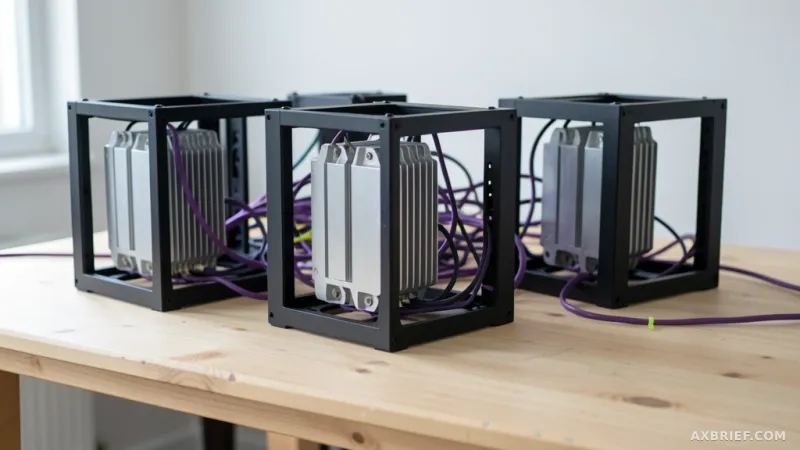
The modern AI developer exists in a state of constant tension between the convenience of managed APIs and the rigid constraints of local hardware. For those seeking data privacy or absolute model control, the barrier is almost always the VRAM wall. A developer might own three different machines with mid-range GPUs, but because that memory is fragmented across different motherboards, they cannot load a single high-parameter model. They are forced back into the ecosystem of expensive monthly subscriptions and opaque data policies, not because they lack the total compute power, but because they lack a way to unify it.
The Architecture of Distributed Resource Pooling
Mesh LLM addresses this fragmentation by transforming a collection of disparate machines into a single, unified resource pool. Rather than treating each computer as an isolated silo, the system aggregates the GPU and memory capacity of every connected node and exposes them through a standardized OpenAI-compatible API. This allows developers to interact with their distributed cluster as if it were a single high-end server, utilizing the address `localhost:9337/v1` to route requests.
The software footprint is remarkably lean, requiring only an 18MB installation to turn a machine into a participating node. Once deployed, the system manages the allocation of resources dynamically. It decides whether a specific model should run entirely on the local machine, be routed to a more powerful peer node on the network, or be split across multiple machines to maximize available VRAM. This flexibility is supported by a model catalog featuring over 40 options, ranging from small-scale models suitable for laptops to massive 235B Mixture-of-Experts (MoE) models that would typically require enterprise-grade data center hardware.
From Hardware Silos to P2P Orchestration
The technical breakthrough that enables this is a partitioning strategy called Skippy. In standard local LLM deployments, the entire model must fit within the available memory of the active device. Skippy bypasses this by implementing a pipeline structure where the model is partitioned by layer ranges. For instance, layers 0 through 15 might be hosted on the first node, while layers 16 through 31 reside on the second. The activations pass sequentially through these nodes, allowing the system to execute models that are physically larger than any single machine's memory capacity.
This orchestration does not rely on a central coordinator, which would create a single point of failure and a bottleneck for traffic. Instead, Mesh LLM leverages iroh, a P2P networking protocol, to establish direct communication between nodes. Every participant runs an iroh endpoint defined by a public key, which serves as the sole network identity. By utilizing QUIC for fast and secure transport, and incorporating hole punching and NAT traversal, the system creates a direct mesh of authenticated connections. This removes the need for traditional server-client hierarchies and allows for the creation of either public resource-sharing meshes or strictly private, secure corporate deployments.
To further expand the reach of this decentralized compute, the project is integrating the Agent Communication Protocol (ACP) to allow diverse external clients to join the mesh. There is also a mobile application in development based on the iroh Swift SDK, which would allow mobile devices to contribute their resources to the pool. This shift transforms the nature of AI deployment from a struggle over individual chip specifications to a challenge of network orchestration.
Local AI performance is no longer defined by the limits of a single GPU, but by the efficiency of the mesh.