Modern aerial combat is increasingly defined by a struggle against cognitive overload. In the cockpit of a high-performance fighter, the pilot is no longer just a flyer but a systems manager, filtering a deluge of sensor data while attempting to maintain situational awareness in a chaotic environment. For years, the aerospace industry has attempted to solve this through simulation and highly specialized prototype aircraft, but there has always been a stubborn gap between a successful digital model and a combat-ready machine. This week, that gap narrowed significantly as the US Air Force and DARPA moved their AI ambitions out of the lab and into the standard fleet.
The Architecture of the VENOM Flight Kit
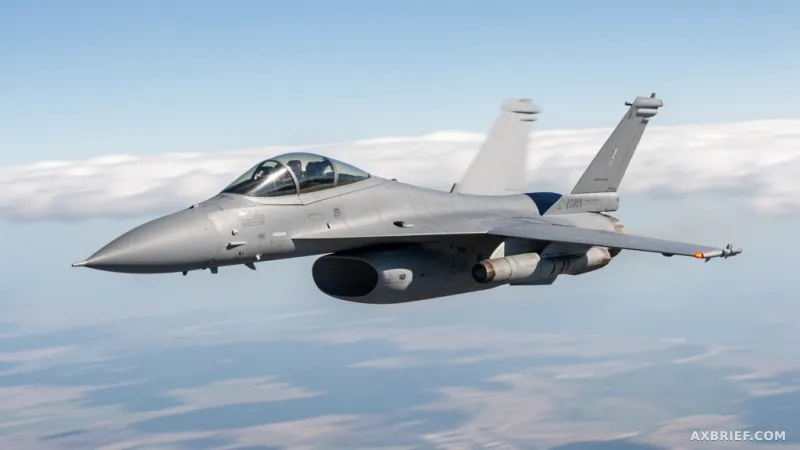
The core of this transition is the VENOM program, known formally as the Viper Experimentation and Next-generation Operations Model. Rather than building a new aircraft from the ground up, DARPA and the US Air Force have focused on the VENOM Autonomous Flight Kit (VAK). This kit serves as a modular interface that connects AI agents directly to the flight control and mission systems of a standard F-16. Crucially, the VAK is designed to integrate without requiring a complete overhaul of the aircraft's core flight software, allowing the AI to interface with existing hardware through a specialized layer.
Safety and reliability are managed through a human-on-the-loop architecture. The VAK includes a physical switch that allows the pilot to instantly toggle control between the human operator and the AI agent. This mechanism ensures that while the AI can execute complex maneuvers and mission parameters, a human remains the ultimate authority, capable of overriding the system in milliseconds. This approach marks a departure from previous efforts that relied on a single, highly modified aircraft. While the X-62A VISTA had already proven that AI could handle the intensities of a dogfight, it was a unique, one-of-a-kind testbed. The VENOM program proves that these capabilities can be retrofitted onto the standard F-16s already in service.
From Proof of Concept to Fleet Scalability
The shift from the X-62A to the VENOM-equipped standard F-16 represents a fundamental change in the AI development lifecycle. For a long time, AI flight testing was a proof-of-concept exercise, where success was measured by whether a specific, modified aircraft could perform a specific task. By moving to standard fleet aircraft, the US Air Force is shifting its focus toward scalability. The ability to deploy AI agents across a wider variety of standard airframes means the military can now build a high-throughput pipeline for testing and deploying new autonomous behaviors without waiting for the production of specialized prototypes.
This infrastructure feeds directly into DARPA's AIR (Artificial Intelligence Reinforcements) program. The goal of AIR is to use the VENOM fleet to refine how multiple AI agents interact in real-world flight scenarios. This is not merely about making a single plane fly better, but about creating a system where human pilots can command and coordinate teams of autonomous unmanned aircraft. This aligns with the broader Collaborative Combat Aircraft (CCA) initiative, where the AI's role evolves from a simple autopilot to a strategic partner capable of managing Beyond-Visual-Range (BVR) combat. In these high-friction environments, the AI is designed to absorb the cognitive load of sensor fusion and tactical positioning, leaving the human pilot to focus on high-level command and ethical decision-making.
For developers and engineers, the most critical takeaway is the implementation of the rapid iteration cycle. The VENOM program demonstrates a streamlined path from simulation to reality. AI models are trained in virtual environments, ported to the VAK, and then validated in the air with a safety switch that allows for real-time failure analysis and correction. This design pattern—combining a modular hardware interface with a strict human-override protocol—provides a blueprint for integrating AI into any high-risk physical system where the cost of failure is absolute.
The next technical inflection point will be the transition from single-aircraft autonomy to multi-agent synchronization, where the success of the system depends on how AI agents communicate and cooperate under human command.