For years, the promise of humanoid robotics has been stalled by a fundamental disconnect between cognitive reasoning and physical execution. We have seen large language models that can write complex code and robotic arms that can perform repetitive factory tasks, but the two rarely speak the same language in real-time. The result has been a generation of robots that feel disjointed, moving with a stiffness that betrays the sophistication of the AI driving them. The industry has been waiting for a bridge that allows a robot to not just follow a script, but to understand its own physical presence in a three-dimensional space.
The Three-Tier Architecture of Physical Intelligence
Google is addressing this gap with the introduction of Gemini Robotics 2, a system designed to move beyond isolated upper-body movements toward integrated whole-body control. This capability allows a robot to bend, stretch, and maintain balance organically, mimicking human kinematics rather than mechanical presets. To demonstrate this, Google deployed the system on the Apollo 2 humanoid robot from Apptronik. In a practical test, the robot was tasked with placing a watering can into a green bin on a lower shelf. This required the robot to autonomously decide how to navigate the room, maintain its center of gravity while leaning, and execute a precise grip and release sequence.
Precision is handled through a specialized hardware-software synergy. The system controls the SharpaWave hand, which features 22 degrees of freedom, enabling high-dexterity tasks such as tying knots or sealing ziplock bags. For more industrial applications, the system supports the Franka Duo platform using a 2-finger gripper for precision packing. This versatility is powered by a hierarchical three-model framework. At the top is Gemini Robotics ER 2, which serves as the high-level brain, processing user instructions and reasoning through the necessary steps to complete a goal. Below this sits the Vision-Language-Action (VLA) model, which translates those reasoned steps into actual physical movements. Finally, Gemini Robotics On-Device 2 handles local execution, ensuring that the robot can react to its environment without the latency associated with cloud processing.
Breaking the Hardware Lock-in via Multi-Embodiment
While the ability to control a single robot is impressive, the true shift in Gemini Robotics 2 is the move toward multi-embodiment. Historically, robotic AI was brittle; a model trained for one specific arm or chassis was virtually useless if moved to a different piece of hardware. The process of retraining for a new body often took weeks of data collection and manual tuning. Google has countered this with motion transfer technology, which allows the AI to adapt to a new robotic body in a matter of hours using fewer than 200 example data points.
This flexibility was validated across a diverse array of platforms, including Dexmate, SO101, and Trossen. Despite these robots having entirely different sensors, joint configurations, and degrees of freedom, the Gemini Robotics 2 framework remained functional. This suggests that the AI is learning the general principles of physics and manipulation rather than just memorizing specific motor commands. Furthermore, the system introduces multi-robot collaboration, where different types of robots communicate to solve complex workflows that a single unit could not handle alone. By decoupling the intelligence from the hardware, Google is shifting the goalpost from task-specific automation to general-purpose physical intelligence.
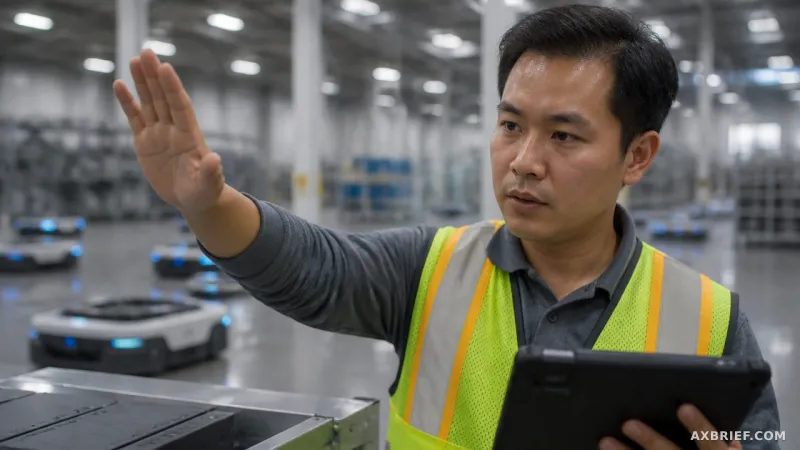
As these models move toward deployment, the focus has shifted from what the robot can do to what it should refuse to do. Google has introduced the ASIMOV-Agentic benchmark to quantify safety in physical environments. This benchmark measures whether an agent can identify and reject unsafe tool calls from the VLA or recognize when a task is impossible and request human intervention. Specifically, the ER 2 model has been enhanced to detect human proximity and trigger immediate, safe halts. For enterprises integrating these models via Google AI Studio or the Gemini Enterprise Agent Platform's private preview, the priority is no longer just benchmark scores, but the strict adherence to these safety constraints and human-collaboration standards.